A cart has roughly three square feet of usable surface. Fill it with six bottles, four tools and two glass shapes and you can make most of the cocktail canon; fill it with eleven bottles and you can make nothing without moving something first.
Updated November 2026 · By Stephen V.
Six bottles, four tools, two glass shapes, and ice. That is the whole list, and it fits a three-tier cart with room left to set a drink down. Gin, bourbon or rye, blanco tequila, a dry vermouth, a sweet vermouth and one bitter liqueur will build most of the cocktail canon. The four tools are a shaker, a jigger, a strainer and a bar spoon. The two glass shapes are a tall tumbler and a rocks glass. Everything else is an upgrade, and most of it should live in a cupboard.
The constraint nobody plans for is surface area. A typical home bar cart gives you three shelves of roughly 18 by 12 inches — call it four and a half square feet in total, of which the top shelf is the only one you can comfortably work on. Bottles are about three inches square at the base, so eleven bottles and a shaker fill the top shelf completely and you have nowhere to build a drink. This guide is organized around that limit rather than around a shopping list, because the limit is what decides whether the cart gets used.
The rule we are applying
Everything on the cart has to earn its footprint in drinks-per-square-inch. Three tests, applied in this order:
Does it appear in more than one drink you actually make? A bottle of blue curacao serves exactly one drink nobody orders. Sweet vermouth serves a Manhattan, a Negroni, a Boulevardier and an Americano. Buy the second kind first — and keep buying that way until the shelf is full.
Does it have to be within reach, or just in the house? The tools and the bottles you pour from have to be on the cart. Backup bottles, spare glassware, a second shaker and anything seasonal do not — they belong in a cupboard or a bar cabinet. A cart is a working surface, not a store room.
Does it survive sitting out? Open bottles on a cart are exposed to light and room temperature indefinitely. Spirits do not care. Vermouth, sherry and anything else wine-based oxidizes within weeks of opening and belongs in the fridge once opened, no matter how good it looks on the cart. This is the single most common mistake on a well-stocked cart.
We have not stocked and photographed a cart for this guide, and we are not going to pretend we tested bottles — the bottle list below is the standard backbar logic every cocktail book uses, and the products we recommend are tools and glassware rather than alcohol, which we do not sell. See how we pick. Prices come live from Amazon with the date we checked them.
The short answer
In a hurry? These are the picks we'd buy. Prices are live; tap a card below for the full reasoning.
$15.9920% offPrice as of November 22, 2026·#addisclosure
Quick picks
#
Product
Best for
Score
Price
1
The cart
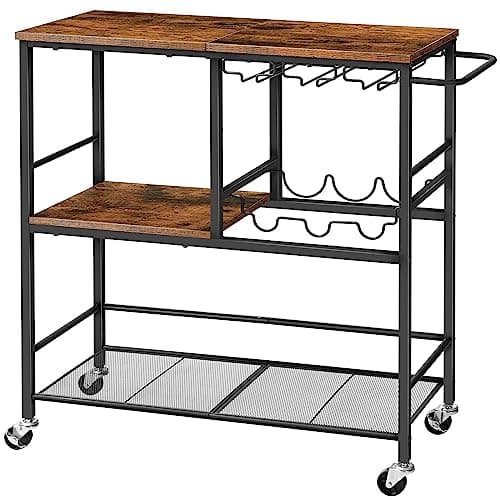
HOOBRO 3-Tier Rolling Bar Cart (29.5 in)
A 29.5-inch three-tier rolling cart with a wine rack and a glass holder — the format this whole guide assumes, at the price most people should pay for it.
A three-shelf working cart with a rail for glasses and a rack for bottles
$59.9921% offPrice as of November 22, 2026·#addisclosure
HOOBRO 3-Tier Rolling Bar Cart (29.5 in)
A 29.5-inch three-tier rolling cart with a wine rack and a glass holder — the format this whole guide assumes, at the price most people should pay for it.
Width
29.5 in (published)
Shelves
3 tiers
Storage
Wine rack + glass holder
Mobility
On wheels
Pros
Three shelves is the right number: one to work on, one for bottles, one for glassware
The integrated wine rack and glass holder move two categories off the flat shelves, which is where the space actually comes from
29.5 inches wide is enough working surface to build a drink without moving a bottle first
On wheels, so the cart can live against a wall and come out when you are pouring
Cons
29.5 inches is too wide for a genuinely tight room — measure the wall before ordering
Open shelving means everything on it is on display and collecting dust
Flat-pack assembly, and the shelf fixings are the usual weak point on a cart at this price
No lockable storage, which matters in a house with teenagers
Best for: A three-shelf working cart with a rail for glasses and a rack for bottles.
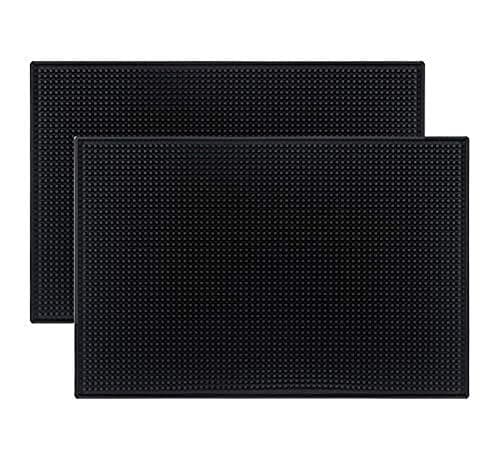
An 18 by 12 inch rubber service mat, two to a pack — the cheapest thing here and the one that decides whether the cart still looks good in a year.
Size
18 x 12 in (published)
Quantity
2-pack
Material
Rubber
Also does
Non-slip surface for the shaker and jigger
Pros
Catches the drips that otherwise soak into an open shelf and leave rings
Non-slip, so a wet shaker tin stays where you set it down
18 by 12 inches is close to a full shelf, which turns the top tier into a defined work area
Two in the pack, so the second one goes under the glassware shelf
Cons
Rubber mats hold smell if you do not rinse them, and a sweet mat attracts fruit flies
Black rubber is a utilitarian look on a decorative cart
Covers the shelf, so if you bought the cart for the wood or the mirror you will not see it
Needs lifting and rinsing weekly, which is one more small chore
Best for: Keeping the top shelf of the cart from becoming sticky.
Skip this
The budget traps that look cheap and cost you twice. We'd skip these.
Vermouth left open on the cart
Vermouth is wine. Once opened it oxidizes in weeks, and a bottle that has been sitting out since spring is why a lot of home Manhattans taste flat and tired. Buy the small bottle, keep it in the fridge after opening, and bring it to the cart when you pour. This is the most common and most fixable mistake on a good-looking cart.
A bottle for every drink
Eleven bottles fills the working shelf and leaves nowhere to build a drink. Six bottles chosen for overlap make more cocktails than eleven chosen one-per-recipe, because the backbone spirits and the two vermouths recombine. Add a seventh only when you have run the first six out.
Four different glass shapes
A cart holds roughly six to eight glasses. Six of one useful shape beats two each of three shapes, because any round of drinks needs matching glasses and two coupes will not serve four people. Keep a tall tumbler and a rocks glass on the cart and put the specialist shapes in a cupboard.
Nine-piece bar tool kits with a stand
The stand takes a quarter of a shelf and holds five tools you will not use. Four tools do the work: shaker, jigger, strainer, bar spoon. If you buy a kit for the price, take the four out and put the rest away rather than parking the whole display on the cart.
The six bottles, and why these six
The logic is overlap, not variety. A bottle that appears in four drinks you will actually make is worth four times the shelf space of a bottle that appears in one. Working from the standard cocktail canon, six bottles reach the largest number of recognizable drinks:
Gin — gin and tonic, Negroni, Martini, Tom Collins, Gimlet. The most productive single bottle on the cart.
Bourbon or rye — Old Fashioned, Manhattan, Whiskey Sour, Boulevardier, whiskey highball. Pick one; you do not need both to start.
Blanco tequila — Margarita, Paloma, Ranch Water. Covers the entire sour-and-soda side of the list that gin does not.
Sweet vermouth — Manhattan, Negroni, Boulevardier, Americano. A modifier that behaves like a base spirit in terms of how many drinks it unlocks.
Dry vermouth — Martini, and the dry half of anything split. The least-used of the six, and the one to buy in the smallest bottle.
One bitter liqueur — the red Italian kind. Negroni, Boulevardier, Americano, and a splash in a highball.
Add citrus and simple syrup and that list makes something close to twenty recognizable cocktails. The two vermouths and the bitter liqueur are doing the heavy lifting there, which is the opposite of how most people stock a cart — the usual pattern is five base spirits and no modifiers, which makes five drinks.
A practical note on sizes: buy the smallest bottle of each vermouth and the largest of whichever base spirit you actually drink. Vermouth goes off; gin does not. Getting this backwards is how a cart ends up with a mostly-full oxidized bottle of dry vermouth and an empty bottle of bourbon.
The four tools, in buying order
A shaker, a jigger, a strainer and a bar spoon. In that order, and nothing else is required to make every drink above.
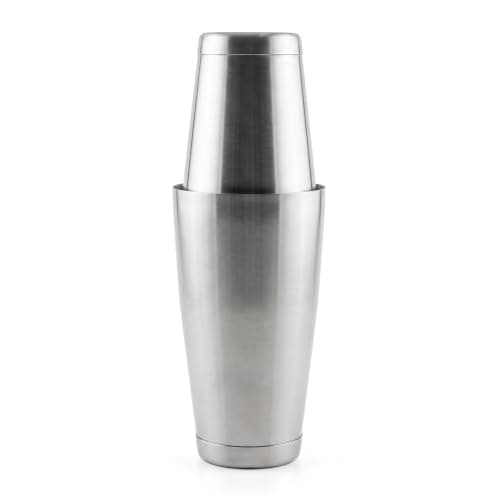
Shaker. For anything with citrus, cream or egg. A two-tin Boston set is the one bars use because it cannot seize shut — our cocktail shaker roundup works through Boston versus cobbler, and the comparison guide covers the decision in detail.
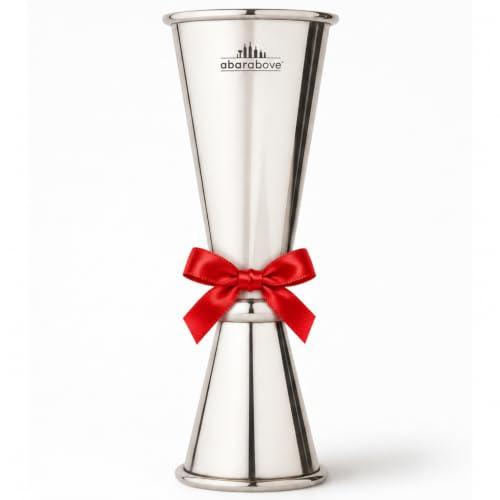
Jigger. Because every recipe above is a ratio and a free pour is wrong by a quarter-ounce. Get one with interior graduations and it covers the 0.75 oz measures too — see the jigger roundup.
Strainer. A Hawthorne strainer, because a Boston shaker has no built-in one. It also strains a stirred drink out of a mixing glass.
Bar spoon. For stirred drinks — a Martini, a Manhattan, a Negroni. Stirring is not optional on those; shaking a Manhattan aerates it and ruins the texture. A long spiral spoon doubles as a muddler handle on most sets.
Our bar tool set roundup covers buying all four at once, which is usually cheaper and usually means a worse jigger — the jigger is the component manufacturers economize on. Buying a set and then upgrading the jigger separately is a perfectly reasonable plan.
The two glass shapes
A cart realistically holds six to eight glasses. Spend them on two shapes, six and two, rather than four shapes at two each — because a round of drinks needs matching glasses and a pair of anything cannot serve four people.
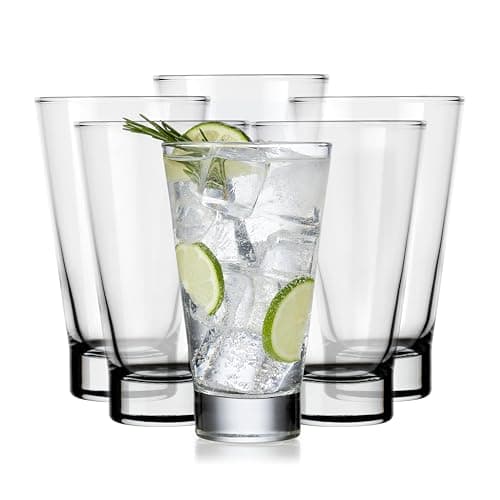
The tall tumbler is first and it is not close. Everything built in the glass over ice goes in one: gin and tonic, whiskey highball, rum and coke, Collins, Paloma, mojito. Our highball glass roundup explains why 12 oz is the capacity to aim for — shorter and the drink comes out strong and short, taller and a standard pour tastes thin. The rocks glass is second: whiskey over ice, an Old Fashioned, a Negroni. Our whiskey glass picks cover that shape.
Everything else is a cupboard glass. Coupes and Nick and Nora glasses for drinks served up, wine glasses, and a nosing glass for whiskey neat — all worth owning, none worth a cart shelf. A full home bar glassware list is a separate problem from a cart list, which is exactly the distinction most stocking articles miss.
Ice is the thing the cart cannot hold
Every drink on the list above needs ice, and a cart has nowhere to keep it. This is the one genuine gap in the format, and there are only two honest answers: walk to the freezer per drink, or put an ice bucket on the cart and accept that it is a twenty-minute window before everything in it is water.
What makes the walk worthwhile is better ice. Standard freezer cubes are small and wet, so they dilute a drink fast — one large dense cube melts several times slower than the same volume in small pieces. A silicone mold costs about ten dollars and fixes it; our ice ball mold and clear ice tray roundup covers both the cheap trays and the directional-freezing molds that make genuinely clear ice. If the cart is doing real hosting duty, a countertop ice maker near it solves the volume problem properly.
What goes on which shelf
Three tiers, three jobs, and getting this wrong is why some well-stocked carts are still annoying to use.
Top shelf — the work surface. The mat, the shaker, the jigger and the strainer, and nothing else. If you cannot set a glass down on the top shelf and build a drink in it, the cart has failed at its only job. Resist putting bottles here; they migrate up and never leave.
Middle shelf — the bottles. Six bottles, label out, tallest at the back. If the cart has a wine rack, that is where any wine goes so it is off the flat shelf entirely.
Bottom shelf — glassware and weight. Glasses in the rail if the cart has one, otherwise upright on the shelf. The bottom shelf is also where heavy things belong on a cart with wheels: a cart loaded top-heavy will tip on a rug edge.
If you are still choosing the cart itself, our bar cart roundup covers the formats and the carts on wheels page covers the mobility question. If the bottles are outgrowing the cart, the next step up is a bar cabinet with doors, or a wall-mounted wine rack to move the wine off the cart entirely — which is the cheapest way to buy back a shelf.
A realistic first shop
In order, stopping whenever the budget runs out: the cart, then the shaker and jigger, then six tall glasses, then the strainer and bar spoon, then the bottles one at a time starting with whichever base spirit you drink and sweet vermouth, then an ice mold, then the rocks glasses, then the bar mat. Each step makes more drinks possible than the one after it.
What that deliberately leaves out: a mixing glass (the shaker tin does the job), a cocktail smoker, a decanter, a second shaker, coasters, and any tool with the word 'professional' on the box. All fine purchases later. None of them make a drink you could not already make, and all of them cost shelf space that the first list has a better use for. If you want the full house-wide version of this exercise, the home bar equipment pillar covers it in buying order, and what a home bar actually costs puts numbers against each stage.
The two things that go on the cart and get forgotten
A cart with bottles, tools and glasses on it is still missing the vessel stirred drinks are made in and somewhere for the ice to sit. Our mixing glass roundup covers the first — 16 oz is the floor, 20 to 24 oz is comfortable — and the ice bucket roundup covers the second, where a 3-quart lidded double-wall bucket is about as large as a cart shelf will take.
Frequently asked questions
What should you put on a bar cart?+
Six bottles, four tools, two glass shapes and a mat. The bottles: gin, bourbon or rye, blanco tequila, sweet vermouth, dry vermouth and one red bitter liqueur. The tools: shaker, jigger, strainer, bar spoon. The glasses: six tall tumblers and a couple of rocks glasses. That fits a three-tier cart and makes close to twenty recognizable cocktails.
How many bottles should a bar cart hold?+
Six, and no more than eight. Bottles are about three inches square at the base, so eleven bottles plus a shaker fills the working shelf and leaves nowhere to build a drink. Six bottles chosen for overlap make more cocktails than eleven chosen one per recipe, because the vermouths and the bitter liqueur recombine with every base spirit.
Should vermouth be kept on the bar cart?+
Not once it is open. Vermouth is wine and it oxidizes within weeks of opening, so a bottle that has sat out since spring is why a lot of home Manhattans taste flat. Keep it in the fridge after opening and bring it to the cart when you pour. Buy the small bottle for the same reason.
What tools do you actually need on a bar cart?+
Four: a shaker for anything with citrus or cream, a jigger because every recipe is a ratio, a strainer because a Boston shaker has no built-in one, and a bar spoon for stirred drinks. Nine-piece kits with a display stand cost you a quarter of a shelf for five tools you will not use.
What glasses go on a bar cart?+
Two shapes, weighted toward one. Six tall tumblers around 12 oz, because everything built over ice goes in one, plus two or three rocks glasses for whiskey and Old Fashioneds. Coupes, wine glasses and nosing glasses are worth owning but belong in a cupboard — a cart holds six to eight glasses and a round of drinks needs them matching.
How do you keep ice on a bar cart?+
You mostly do not. A cart has no refrigeration, so an ice bucket gives you about a twenty-minute window before it is water. Either walk to the freezer per drink, or keep large-format ice in the freezer so what you do fetch melts slowly — a silicone mold that makes 2-inch cubes costs about ten dollars and is the single cheapest upgrade to a cart-made drink.
What goes on which shelf of a bar cart?+
Top shelf is the work surface: mat, shaker, jigger, strainer, and space to set a glass down. Middle shelf is bottles, label out, tallest at the back. Bottom shelf is glassware and anything heavy, because a cart loaded top-heavy will tip on a rug edge. If you cannot build a drink on the top shelf, the cart has failed at its only job.
What is the first thing to buy for a bar cart?+
After the cart itself, the shaker and the jigger. They are the two objects that turn a shelf of bottles into a bar, and the jigger in particular has the best ratio of drink improvement to shelf space of anything on the list. Glassware next, then the strainer and bar spoon, then bottles one at a time.
Prices and availability shown here come from Amazon's live data and change often; we re-verify them regularly. Bar Bumper is an Amazon Associate and earns a commission on qualifying purchases at no extra cost to you. Read our full disclosure.