The game table that fits where nothing else will: 20 inches wide, no cue clearance, and the only one you can play properly with a drink in your hand.
Updated October 2026 · By Stephen V.
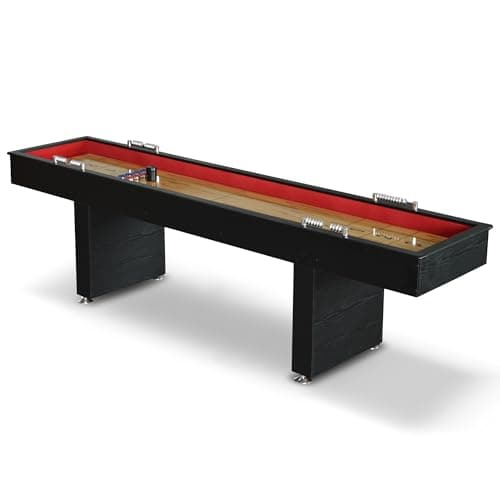
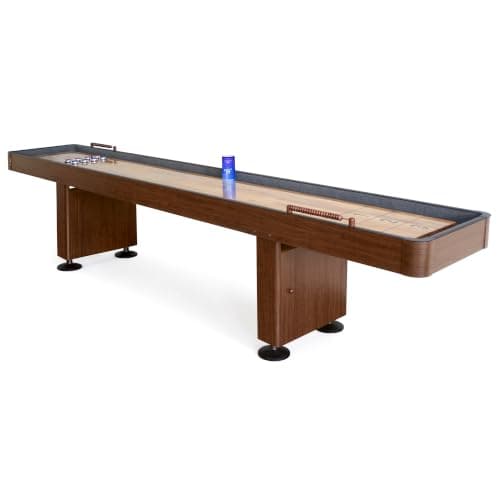
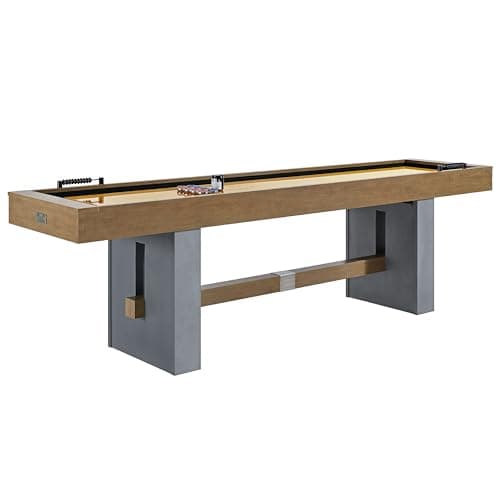
The Hathaway Avenger 9 ft is the shuffleboard table most home game rooms should buy. It is the shortest length that plays a real game, it has a poly-coated playfield that needs no maintenance beyond wax, and at 9 feet it fits along a wall in rooms that cannot hold any other game table. If you have the length and want the game to play like a bar table, the Hathaway Challenger 12 ft is the upgrade; the Barrington Urban 9 ft is the value alternative; and the Playcraft Woodbridge is the one to buy if the table has to be furniture.
Shuffleboard is the sleeper of this hub. A 9-foot table is about 20 inches wide, which means it needs a strip of floor rather than a room — and because you slide a weight down the board rather than swinging a cue, there is no side clearance requirement at all. A 12-foot table against a wall in a 14 by 7 foot space is a complete, properly playable game room. Nothing else here comes close to that.
We have not played these tables. The ranking draws on published playfield construction and thickness, cabinet and leg specifications, climate-adjuster provision, included accessories, and owner-review consensus reported as other people's experience. Prices come live from Amazon with the date we verified them.
The short answer
In a hurry? These are the picks we'd buy. Prices are live; tap a card below for the full reasoning.
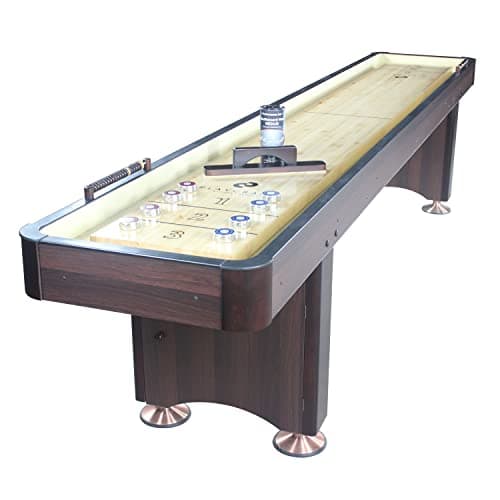
Playcraft Woodbridge Shuffleboard Table with Storage Cabinet
A furniture-grade table with a storage cabinet underneath, which solves the one real problem with shuffleboard: where the pucks and wax live.
Type
Shuffleboard with storage cabinet
Finish
Furniture-grade
Includes
Game set per listing
Pros
Integrated storage for pucks, wax and brush
Best-finished cabinet here — reads as furniture
Playcraft is a specialist shuffleboard maker
Cons
The most expensive table in this roundup
Storage cabinet adds bulk under the board
Overkill for a basement or garage
Best for: A finished room where the table must look built-in.
Skip this
The budget traps that look cheap and cost you twice. We'd skip these.
Tabletop shuffleboard under 6 feet
Shuffleboard is a game of controlling how far a weight slides. Under about 6 feet there is no distance to control and the game becomes a flick. They are fine as a novelty and nothing like the real thing.
Any table whose listing does not state playfield thickness
Playfield thickness is the spec that determines whether the board stays flat. Thin boards cup and warp with humidity, and a cupped shuffleboard playfield steers every puck the same way. A seller who omits it usually has a thin board.
How to choose (and what to skip)
Length is the only size decision
Home tables run 9, 12, 14 and 16 feet. Nine feet fits almost anywhere and plays a real if compressed game. Twelve feet is where touch and strategy properly appear, and it is the common bar length. Fourteen and sixteen feet are tournament lengths for dedicated rooms. Width barely changes — about 20 inches of playfield, roughly 30 inches overall — so the only question is how much wall you have.
Playfield construction and thickness
The board should be thick laminated hardwood, and thicker is better: a thin board cups as humidity changes and a cupped board steers every puck. Two finishes dominate: poly or UV coatings, which are hard, fast and need no maintenance beyond wax; and traditional lacquered hardwood, which plays with more subtlety and occasionally needs refinishing. For a home, a poly-coated board is the practical choice.
Climate adjusters, if the room swings
Better tables have adjusters along the underside that let you pull a slight crown or dish out of the board as seasons change. In a dry conditioned room you may never touch them. In a basement or garage that swings between damp summers and dry winters they are the difference between a board that stays true and one that develops a permanent lean. If the table lives in an uncontrolled space, treat them as a requirement.
Wax is not optional, and it is not wax
Shuffleboard 'wax' is silicone-coated beads you scatter across the board so the pucks glide. Without it the board is unplayable; with the wrong amount the game is either sluggish or uncontrollable. Different speed grades exist. Budget for a spray and a couple of grades of powder, and buy a board brush with the table.
Pucks and the ends
A set is eight weights, four per colour. They are a consumable in the sense that they get chipped and the plastic caps wear. Check whether the table includes a full set, and note that puck size differs between table widths — buy replacements matched to your table rather than generically.
Why shuffleboard fits where other tables cannot
Every other table in this hub needs clearance all the way around, because you swing something. Shuffleboard does not: you stand at one end and slide a weight. That means the table can sit against a wall, in a hallway-shaped space, down one side of a finished basement, or along the back wall of a garage bay. A 12-foot table needs about 14 by 3 feet of floor plus standing room at the two ends. A 7-foot pool table needs 17 by 13 feet. For a long, narrow room, shuffleboard is not a compromise — it is the correct answer.
It is also nearly silent, which makes it the right table for a finished basement under a bedroom where an air hockey table would be unbearable. And it is the one game here you play comfortably holding a drink, which is why it belongs in a home bar rather than just a game room.
How the game works, and why length matters
Players alternate sliding weights down the board, trying to leave them in the scoring zones at the far end without going off the end, and knocking the opponent's weights out of scoring position. The skill is entirely in judging distance: a shot that stops two inches short scores nothing. On a 9-foot board the distances are short enough that most shots are achievable, which makes it accessible and a little blunt. On a 12-foot board, controlling a weight to stop in a 6-inch zone is a genuine skill and the strategic game — hanging a weight off the edge, blocking a lane — properly appears.
That is the whole argument for the longer table. If you are buying for guests who will play twice a year, 9 feet is right. If you expect to play weekly and get better, find the 14 feet of wall.
Maintenance is wax and a brush
Upkeep is genuinely trivial. Keep the board clean and dry, scatter fresh wax before a session, brush it level, and sweep the excess off the ends. Do not use furniture polish or anything oil-based on a poly playfield; it leaves a film that makes the board inconsistent. Keep drinks off the board itself — a wet patch on a shuffleboard playfield is both a dead spot and, over time, a swollen one. Cover the board if it sits in direct sunlight.
A table that plays slow usually needs more wax; a table where pucks fly off the end needs less, or a slower wax grade. Having two grades on hand is how you tune the board to the players in the room.
Frequently asked questions
How long should a shuffleboard table be?+
Nine feet is the shortest that plays a real game and fits almost any room. Twelve feet is where touch and strategy properly appear and is the common bar length. Fourteen and sixteen feet are tournament sizes. Since width stays at roughly 30 inches overall regardless of length, the only real question is how much uninterrupted wall you have.
How much space does a shuffleboard table need?+
The table's length plus about 2 to 3 feet of standing room at each end, and only about 3 feet of width. A 12-foot table fits in roughly 17 by 4 feet of floor. There is no side clearance requirement because nothing is swung, which is why shuffleboard fits long narrow rooms that no other game table suits.
What is shuffleboard wax and do I need it?+
It is silicone-coated beads — sometimes called sand or powder — scattered across the board so pucks glide. It is not optional: without it the board is unplayable. Different speed grades exist, and keeping two on hand lets you tune the board's speed. Budget for a silicone spray, a powder or two, and a board brush.
What are climate adjusters on a shuffleboard table?+
Threaded adjusters under the playfield that let you pull a slight crown or dish out of the board as humidity changes. In a climate-controlled room you may never use them; in a basement or garage that swings between damp and dry they are what keeps the board playing true, and worth insisting on.
Prices and availability shown here come from Amazon's live data and change often; we re-verify them regularly. Bar Bumper is an Amazon Associate and earns a commission on qualifying purchases at no extra cost to you. Read our full disclosure.