Table footprint plus a full cue length on every side. For a 7-foot table that is about 17 by 13 feet — here is the chart, and the options if you do not have it.
Updated October 2026 · By Stephen V.
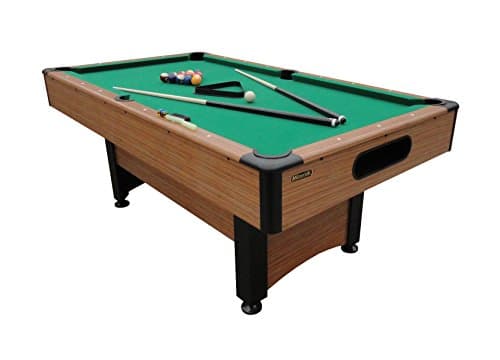
Take the table's overall footprint and add a full cue length on every side. With a standard 58-inch cue that is 4 feet 10 inches of clear floor around the entire table, which means a 7-foot table needs roughly a 17 by 13 foot room. That one formula is the whole answer, and it is the measurement most often skipped before a pool table is bought.
Get it wrong and the table is not unusable, it is permanently annoying: you spend years playing rail shots with a shortened cue jammed against a wall. A correctly sized smaller table is a far better game than an oversized one, and if nothing fits, two other games fit almost any room.
The short answer
In a hurry? These are the picks we'd buy. Prices are live; tap a card below for the full reasoning.
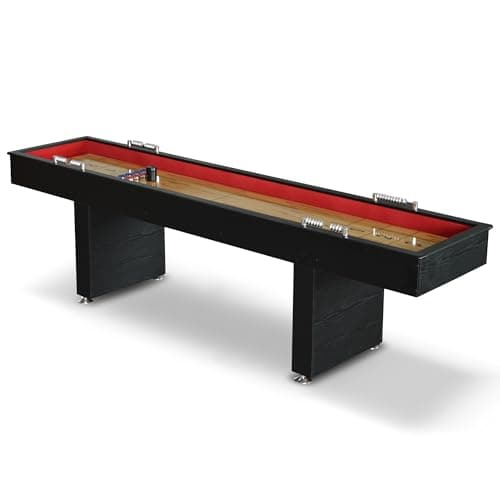
A 9-foot shuffleboard table about 20 inches wide, needing no side clearance at all — fits along a wall where nothing else will.
Length
9 ft
Floor needed
~11 x 3 ft plus standing room
Side clearance
None
Pros
No side clearance required because nothing is swung
Fits long narrow rooms no other table suits
Near-silent
Cons
Needs 11 feet of uninterrupted wall
9 ft is short for strategic play
Wax and brush are required accessories
Best for: A long wall with no width to spare.
The room-size chart
These figures assume a standard 58-inch cue and are the clear floor you need, not the room's nominal dimensions — subtract anything permanent along the walls.
6.5 ft table (about 78 x 44 in overall) — roughly 16 x 12.5 ft
7 ft table (about 84 x 48 in overall) — roughly 17 x 13 ft
7.5 ft table (about 90 x 50 in overall) — roughly 17.5 x 13 ft
8 ft table (about 96 x 54 in overall) — roughly 18 x 13.5 ft
9 ft table (about 108 x 60 in overall) — roughly 19 x 14 ft
Note that the clearance requirement is the same for every size — it is set by the cue, not the table. That means the jump from a 7-foot to an 8-foot table costs you only a foot in each direction, and the difference between a room that works and one that does not is usually a single obstruction rather than a whole foot.
What shorter cues buy back
A 52-inch cue reduces the clearance requirement to about 4 feet 4 inches, which gives back roughly a foot in each direction. A 48-inch cue gives back close to 2 feet. Most tables ship with at least one short cue for exactly this reason, and keeping a 48-inch cue on the rack for the one tight side of the room is a legitimate solution rather than a compromise.
What it is not is a licence to buy a bigger table. If three sides of a room are fine and one is 6 inches short, a short cue solves it. If every side is a foot short, you need a smaller table.
Measure the clear floor, not the room
Three things eat clearance and are routinely forgotten. Permanent obstructions: a staircase bulkhead, a support post, a radiator, a water heater. Door swings: a door that opens into the clearance zone has to be allowed for. And furniture you intend to move but will not — a sofa against the long wall is part of the room, honestly assessed.
Ceiling height matters too, and almost nobody checks it. A standard pool cue is raised on a jump or masse shot and, more routinely, you need room to bring the cue up over the rail. A ceiling under about 8 feet is workable; under 7.5 feet it becomes genuinely restrictive, especially if you want a hanging light over the table, which also needs roughly 30 to 36 inches above the bed.
If the room is too small
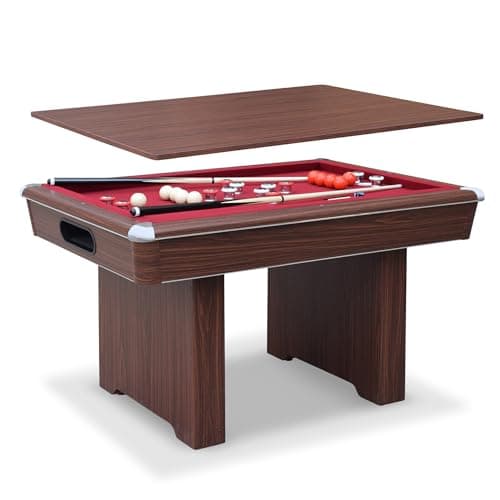
Three good answers, in order of how little space they need. Darts needs a 3-foot patch of wall and about 9 feet of standing room, and is the best value game in a home bar. Shuffleboard needs length but almost no width — a 9-foot table is about 20 inches wide and needs no side clearance at all, because nothing is swung. And bumper pool needs about 11 by 11 feet, because it is played with 48-inch cues on a 54-inch table.
Bumper pool is the answer most people are looking for and have not considered: it is a real cue game, most tables convert to poker and dining, and it fits rooms a pool table cannot. Our comparison covers what you gain and give up.
Before the table arrives
Measure the delivery path, not just the room. These tables arrive as 200 to 400 lb of freight in rigid sections, and the commonest delivery problem is a basement stair turn rather than a doorway. Check the narrowest point and the tightest turn against the largest single box or slate section in the specification.
Frequently asked questions
How much space do you need for a 7 ft pool table?+
About 17 by 13 feet of clear floor with standard 58-inch cues. The formula is the table's overall footprint (roughly 84 by 48 inches for a 7-footer) plus a full cue length — 4 feet 10 inches — on all four sides. Measure the clear floor, not the room's nominal size.
Can I use shorter cues in a small room?+
Yes, and most tables ship with one for exactly that reason. A 52-inch cue gives back roughly a foot in each direction and a 48-inch cue close to two. It is a good solution for one tight side of a room, and not a reason to buy a bigger table when every side is short.
What ceiling height do you need for a pool table?+
About 8 feet is comfortable. Below roughly 7.5 feet it becomes restrictive, because you need room to bring the cue up over the rail as well as for the occasional jump shot. A hanging light over the table needs 30 to 36 inches of clearance above the bed, which eats into low ceilings further.
What should I buy if my room is too small for a pool table?+
Darts needs a patch of wall and about 9 feet of standing room. Shuffleboard needs length but no side clearance — a 9-foot table is only about 20 inches wide. Bumper pool needs about 11 by 11 feet because it uses 48-inch cues. All three are real games, and all beat a cramped pool table.
Prices and availability shown here come from Amazon's live data and change often; we re-verify them regularly. Bar Bumper is an Amazon Associate and earns a commission on qualifying purchases at no extra cost to you. Read our full disclosure.