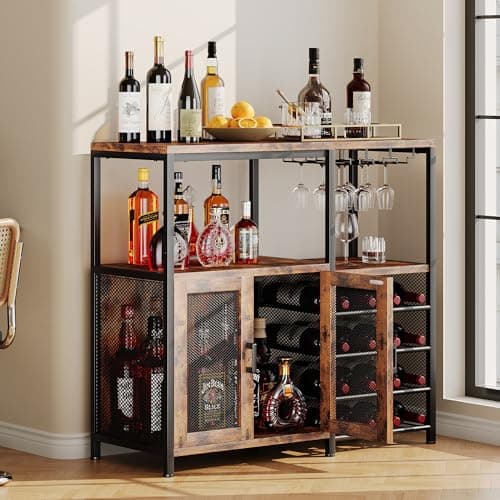
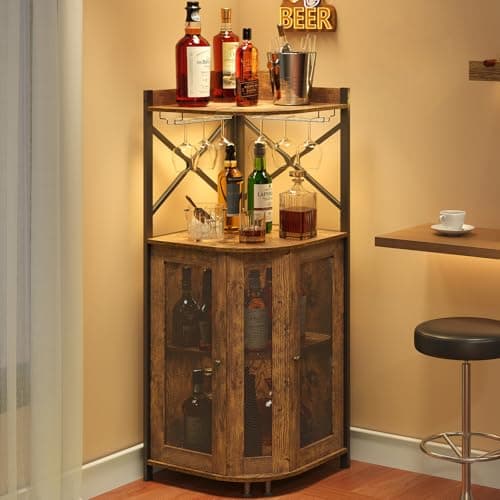
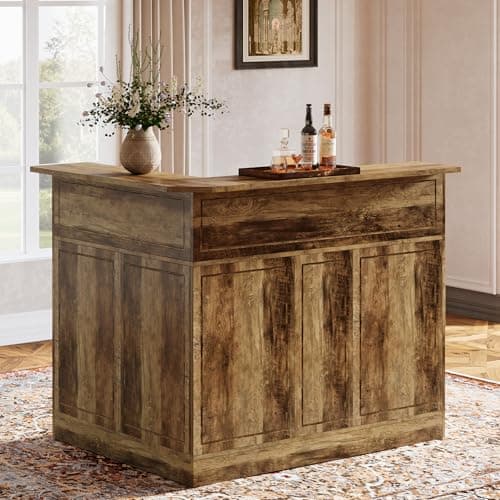
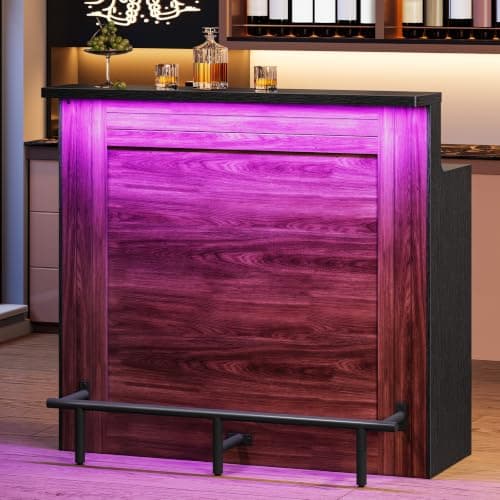
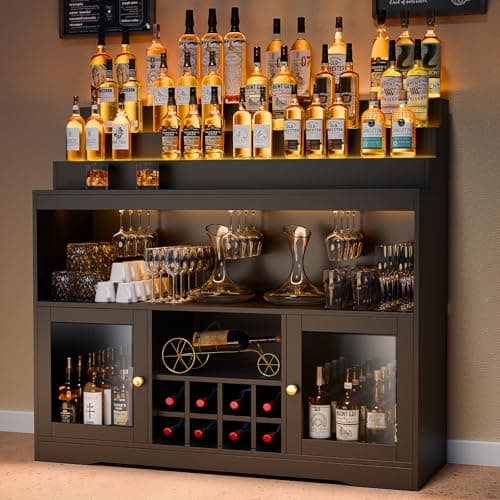
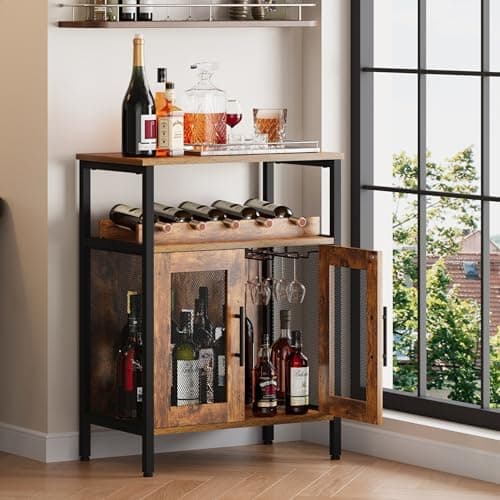
A cabinet holds three or four times what a cart holds in the same footprint, and keeps the bottles out of the light. The spec that decides it is shelf clearance.
Updated October 2026 · By Stephen V.
The Homeiju bar cabinet with an integrated wine rack is the home bar cabinet to buy: enclosed storage, a real rack and a footprint that fits against a normal wall. If the only spare space is a corner, the JKsmart four-tier corner cabinet is the pick, and the HOOBRO five-tier corner unit is the taller version of the same idea. The Tribesigns L-shaped unit is the one to buy if you want a bar you can stand behind, the Loomie cabinet is the display option with lit bottle shelving, and the X-cosrack is the small-space answer where even a corner unit will not go.
Cabinets and carts solve the same problem differently, and the choice is not about looks. A cabinet holds three to four times what a cart holds in the same floor area, keeps bottles out of the light, and gives you a surface at a usable height. A cart moves. If the bar is going to live in one corner of a room for the next five years, a cabinet is the correct furniture and a cart is a compromise. If you want to wheel the bar into the living room during a party, that is the one thing a cabinet cannot do.
The number that decides whether a cabinet is useful is the same one that decides a cart: shelf clearance. A 750 ml spirits bottle stands about 12 inches tall and a wine bottle 12 to 13, so a shelf needs roughly 13 inches of vertical clearance to stand bottles upright. It is almost never stated in the listing, and it is worth working out from the overall height and the number of shelves before you buy anything.
We have not loaded these cabinets. The ranking draws on published dimensions, shelf and rack configurations, stated capacities, materials and assembly notes, plus owner-review consensus reported as other people's experience — see how we pick. Prices come live from Amazon with the date we verified them.
The short answer
In a hurry? These are the picks we'd buy. Prices are live; tap a card below for the full reasoning.
$249.9927% offPrice as of October 7, 2026·#addisclosure
Quick picks
#
Product
Best for
Score
Price
1
Best overall
Homeiju Bar Cabinet with Wine Rack
A bar cabinet with an integrated wine rack and enclosed storage — considerably more capacity per square foot than any cart, with the mobility traded away.
A permanent bar against a wall, where storage matters more than mobility
X-cosrack Small Bar Cabinet with Detachable Wine Rack & Glass Holder
A small bar cabinet with a detachable wine rack and a glass holder — the least floor space here, and the cheapest way into a cabinet rather than a cart.
An apartment, or a bar that has to fit in under two feet of wall
A bar cabinet with an integrated wine rack and enclosed storage — considerably more capacity per square foot than any cart, with the mobility traded away.
Type
Bar cabinet
Wine rack
Integrated
Storage
Enclosed plus open
Mobility
None
Pros
Far more storage per square foot than an open cart
Enclosed sections keep bottles out of the light and out of sight
Reads as furniture in a living room rather than as equipment
Flat against a wall, so it does not eat a walkway
Cons
Does not move
Takes a fixed footprint you have to commit to
Larger assembly job than a cart
Best for: A permanent bar against a wall, where storage matters more than mobility.
X-cosrack Small Bar Cabinet with Detachable Wine Rack & Glass Holder
A small bar cabinet with a detachable wine rack and a glass holder — the least floor space here, and the cheapest way into a cabinet rather than a cart.
Type
Small bar cabinet
Wine rack
Detachable
Glasses
Glass holder
Size
Small footprint
Pros
Smallest footprint on this page, and it still has a rack and a glass holder
The detachable rack means the layout can change as the collection does
Cheapest cabinet here
Doubles as a coffee bar, which is how a lot of them get used
Cons
Least capacity of anything here
No enclosed storage
Low, so there is no real standing surface
Best for: An apartment, or a bar that has to fit in under two feet of wall.
Skip this
The budget traps that look cheap and cost you twice. We'd skip these.
Cabinets with under about 13 inches of shelf clearance
A 750 ml bottle is roughly 12 inches tall. Below 13 inches of vertical clearance, bottles cannot stand on the shelf and the cabinet's usable capacity collapses to its top surface and its rack. This number is almost never in the listing and is the single most important thing to work out from the overall dimensions.
Decorative wine racks that hold two bottles
A lot of cabinets have a few curved wires that cradle two bottles at an angle and block anything else going in that space. A real rack takes four or more. Count the bottles in the manufacturer's own photographs, because that is the number the rack was designed around.
A glass-front display cabinet for wine you are keeping
Light degrades wine, which is why serious storage is dark. A lit display cabinet is an excellent place for spirits, mixers and glasses and a poor place for bottles you intend to keep for years. If you have wine worth keeping properly, that belongs in a <a href="/bar-fridges/best-wine-fridge">wine fridge</a>, not behind glass with an LED strip on it.
How to choose (and what to skip)
Work the shelf clearance out yourself
Take the overall height, subtract the shelf thicknesses, and divide by the number of gaps — or look at the manufacturer's photographs and see whether the bottles are standing or lying down. You want about 13 inches on at least one shelf so 750 ml bottles stand upright. A cabinet that fails this test stores bottles only in its rack and on its top.
Decide between a wall unit, a corner unit and an L
A wall cabinet is the most capacity per dollar and the easiest to place. A corner unit uses floor nobody else wants, which in a finished basement or a small den is the difference between having a bar and not having one. An L-shaped unit gives you a counter with a service side behind it — a real bar — at a footprint two or three times a wall cabinet's. Measure the wall or the corner before you shortlist anything.
Count stemware storage as real capacity
A rail or rack that holds glasses upside down by the foot uses the dead space under a shelf, keeps glasses dust-free and visible, and frees an entire shelf you would otherwise lose to tumblers. Cabinets with stemware racks hold meaningfully more than cabinets without, at the same external size. It is the cheapest capacity on the spec sheet.
Enclosed storage beats open shelving for anything you keep
Light and dust are what age a collection badly. Open shelving looks better and is easier to pour from; enclosed doors protect what is behind them. The practical answer in most rooms is both — the bottles you pour weekly in the open, the ones you are saving behind a door. Cabinets that offer only one or the other are making that choice for you.
Check whether the top is a usable working height
A bar cabinet's top surface is where drinks actually get built, and some cabinets are coffee-table height. Around 36 inches is a comfortable standing work surface; 30 inches is a sideboard you have to bend over. If the cabinet is the whole bar, the top height matters as much as the storage, and a bar mat on it is the cheapest upgrade there is.
Cabinet or cart
A bar cart is the lowest-commitment home bar there is: no cabinetry, no permanent floor space, and you can move the whole bar to the other side of the room next month. What it cannot do is hold volume. An open cart stores what fits on two or three shelves, in view, where light hits it.
A cabinet reverses both. It holds three to four times as much in the same plan area because it uses full height and encloses it, it protects bottles from light, and it gives you a surface at a working height instead of a tray on wheels. The cost is permanence. For most people the honest answer is a cabinet for storage and, if you entertain, a small cart for service — the cart carries the drinks to the people and the cabinet holds everything else.
Bar carts and cabinets: how to use both
If you end up with both, split them by function rather than by bottle. The cabinet takes the stock: backup bottles, mixers, spare glassware, the wine rack, anything you are keeping. The cart takes the working set: the six bottles you actually pour, the tools, the glasses for tonight, an ice bucket. Restock the cart from the cabinet.
Done that way a small cart stops being a compromise, because it never needs to hold more than one evening's worth. It also means the cart can be the handsome one and the cabinet can be the practical one, which is usually how the budget wants to split anyway.
What a cabinet should actually hold
A complete home bar in one cabinet is roughly: eight to twelve bottles standing upright, four to six bottles lying in a rack, six to twelve glasses across two shapes, a tool stand, a jigger and strainer, and a tray of mixers. That is more than almost any cart manages and well within a mid-size cabinet, provided the shelf clearance clears 13 inches.
Lay it out the way a working bar is laid out. Top surface: kept mostly clear, with the tools at the back and room to build a drink at the front. Upper shelf: the bottles you pour most, standing, labels out. Rack: wine, lying down. Lower shelf or enclosed section: heavy and infrequent — mixers, backup bottles, spare glasses. Glasses hang upside down from the stemware rail if there is one.
Where the cabinet sits in a home bar build
Storage is stage five of six in our home bar accessories and essentials order, alongside seating. That is deliberate: a cabinet makes an existing bar tidier and more pleasant, but it does not change what you can serve. Tools, glassware, ice and cold storage do that, and all four come first.
The upgrade from a cabinet is almost always cold: a beverage fridge beside it, or an 15-inch undercounter unit built into the run if the bar is permanent. Add stools if the cabinet top is at standing height and people are going to linger, and see home bar ideas for how the whole corner comes together.
Frequently asked questions
What should I look for in a home bar cabinet?+
Shelf clearance of about 13 inches on at least one shelf, so 750 ml bottles stand upright; a wine rack that holds four or more bottles rather than two; stemware storage that hangs glasses by the foot; and a top surface around 36 inches so drinks can be built on it standing. Clearance is almost never stated, so work it out from the overall height.
Is a bar cabinet better than a bar cart?+
For storage, yes — a cabinet holds three to four times as much in the same floor area, keeps bottles out of the light and gives you a working surface. A cart is better for one thing only, which is moving the bar to where the people are. If the bar will live in one corner for years, buy the cabinet.
How many bottles does a home bar cabinet hold?+
A mid-size cabinet with 13 inches of shelf clearance takes roughly eight to twelve bottles standing plus four to six lying in a rack, alongside glasses and tools. Cabinets with tight clearance store bottles only in the rack and on the top surface, which can cut usable capacity by more than half.
Does a corner bar cabinet hold less than a wall one?+
Less per tier, but it uses floor area nothing else wants, so in a room with a spare corner and no spare wall it holds infinitely more than the wall cabinet you cannot fit. Four and five-tier corner units compensate for the narrower shelves with height. The trade-off is reach: the back of a corner shelf is awkward.
Should a bar cabinet have doors?+
For anything you are keeping, yes — light and dust are what age a collection. The practical layout in most rooms is both: the bottles you pour weekly on open shelving where you can reach them, and the backup stock and spare glassware behind a door. Wine you intend to keep for years belongs in a wine fridge rather than any cabinet.
Prices and availability shown here come from Amazon's live data and change often; we re-verify them regularly. Bar Bumper is an Amazon Associate and earns a commission on qualifying purchases at no extra cost to you. Read our full disclosure.