A cobbler is one piece easier and one piece slower. A Boston seals better, strains cleaner and needs a separate strainer. For a home bar the honest answer depends on how often you make two drinks at once.
Updated October 2026 · By Stephen V.
Buy a Boston shaker — two tins, no built-in strainer — if you want the better tool: it seals harder, chills faster, holds more, strains cleaner through a separate Hawthorne strainer and has nothing to jam. Buy a cobbler — three pieces with a built-in strainer and a cap — if you make one or two drinks at a time and would rather own one object than three. The Barfly 18 oz + 28 oz tin set is the pick.
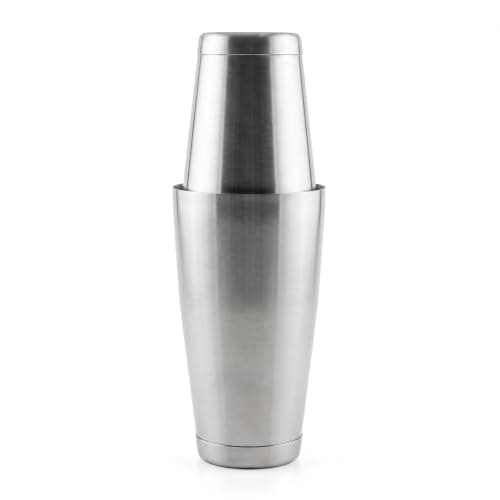
The two shakers are different objects solving the same problem. A cobbler is the one most people picture: a tin, a lid with a perforated strainer built into it, and a small cap over the pour spout. You shake, pull the cap, and pour. A Boston is two tins — traditionally a 28-ounce and an 18-ounce, or a tin and a mixing glass — that wedge together, and you strain through a separate Hawthorne strainer held against the rim.
Three things separate them in use. The seal. Two tins pressed together form a tighter seal as the metal contracts with the cold, which is why they almost never leak; a cobbler's lid is fitted and can be pushed on so firmly by the same contraction that it will not come off. The strainer. A built-in strainer has small fixed holes that clog with citrus pulp, mint and fine ice, and nothing can be done about it mid-drink; a Hawthorne is swapped, rinsed or fitted with a fine mesh. The capacity. A 28-ounce tin takes two drinks' worth of liquid and ice at once; most cobblers struggle with one and a half.
If you are buying for a home bar rather than a shift, the honest tie-breaker is how many drinks you make at once. Below are four shakers — two Boston, one cobbler, one insulated hybrid — with live prices from Amazon and the date we checked them.
The short answer
In a hurry? These are the picks we'd buy. Prices are live; tap a card below for the full reasoning.
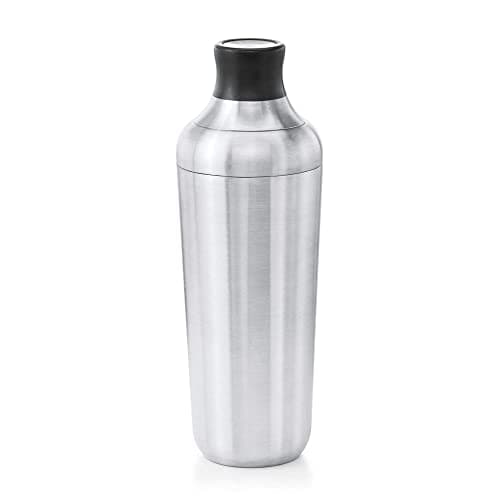
A 24 oz cobbler with a built-in strainer — the best version of the convenient shaker, and genuinely the right buy for a bar that makes one drink at a time.
One or two drinks at a time, with nothing extra to buy
A 24 oz cobbler with a built-in strainer — the best version of the convenient shaker, and genuinely the right buy for a bar that makes one drink at a time.
Type
Cobbler (three-piece)
Capacity
24 oz
Strainer
Built in
Brand
OXO
Pros
Nothing else to buy — the strainer is in the lid
Fewer parts on the counter and nothing to learn
OXO builds to a higher standard than the cobblers in gift sets
Pours accurately through the spout, which a Hawthorne on a tin does not
Cons
Built-in strainer holes clog with citrus pulp and mint — strain slowly
A cold cobbler lid can seize; run warm water over the seam to free it
24 ounces is a one-and-a-half drink shaker in practice, not a two-drink one
Best for: One or two drinks at a time, with nothing extra to buy.
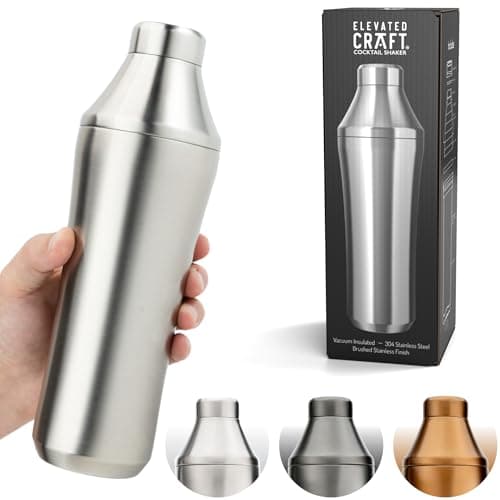
A 28 oz vacuum-insulated hybrid — a Boston-capacity shaker you can actually hold through a hard thirty-second shake, at a price to match.
Type
Hybrid, vacuum-insulated
Capacity
28 oz
Insulated
Yes
Brand
Elevated Craft
Pros
Insulation means you can shake as long as the drink needs without your hand giving up
28 ounces, so it has Boston capacity rather than cobbler capacity
Built for measuring inside the vessel, which removes a tool from the counter
Keeps the drink colder for longer between shake and pour
Cons
The most expensive shaker here by a wide margin
Insulation means you cannot feel the frost on the outside, which is how bartenders judge a shake
More parts and seals to wash than a plain tin
Best for: Long shakes without a numb hand, and measuring inside the tin.
Skip this
The budget traps that look cheap and cost you twice. We'd skip these.
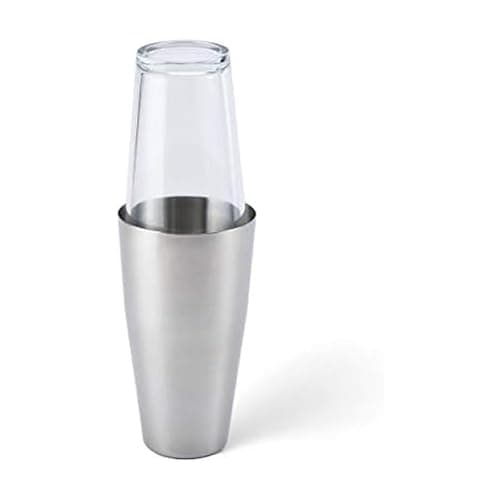
A glass-and-tin Boston shaker
The classic Boston was a pint glass and a tin, and it is still sold that way. Do not buy it for a home bar. Glass chills your hand faster, it cracks when a tin is tapped off it carelessly, and a broken shaker over a drink means pouring the drink away and checking the whole station for shards. Tin on tin seals better, chills the drink faster because metal conducts, and does not break. Keep a mixing glass for stirred drinks, where no impact is involved.
A novelty or gift-set cobbler with a loose lid
The cobblers that come in boxed gift sets are the reason the design has a bad reputation. A lid that is loose at room temperature leaks when the contents chill and the pressure rises, and a strainer stamped with large irregular holes passes ice chips straight into the glass. If you want a cobbler — and there are good reasons to — buy one from a kitchenware or bar brand, where the lid is machined to fit.
How to choose (and what to skip)
Pick on how many drinks you make at once
This is the real decision. One drink at a time, occasionally: a good cobbler is simpler, has fewer parts and pours accurately. Two drinks at a time, or anything with mint, pulp or egg white: a Boston, every time, because you need the volume and you need to be able to change the strainer. A home bar that entertains ends up with a Boston.
If you buy a Boston, buy the strainer in the same order
The most common mistake with a Boston shaker is buying the tins and discovering there is nothing to strain through. You need a Hawthorne strainer — the flat one with the coiled spring — and ideally a fine-mesh conical strainer for anything with citrus pulp or egg, which you hold under the Hawthorne to double-strain. Both are inexpensive, and our bar tool set roundup covers which kits include them.
Shake until the tin frosts, which is about 12 to 15 seconds
The point of shaking is to chill and dilute to the right degree, and the tin tells you when: shake hard until a layer of frost forms on the outside and the metal is uncomfortable to hold. That is usually 12 to 15 seconds with fresh, hard ice. This is the one practical advantage of an uninsulated metal shaker — it gives you the signal. With an insulated shaker, time it instead.
Only shake what should be shaken
Anything with citrus, juice, cream, egg or a syrup gets shaken, because those need aeration and vigorous dilution. All-spirit drinks — martini, manhattan, negroni, sazerac — get stirred in a mixing glass, because shaking clouds them and over-dilutes. A shaker is therefore not a complete toolkit on its own: a bar that makes martinis also needs a mixing glass and a bar spoon.
How to free a stuck shaker, both kinds
A Boston that has sealed tight comes apart with the heel of your hand struck once, firmly, on the side of the larger tin where the two overlap — the small deformation breaks the seal instantly. A cobbler whose lid has seized is the harder problem: run warm (not hot) water over the join for a few seconds so the outer piece expands, then twist. Never pry at a cobbler's seam with a knife; it deforms the lid and then it never seals again.
What bar staff actually use, and why it matters to you
Working bars run on Boston tins almost exclusively, and the reasons are all about throughput: a 28-ounce tin makes two drinks in one shake, tins break apart instantly, and a Hawthorne strainer can be rinsed between drinks while the tins keep moving. None of those reasons applies to someone making one negroni on a Tuesday. This is why “bartenders use Boston” is true but is weaker evidence than it looks for a home bar. The arguments that do transfer are the seal, which means no leaks, and the strainer, which means mint and pulp are not a problem.
The cobbler's two real failure modes
Clogging. The built-in strainer has fixed holes. Shake a mojito with mint or a sour with fresh citrus and the holes block partway through the pour, which leaves you shaking the shaker over a glass and getting a dribble. There is no fix mid-drink. Seizing. Metal contracts as it chills, and a cobbler's lid is pressed onto a tapered rim, so a hard shake with very cold ice can wedge it on hard enough that it will not twist off. Warm water on the seam frees it; a knife ruins the lid. Neither failure happens with two tins, which is the whole case for the Boston.
What about the French or Parisian shaker?
There is a third design worth knowing about. A French (or Parisian) shaker is two pieces like a Boston, but both are shaped tins with a smooth hourglass profile and no separate strainer. It seals like a Boston, looks considerably better than one, and costs more. If appearance matters — a shaker that lives on an open bar cart is on display, after all — it is a legitimate choice, and it needs the same Hawthorne strainer as a Boston. It is rarer and more expensive than either of the two main designs, which is why this page is about the other two.
What else the shaker needs around it
A shaker is one of four or five tools, and buying it alone is usually a mistake. You also need a jigger, because cocktails are ratios and a free pour is a different drink every time; a Hawthorne strainer if you went Boston; a bar spoon and mixing glass for stirred drinks; and a muddler if you make anything with fruit or herbs. A complete tool set is often cheaper than buying those separately — our bar tool set roundup covers which kits include a real Hawthorne rather than a token one. The glass matters too: a shaken drink served up wants a 5 to 6 ounce coupe, not a large martini glass.
And the ice matters more than the shaker
This is the honest closing note on every shaker comparison. The single biggest variable in a shaken drink is not the vessel, it is the ice: small, wet, half-melted freezer-tray ice dilutes a drink before it has chilled, and no shaker compensates. Hard, dry, fresh ice lets you shake for the full 12 to 15 seconds and get a cold drink rather than a watery one. A countertop ice maker costs less than the insulated shaker on this page and improves every drink you make, which is the better place to put the money if you only have one of those purchases in you.
Frequently asked questions
What is the difference between a Boston and a cobbler shaker?+
A cobbler is three pieces — a tin, a lid with a built-in strainer and a cap — so you shake and pour with one object. A Boston is two tins that wedge together with no built-in strainer, so you strain through a separate Hawthorne strainer. The Boston seals better, holds more and never clogs; the cobbler is simpler and needs nothing extra.
Which shaker is better for a home bar?+
A Boston if you make two drinks at a time or anything with mint, citrus pulp or egg white. A good cobbler if you make one drink at a time and would rather own one object than three. The Boston is the better tool; the cobbler is the more convenient one, and for a lot of home bars that is the deciding factor.
Why do bartenders use Boston shakers?+
Throughput. A 28-ounce tin shakes two drinks at once, tins come apart with one tap so nothing slows the service down, and a separate strainer can be rinsed and swapped between drinks. Those advantages are about volume of work, which is why they matter less at home than the seal and the strainer do.
Do you need a strainer with a Boston shaker?+
Yes — a Hawthorne strainer, the flat one with a coiled spring. It is the most commonly forgotten purchase when buying tins. Add a fine-mesh conical strainer too if you make drinks with citrus pulp or egg white, so you can double-strain.
Why does my cobbler shaker get stuck?+
Metal contracts as it chills, and a cobbler's lid is pressed onto a tapered rim, so a hard shake with very cold ice can wedge it tight. Run warm water over the seam for a few seconds so the outer piece expands, then twist. Do not pry the seam with a knife — it deforms the lid and it will never seal properly again.
How long should you shake a cocktail?+
About 12 to 15 seconds with fresh, hard ice — long enough that a layer of frost forms on the outside of the tin and it is uncomfortable to hold. That frost is the signal, which is one practical argument for an uninsulated metal shaker. If your shaker is insulated, time it instead.
Should you shake or stir a martini?+
Stir. All-spirit drinks — martini, manhattan, negroni, sazerac — are stirred in a mixing glass with a bar spoon, because shaking clouds them with air bubbles and ice shards and over-dilutes them. Shaking is for drinks with citrus, juice, cream, egg or syrup, which need the aeration.
Prices and availability shown here come from Amazon's live data and change often; we re-verify them regularly. Bar Bumper is an Amazon Associate and earns a commission on qualifying purchases at no extra cost to you. Read our full disclosure.