The same money, the same room, two different answers. The decision is almost always made by floor space — here is the arithmetic, and what each game is actually like.
Updated October 2026 · By Stephen V.
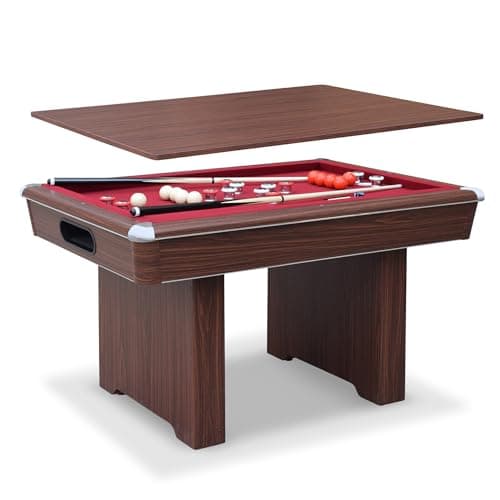
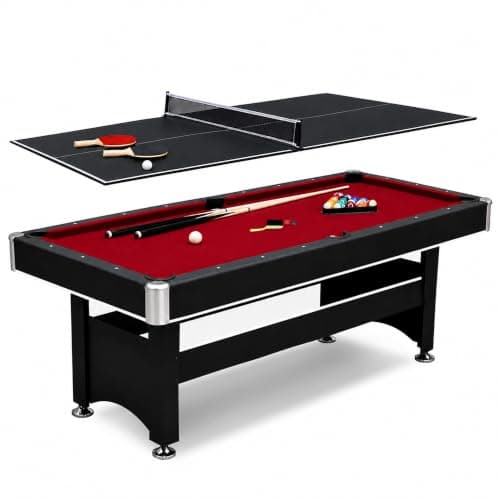
If your room is under about 17 by 13 feet, buy bumper pool; if it clears that, buy a pool table. That one line resolves this question for most people, and everything below is the reasoning. The Hathaway Renegade II is our bumper pool pick because it converts to poker and dining as well; the Hathaway Spartan 7 ft is the pool pick because it includes a ping pong top. Both are recommendations about rooms, not about which game is better.
The comparison gets misframed as beginner-versus-serious. It is not. Bumper pool is a genuinely good game that happens to need half the floor, and plenty of people with room for a pool table would get more use out of bumper pool because theirs is a multi-purpose room. The real axes are space, how long a session lasts, and what the table does when nobody is playing.
The short answer
In a hurry? These are the picks we'd buy. Prices are live; tap a card below for the full reasoning.
Hathaway Spartan 7 ft Pool Table & Ping Pong Top Combo
A full 7-foot pool table with a ping pong top included — the deeper game, if you have the clearance to play it properly.
Game
Pool (+ ping pong)
Table size
7 ft
Cue length
58 in
Room needed
~17 x 13 ft
Session length
A whole evening
Pros
A game with decades of depth — the skill ceiling is the point
Familiar: the same size table bars use
Ping pong top included, so two games in one footprint
Resale and long-term appeal are far stronger than bumper pool
Cons
Needs roughly twice the floor area of bumper pool
Much harder for a beginner to enjoy in the first hour
Heavier, costlier, more involved to assemble and level
Best for: Rooms that clear about 17 x 13 ft.
How to choose (and what to skip)
Do the clearance arithmetic first
Take the table's overall footprint and add a full cue length on every side. Bumper pool uses 48-inch cues: a 54-inch table needs about 11 by 11 feet. Pool uses 58-inch cues: a 7-foot table (roughly 84 by 48 inches overall) needs about 17 by 13 feet. Measure the real clear floor, not the room, and do not count space occupied by furniture you intend to move.
Think about how long a session is
A game of bumper pool is ten to twenty minutes — the right length for someone to suggest a game mid-evening. A game of pool can absorb a whole evening and rewards a group that keeps coming back. If you are buying for parties and mixed company, bumper pool gets played more. If you are buying because you want to get good at something, pool is the one with a ceiling.
Count what the table does when nobody is playing
Most bumper pool tables above entry level convert to poker and dining, so they are furniture that occasionally becomes a game. Pool tables are pool tables; the pool-and-ping-pong combos are the exception. In a dedicated games room that does not matter. In a living room, basement den or dining space it is the deciding factor.
Factor in delivery and permanence
A bumper pool table is 150 to 250 lb of flat-pack. A slate pool table can be 400 lb-plus in rigid sections and is effectively permanent once assembled. If you rent, expect to move, or have an awkward stair turn, that difference is worth more than any spec on either table.
What the two games are actually like
Pool is a game of controlling a cue ball. Every shot is about where the cue ball ends up as much as whether the target ball drops, and that is the depth: the gap between a beginner and a good player is enormous and visible. It needs technique, a decent stroke and a table you can walk around.
Bumper pool removes the cue ball entirely. You shoot your own balls directly, each player has one pocket at their own end, and a field of fixed bumper posts stands in the middle. Almost every shot is a bank or a deflection. There is no break, no rack, and no technique barrier — a complete beginner plays a real game immediately. The skill is reading angles off the bumpers, and it is a shallower pool than pool's but a genuinely interesting one.
Cost, over the whole life of the table
Sticker prices overlap more than people expect: a good bumper pool table and a decent 7-foot MDF pool table sit in similar territory, while slate pool tables are a clear step above both. The differences show up around the table. Pool needs more accessories (a rack, a bridge, more cues, more chalk), the cloth on a heavily played pool table is a consumable, and a 7-foot table really wants a hanging light over it. Bumper pool needs 48-inch cues, a ball set and a cover. Over five years the pool table costs meaningfully more to keep.
The case nobody makes for bumper pool
Bumper pool is better at being in a room with people in it. The table is smaller, so it does not dominate; the game is short, so it does not commit anyone to an hour; the cues are short, so nobody backs into a guest holding a drink; and the convertible versions mean the table is a poker table and a dining table the rest of the time. For a home bar, that combination is often worth more than a deeper game.
The case for the pool table is simpler and also strong: it is the one that is still interesting in year ten. If the room can hold it, nothing here replaces it.
What if neither fits?
Then buy shuffleboard or darts. A 9-foot shuffleboard table needs about 11 by 3 feet of floor and no side clearance at all; a dartboard needs a patch of wall and 8 feet of standing room. Both are real games with real depth, and a cramped pool table is worse than either.
Frequently asked questions
Is bumper pool easier than pool?+
Much easier to start, because there is no cue ball, no break and no rack — a beginner plays a real game within ten minutes. It stays interesting through bank and deflection shots off the bumper field, but the skill ceiling is lower than pool's. That accessibility is the feature, not a compromise.
Can one table do both bumper pool and regular pool?+
No. The two games need different beds — bumper pool has fixed bumper posts set into the playing surface and only two pockets. What does exist are 3-in-1 bumper pool tables that convert to poker and dining, and pool tables that convert to ping pong. Those are the two real multi-game options.
Which is better for a small game room?+
Bumper pool, by a wide margin. It uses 48-inch cues instead of 58-inch ones, so a 54-inch table needs about 11 by 11 feet against the roughly 17 by 13 feet a 7-foot pool table needs. If your room is between those figures, bumper pool is the only one of the two you can actually play properly.
Do bumper pool and pool use the same balls?+
No. Bumper pool uses ten balls at 2-1/8 inches; pool uses sixteen at 2-1/4 inches. The sizes are close enough that people try to substitute and far enough apart that it does not work — bumper pool pockets and bumper gaps are cut for the smaller ball.
Prices and availability shown here come from Amazon's live data and change often; we re-verify them regularly. Bar Bumper is an Amazon Associate and earns a commission on qualifying purchases at no extra cost to you. Read our full disclosure.