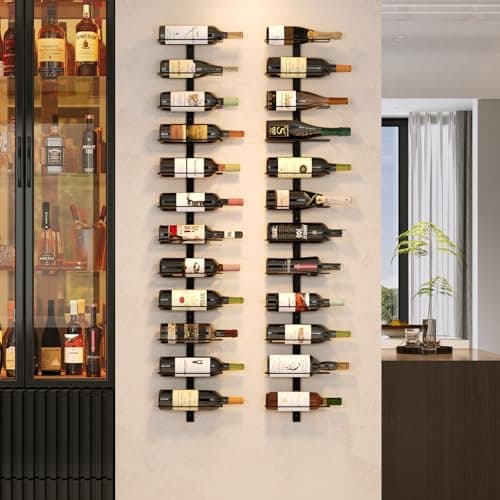
A wall rack is the only wine storage that costs no floor space. The catch is that a full bottle weighs about three pounds, and where your studs are decides what you can hang. Six racks compared on capacity, span and how they fix to the wall.
Updated October 2026 · By Stephen V.
Buy the True Align wrought iron nine-bottle rack. It is the only pick here that publishes its full dimensions — 37.75 inches tall by 9.75 inches wide — which is the single most useful number on a product you are about to drill into a wall, and a vertical nine-bottle strip in that footprint is a lot of storage for a one-foot-wide piece of wall. If you want the same capacity for less, the Sorbus single-row rack does it; if you want bottles and glasses on the same fixture, the Sorbus two-tier shelf is the one; and if you have a whole wall to fill, the X-cosrack modular set scales to 24 bottles.
Wall racks exist because wine storage and floor space are in direct competition in a home bar. A freestanding rack or a cabinet that holds a dozen bottles eats a square foot of floor you could have put a stool on. The same dozen bottles on the wall cost nothing but drilling — which is why wall racks are the default answer in a small home bar, and why the thing that actually decides your purchase is not the rack. It is the wall.
How we judged these
Three criteria, and the first one is the one every other roundup skips.
Published dimensions and mounting span. A loaded wine rack is a cantilevered load on a vertical surface, and whether you can hang it safely depends on the distance between its fixing points versus the 16-inch spacing of your studs. A rack that publishes its height and width lets you work that out before you buy. A rack that publishes neither is asking you to guess, and we have marked every pick here with what the listing actually states.
Real bottle capacity, and what counts as a bottle. Published counts assume standard 750 ml Bordeaux bottles. A Burgundy bottle is wider at the shoulder and a champagne bottle is wider still, and both will reduce the real count on a tight rack. Where a listing specifies standard bottles we say so, because that is a more honest number than a bare total.
Fixing type and what it needs behind it. Multi-piece modular racks spread their load across several small fixings and are far more forgiving of stud positions than a single long rack with two mounting holes. Shelf-style racks carry glassware as well as bottles, which roughly doubles the load for the same wall area. We treat this as a buying criterion rather than an installation footnote, because it is the thing most likely to make a rack unusable on your particular wall.
We have not hung and load-tested these racks. The ranking is built from published dimensions, stated bottle capacities, materials, fixing design and the number of separate pieces in the set, plus owner-review consensus reported as other people's experience — see how we pick. Prices are pulled live from Amazon with the date we checked them.
Before you buy: find the studs, then do the arithmetic
A full 750 ml wine bottle weighs roughly three pounds. Nine bottles is about 27 pounds of wine, plus the rack. That is not a heavy load in absolute terms — it is well within what a single properly fitted fixing can take — but it is a cantilevered load, hanging several inches out from the wall, which multiplies the pull-out force on the top fixings considerably. Drywall anchors fail in exactly this geometry, and they fail slowly, which is how people end up with a rack that was fine for eight months.
The rule we would apply to anything on this page: at least one fixing into a stud, and ideally every fixing into a stud. Studs in US framing sit at 16 inches on center, so a rack under about 10 inches wide will almost always catch a single stud cleanly, and a rack wider than 16 inches can usually be positioned to catch two. The awkward case is a rack 11 to 15 inches wide, which may land between studs with no way to reach either — this is precisely where modular multi-piece racks win, because you can place each piece where the wood is. For masonry or brick, use proper plugs and ignore the drywall anchors in the box.
The short answer
In a hurry? These are the picks we'd buy. Prices are live; tap a card below for the full reasoning.
$44.9916% offPrice as of October 28, 2026·#addisclosure
Quick picks
#
Product
Best for
Score
Price
1
Best overall
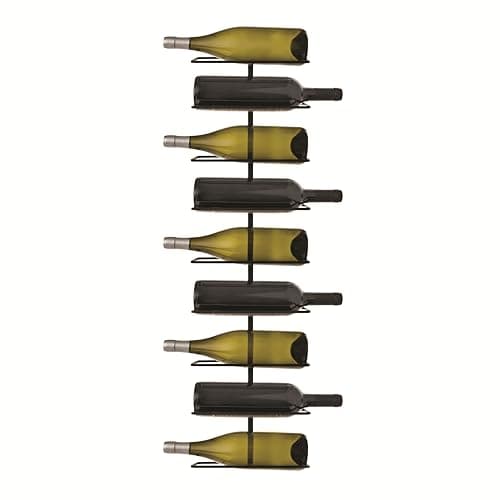
True Align Wall-Mounted Wine Rack, Wrought Iron (9 bottle)
Nine standard bottles in a 37.75 by 9.75 inch wrought iron strip — the only rack here that publishes its footprint, which is the number you need before you drill.
A narrow strip of wall beside a bar, a doorway or a cabinet run
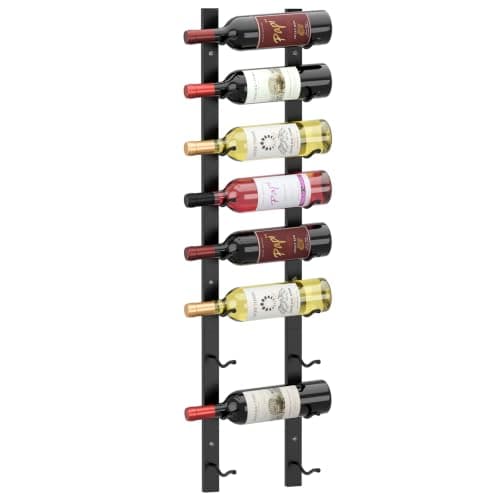
Sorbus Wall-Mounted Wine Rack, Single Row (9 bottle)
A nine-bottle single-row rack in a slim vertical display from a housewares brand with a consistent range — the cheapest route to nine bottles on a wall.
The same nine-bottle job for the least money, from a brand you can buy again
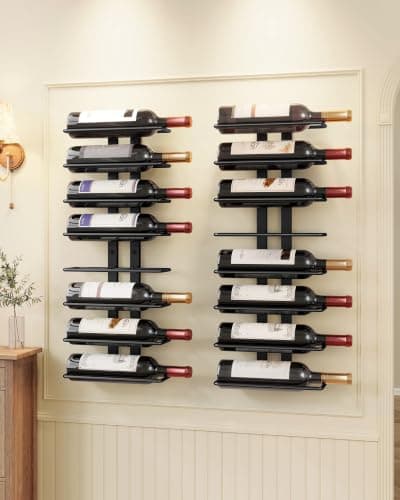
Two eight-tier racks in one box for sixteen bottles total — the cheapest way to get past a case of wine on a wall, and two separate pieces means two chances to hit a stud.
Doubling your wall storage without doubling the fixing problem
Twenty-four bottles across four detachable modules that can be hung as one grid or spread out — the most flexible fixing arrangement on this page by a wide margin.
Filling a wall properly, or working around studs that are in the wrong place
True Align Wall-Mounted Wine Rack, Wrought Iron (9 bottle)
Nine standard bottles in a 37.75 by 9.75 inch wrought iron strip — the only rack here that publishes its footprint, which is the number you need before you drill.
Capacity
9 standard bottles (published)
Dimensions
37.75 in H x 9.75 in W (published)
Material
Wrought iron
Format
Single vertical column
Finish
Black
Pros
Published dimensions, which almost nothing in this category offers and which decide whether it fits your wall
Under 10 inches wide, so it will reliably catch a single stud regardless of where the studs fall
Wrought iron rather than folded sheet steel — the arms do not splay under load the way thin metal does
A vertical column stores nine bottles in roughly a square foot of wall, which is the best density here per inch of width
Cons
Nine bottles in one vertical line means the top bottle sits over three feet up — awkward above a counter
Two mounting points carrying 27 pounds of wine cantilevered off the wall is the least forgiving fixing arrangement on this page
Bottles sit label-out and exposed, so they collect dust and sunlight — this is display storage, not cellaring
Wrought iron finishes chip, and a chip on a black rack shows
Best for: A narrow strip of wall beside a bar, a doorway or a cabinet run.
Sorbus Wall-Mounted Wine Rack, Single Row (9 bottle)
A nine-bottle single-row rack in a slim vertical display from a housewares brand with a consistent range — the cheapest route to nine bottles on a wall.
Capacity
9 bottles (published)
Format
Single row, vertical
Material
Metal
Finish
Black
Sold as
1 pack
Pros
The lowest price here for nine bottles, by a clear margin
Slim vertical format fits the same awkward narrow walls as our top pick
Sorbus sells a consistent range, so you can add a matching second rack later and have it look intentional
Simple single-row geometry means nothing to assemble beyond mounting it
Cons
The listing does not publish height or width, so you cannot plan the stud positions before it arrives
Sheet metal rather than wrought iron — the arms flex more under a full load
No glassware provision at all, so wine glasses need a separate fixture
Sold as a single pack, so scaling up means a second set of fixings and a second alignment job
Best for: The same nine-bottle job for the least money, from a brand you can buy again.
Two eight-tier racks in one box for sixteen bottles total — the cheapest way to get past a case of wine on a wall, and two separate pieces means two chances to hit a stud.
Capacity
16 bottles (published)
Format
2 racks, 8 tiers each
Material
Metal
Install
Two independent wall units
Pros
Sixteen bottles — more than a full case — for less than most nine-bottle racks
Two separate pieces mean you can place each one over a stud instead of hoping one span reaches two
Eight tiers per rack is a tall narrow column, which is the efficient shape for wall storage
Buying in pairs makes a symmetrical two-column arrangement, which looks deliberate rather than improvised
Cons
Two racks means two mounting jobs, and getting them level with each other by eye is harder than it sounds
No published dimensions, so column height and spacing are unknown until it arrives
Hoctieon is an Amazon-native brand with a confusing number of near-identical listings at different capacities
Thin metal construction — this is the lightest-built rack on the page and it is priced that way
Best for: Doubling your wall storage without doubling the fixing problem.
Twenty-four bottles across four detachable modules that can be hung as one grid or spread out — the most flexible fixing arrangement on this page by a wide margin.
Capacity
24 bottles (published)
Format
Detachable, use as one unit or four
Material
Metal
Install
Modular wall hanging
Pros
Four separate modules mean you place every fixing over solid timber instead of compromising
24 bottles is two cases, which is real storage rather than display
Can be hung as a single grid for a feature wall or split across two walls — the layout is yours
Modular design makes it the easiest rack here to add to or rearrange later without new holes
Cons
Four modules is four mounting jobs, four alignments and four chances to get a line crooked
No published overall dimensions, and the module size is what you actually need to plan a grid
Twenty-four bottles is around 72 pounds of wine on one wall — this is the pick that most demands stud fixing
Stacked as one grid, the lower bottles are awkward to reach past the ones above them
Best for: Filling a wall properly, or working around studs that are in the wrong place.
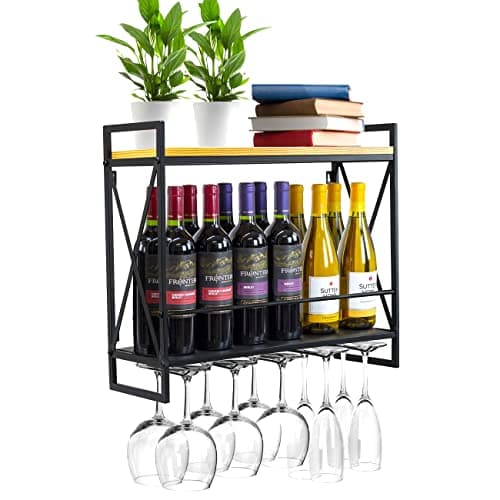
Mkono Wall-Mounted Wine Rack with Glass Holder (2-pack)
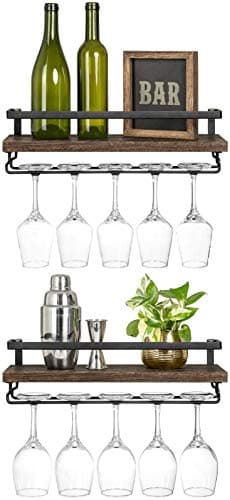
Two small wood-shelf racks with stem hangers, bought as a pair — the cheapest and least committal way to get bottles and glasses off a worktop.
Format
2 racks, wood shelf with stem hanger
Holds
Bottles on the shelf, glasses by the stem
Material
Wood and metal
Assembly
Stated as easy assembly
Pros
Cheapest thing on this page, and it comes as a pair so you can flank a mirror or a cabinet
Small and light enough that the fixing question is much less critical than on a nine-bottle rack
Holds bottles and hangs stems, which is unusual at this size and price
Two small pieces are the easiest format to position around awkward studs or a rented wall
Cons
Holds a handful of bottles, not a case — this is accent storage, not wine storage
No published bottle count, so what fits depends on bottle shape more than on the rack
Wood shelf with a metal rail is a lighter build than the iron racks here, and it looks it up close
Two tiny racks on a big wall look like an afterthought — this needs a small space to make sense
Best for: A rented wall, a first bar, or a gap too small for anything else.
Skip this
The budget traps that look cheap and cost you twice. We'd skip these.
Drywall anchors on a nine-bottle rack
Twenty-seven pounds of wine hanging several inches off the wall is a pull-out load, which is the exact failure mode plastic drywall anchors are worst at. They do not fail on day one, they creep — which means the rack is fine for months and then is not. Get at least one fixing into a stud, or use proper toggle fixings rated for the load.
Wall racks as long-term wine storage
Every rack here stores bottles in the open, in your room's light and at your room's temperature, usually label-out. That is display, not cellaring. Wine you intend to keep for years belongs at a steady 55F in the dark, which means a wine fridge. Use the wall for what you are drinking this month.
Racks that publish no dimensions at all
You are drilling permanent holes. A listing that gives a bottle count and no measurements is asking you to commit to a hole pattern you cannot see, and the 11-to-15-inch width band is exactly where a rack can land between two studs with no way to reach either. Prefer the ones that publish a size, or prefer modular racks you can place freely.
Hanging a rack over a seating area
A wall rack puts glass bottles above head height on fixings you cannot inspect. Over a worktop or a cabinet run this is fine. Over a sofa, a stool or anywhere someone sits for an hour, it is a bad trade for the floor space it saves.
Wall racks store wine; wine fridges keep it
It is worth being clear about what a wall rack is for, because the category is sold with cellar imagery it does not deserve. Wine keeps badly in warm, bright, variable conditions, and a living-room wall is all three. Temperature swings push the cork in and out, UV light degrades the wine through clear and green glass, and a room at 72°F ages a bottle several times faster than a cellar at 55°F. None of that matters over weeks. All of it matters over years.
So the honest division of labor is: the wall holds what you are drinking in the next month or two, and anything you are actually keeping goes in a wine fridge at a steady temperature in the dark. Our wine fridge temperature guide covers the numbers, and if your bar has a single undercounter opening to spend, a wine and beverage combo fridge handles both the bottles and the cans while the wall takes the overflow.
Horizontal, vertical or label-out: what the orientation does
Horizontal storage — bottles lying on their side — keeps the cork in contact with the wine, which stops a natural cork drying out and letting air in. For anything you are keeping more than a few months, and for anything under a real cork rather than a screw cap, this is the orientation you want. Most of the racks on this page hold bottles roughly horizontally, with the neck pitched slightly up or down depending on the arm design.
Label-out designs tip the bottle so the label faces the room. They look better and they make a nine-bottle rack a feature rather than storage, and they are perfectly fine for wine you will drink soon. Vertical storage, neck up, is the worst case for a corked bottle and the reason wine racks almost never do it. If your wall rack holds bottles upright, treat it as a two-week shelf.
Working out what fits: the 16-inch problem
US stud framing puts vertical timbers at 16 inches on center, which creates three distinct cases for a wall rack. Under about 10 inches wide, a rack will catch one stud wherever you put it, and one stud is enough for a nine-bottle column. Over 16 inches wide, you can usually position the rack so both ends land on timber, which is the strongest arrangement available. Between 11 and 15 inches, you may be able to reach only one stud with one of two fixing points, or neither — and that is the band where a modular rack you can place piece by piece is worth paying for.
Find the studs before you buy, not after. A magnet dragged along the wall finds the drywall screws, which are in the studs; an electronic stud finder is faster and worth the small cost if you are hanging anything else. Mark the centers in pencil, measure the gap, and then shop for a rack whose width works with what you found. This is five minutes that decides whether the thing you buy is mountable.
What a wall rack frees up
The reason to put wine on a wall is that it is the only storage in a home bar with no floor-space cost, and floor space is what every other decision in a small bar is competing for. A dozen bottles off the floor is room for a stool, or for the bumper pool table that needs cue clearance on all four sides, or for the bar cart to sit somewhere it can actually be rolled.
If the wall is doing the storage, the floor can do the furniture. Our home bar cabinet roundup covers the cabinets that hold glassware and bottles behind doors, the bar-height stools page covers seating against a 42-inch bar, and the home bar ideas pillar and how to set up a home bar work through small-room layouts that start from the walls rather than the middle of the room.
Glasses on the wall too?
Hanging stemware by the foot is good storage — it keeps dust out of the bowl and it uses the dead space under a shelf. Two things to know. First, it roughly doubles the load for the same wall area, because a stem rail full of glasses weighs about as much as the bottles above it, so a combined fixture genuinely needs stud fixing rather than anchors. Second, hanging glasses collect kitchen grease if they are anywhere near a stove, which is a real argument for a cabinet in an open-plan room.
Stem rails only take stemmed glasses, which means they handle wine glasses and coupes and nothing else. Tumblers — highballs, rocks glasses and the rest — need shelf or cabinet space, which is why a bar wall usually ends up as a rack plus a shelf rather than a rack alone.
Our verdict
Buy the True Align nine-bottle wrought iron rack. It publishes the dimensions you need to plan the install, it is narrow enough to catch a stud wherever your studs happen to be, and the iron construction is a real step above the folded sheet metal elsewhere in the category. Buy the Sorbus single row if you want the same nine bottles for less and will work out the fit when it arrives, the Hoctieon pair if you want a case and a half on the wall for the least money, and the X-cosrack modular set if you have a whole wall or awkward framing. Add the Sorbus two-tier shelf if the glasses need a home as well — and whichever you buy, find the studs first.
Frequently asked questions
How much weight does a wall-mounted wine rack hold?+
Work from the wine, not the rack. A full 750 ml bottle weighs about three pounds, so nine bottles is roughly 27 pounds and 24 bottles is around 72 pounds, before the rack itself. That load hangs several inches out from the wall, which multiplies the pull-out force on the top fixings — which is why stud fixing matters more here than the rack's own rating.
Do I need to hit a stud to hang a wine rack?+
Get at least one fixing into a stud, and all of them if you can. Plastic drywall anchors are weakest in exactly this geometry — a cantilevered pull-out load — and they tend to creep rather than fail outright, so a rack can be fine for months before it moves. On masonry, use proper plugs and ignore the anchors that come in the box.
How wide should the rack be relative to my studs?+
US studs sit 16 inches on center. A rack under about 10 inches wide will catch a single stud wherever you place it. A rack over 16 inches wide can usually be positioned to catch two. The awkward band is 11 to 15 inches, where a two-hole rack can land between studs with no way to reach either — and where a modular rack you place piece by piece is worth the extra money.
Should wine bottles be stored horizontally on a wall rack?+
Yes for anything with a natural cork that you will keep more than a few months — horizontal keeps the cork wet so it does not dry out and admit air. Label-out designs that tip the bottle are fine for wine you will drink soon. Neck-up vertical storage is the worst case for a corked bottle and should be treated as a two-week shelf.
Is a wall rack good enough for storing wine long term?+
No. Every wall rack puts bottles in your room's light and at your room's temperature, and a room at 72F ages wine several times faster than a cellar at 55F while UV light degrades it through the glass. Use the wall for the next month or two of drinking, and a wine fridge for anything you are actually keeping.
Can wall wine racks hold glasses as well?+
Some do — the shelf-style racks here have stem rails underneath. It is good storage because hanging a glass by the stem keeps dust out of the bowl. Two caveats: a full stem rail roughly doubles the load on the same patch of wall, so stud fixing becomes non-negotiable, and hanging glasses collect airborne grease if they are near a stove.
How many bottles should a home bar keep on the wall?+
As many as you will drink in a couple of months, which for most people is six to twelve. Beyond that you are storing rather than displaying, and storage wants a fridge. The useful exception is a feature wall in a game room or den, where a 24-bottle modular grid is as much decor as it is storage.
Will a Burgundy or champagne bottle fit a standard wine rack?+
Often not. Published capacities assume standard 750 ml Bordeaux bottles, which are the narrowest common shape. Burgundy bottles are wider at the shoulder and champagne bottles are wider still and heavier, so on a tight rack they take two slots or do not seat at all. If you buy either style regularly, size up or choose a rack with wider arms.
Prices and availability shown here come from Amazon's live data and change often; we re-verify them regularly. Bar Bumper is an Amazon Associate and earns a commission on qualifying purchases at no extra cost to you. Read our full disclosure.