A nosing glass is not a small tumbler. The narrow neck concentrates aroma and the wide bowl gives it room to develop, which is why neat whiskey tastes different out of one.
Updated October 2026 · By Stephen V.
If you want one glass for drinking whiskey neat, buy the Glencairn Whisky Glass in the set of four. It is the glass the Scotch industry actually uses, it costs very little per glass, and the tulip shape does the job every other design on this page is trying to do differently. Buy the set of six if you pour for company, the Schott Zwiesel Bar Special if you want a dishwasher-safe set that will survive a decade of use, and one of the two aeration glasses if high-proof spirits burn your nose.
A nosing glass is a different object from the rocks glass most people own. A rocks glass is a wide, straight-sided cylinder designed to hold ice and a cocktail; its open mouth lets aroma escape as fast as it rises. A nosing glass is a tulip: a bowl wide enough to swirl a small pour and let it breathe, pulled in to a narrow neck that funnels everything that evaporates to one point under your nose. That is the whole mechanism, and it is why the same whiskey reads as more complex out of one and flatter out of the other.
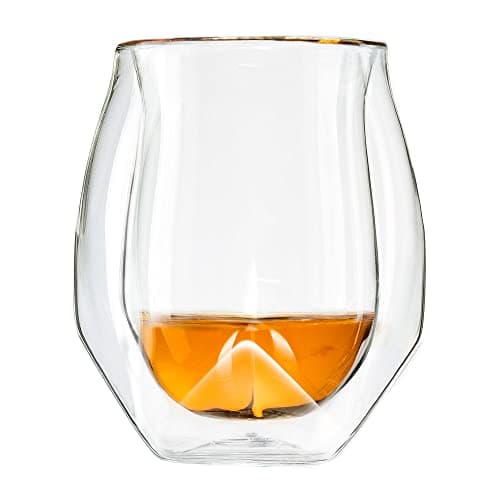
The second thing worth knowing before you spend money is that ethanol is the problem the whole category is arguing about. Alcohol evaporates faster than the aromatic compounds you actually want to smell, so at cask strength a concentrating neck can deliver a lungful of solvent instead of fruit. The classic answer is to add a few drops of water. The design answer — which is what the Neat and the Norlan are both selling — is to change the shape so more ethanol disperses before it reaches you. Both routes work. Only one of them costs money.
We have not run a blind tasting panel, and we are not going to pretend otherwise. What is below is sorted on published dimensions and capacity, glass construction, dishwasher safety, how many glasses you get, and what the makers and reviewers each claim their shape does — see how we pick. Prices come live from Amazon with the date we checked them.
The short answer
In a hurry? These are the picks we'd buy. Prices are live; tap a card below for the full reasoning.
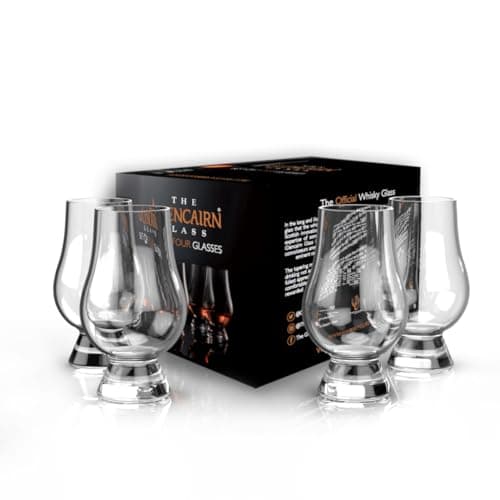
The glass the Scotch industry settled on — a tulip bowl with a short stem, sold in a four-pack, and the reference point every other nosing glass on this page is measured against.
Anyone who wants one tasting glass and does not want to think about it again
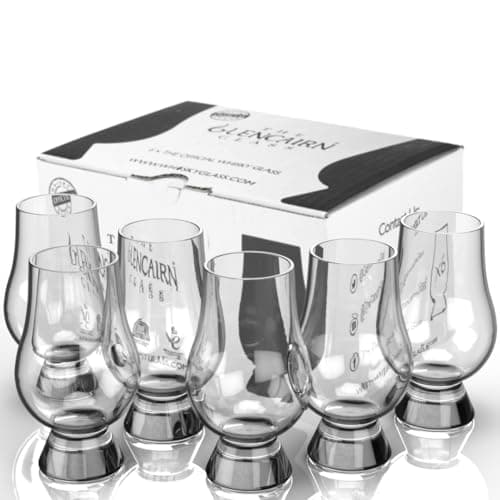
The same glass in a six-pack trade carton — the right buy if you ever pour the same dram for several people and want everyone smelling it out of identical glassware.
A home bar that pours flights or hosts four or more people
Best upgrade, and the only dishwasher-safe set here
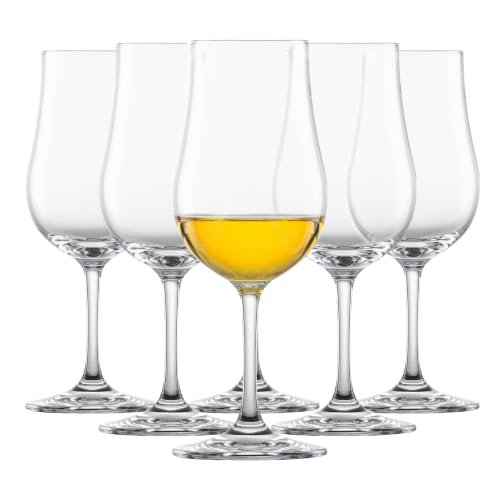
Schott Zwiesel Bar Special Whiskey Nosing Glass (set of 6, 7 oz)
A 7 oz German nosing glass in Tritan crystal, sold as six and rated dishwasher-safe — the set to buy if these are going to be used weekly rather than ceremonially.
A bar that uses tasting glasses often enough to resent hand-washing them
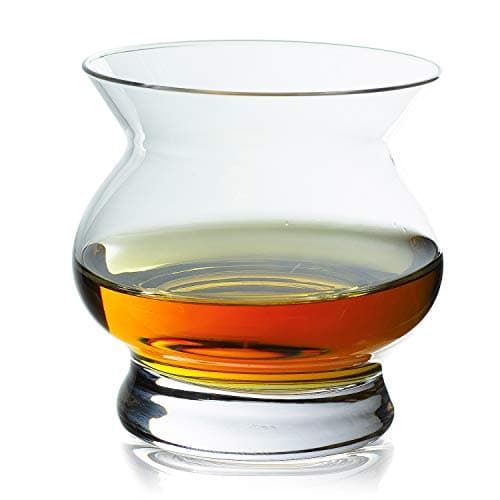
A short, sharply flared glass built on the opposite theory to the tulip — the rim opens out so ethanol vapor spills sideways instead of funneling up at you.
Barrel-proof bourbon and anything over about 55% ABV
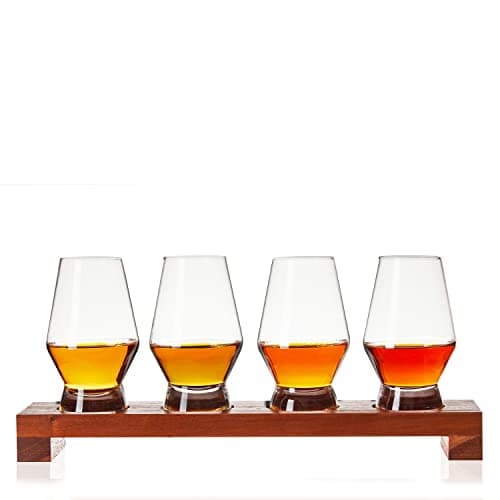
Viski Spirit Tasting Flight Set (4 glasses + wooden tray)
Four small crystal tasting glasses on a wooden tray — the simplest way to turn a shelf of bottles into an actual flight instead of four separate pours.
The glass the Scotch industry settled on — a tulip bowl with a short stem, sold in a four-pack, and the reference point every other nosing glass on this page is measured against.
Shape
Tulip bowl, narrow neck, short solid base
Capacity
About 6-7 fl oz to the rim
Intended pour
Roughly 1.5-2 fl oz
Set size
4 glasses, gift carton
Pros
The shape is derived from the copita used by master blenders, so you are buying the industry standard rather than a reinterpretation of it
Very low cost per glass in the four-pack, which matters because tasting glasses get broken
Short solid base instead of a long stem: much harder to knock over on a bar top
Small enough that a normal 1.5 oz pour fills the bowl to the right depth for swirling
Cons
Concentrates ethanol along with everything else, so cask-strength pours can burn without a drop of water added
The thick base and bowl junction is the hardest part of the glass to dry, and it spots if you leave it
Not dishwasher-rated by most sellers, so it is a hand-wash glass
Counterfeit Glencairns circulate from unofficial sellers; buy from a listing that names Glencairn
Best for: Anyone who wants one tasting glass and does not want to think about it again.
The same glass in a six-pack trade carton — the right buy if you ever pour the same dram for several people and want everyone smelling it out of identical glassware.
Shape
Tulip bowl, narrow neck, short solid base
Set size
6 glasses, trade pack
Packaging
Trade carton, not a gift box
Intended pour
Roughly 1.5-2 fl oz
Pros
Six identical glasses means a side-by-side comparison is actually valid — different shapes change the result
Lower cost per glass than buying two four-packs for a six-person tasting
Trade packaging is plainer and uses less material than the gift cartons
Spares matter in this category: you will break one eventually and the replacement matches
Cons
Trade carton is not a gift box, so it is the wrong version to hand someone
Six small glasses take real cabinet space for something used occasionally
Same ethanol concentration issue as the four-pack at high proof
Hand wash, six at a time
Best for: A home bar that pours flights or hosts four or more people.
#3Best upgrade, and the only dishwasher-safe set here
Schott Zwiesel Bar Special Whiskey Nosing Glass (set of 6, 7 oz)
A 7 oz German nosing glass in Tritan crystal, sold as six and rated dishwasher-safe — the set to buy if these are going to be used weekly rather than ceremonially.
Capacity
7 fl oz
Material
Tritan crystal glass
Dishwasher
Dishwasher-safe
Set size
6 glasses
Pros
Dishwasher-safe, which no other nosing glass on this page is — that alone decides it for a lot of people
Tritan is Schott Zwiesel's toughened formulation, aimed at bar and restaurant service rather than display
Slightly larger bowl than the Glencairn, so a two-ounce pour has more room to breathe
Made in Germany, with a bar-trade spec sheet behind it rather than a gift-market one
Cons
Costs more per set than the Glencairn six-pack — you are paying for the material and the dishwasher rating
A 7 oz bowl under-fills visually with a small 1 oz pour
Taller and wider than a Glencairn, so it does not fit a tight glass shelf as neatly
Stocked more thinly than Glencairn, so replacing a broken one takes longer
Best for: A bar that uses tasting glasses often enough to resent hand-washing them.
A short, sharply flared glass built on the opposite theory to the tulip — the rim opens out so ethanol vapor spills sideways instead of funneling up at you.
Shape
Squat bowl, outward-flared rim
Sold as
Single glass
Design intent
Disperse ethanol vapor (maker's claim)
Suits
High-proof, unwatered pours
Pros
The flared rim is a real geometric difference, not a finish: aroma leaves the glass over a wide area instead of through a neck
Reviewers who have compared aeration designs side by side report the largest difference from this shape
Lets you assess a cask-strength pour without diluting it first
Least expensive glass on this page and sold singly, so it is a low-cost experiment
Cons
The claim that it selectively removes ethanol is the maker's and we have not found an independent measurement of it
Sold as a single glass, so a set costs several times the Glencairn four-pack
The wide rim is clumsy to drink from compared with a tulip neck
An odd-looking glass on a bar shelf, and that puts some people off
Best for: Barrel-proof bourbon and anything over about 55% ABV.
#5Best-looking glass, and the other aeration design
Viski Spirit Tasting Flight Set (4 glasses + wooden tray)
Four small crystal tasting glasses on a wooden tray — the simplest way to turn a shelf of bottles into an actual flight instead of four separate pours.
Includes
4 glasses + wooden serving tray
Glass
Crystal
Use
Flights: bourbon, Scotch, gin, brandy
Pour size
Small tasting measures
Pros
The tray is the point: a flight stays in order, so you know which glass is which after the third one
Four matched glasses, which is what a valid comparison needs
Small pour sizes keep a four-whiskey flight to a sensible total measure
Presents well enough to use when guests are over, which a bare Glencairn does not
Cons
The glasses are tasting measures, not full nosing tulips — less bowl to swirl in than a Glencairn
A wooden tray is one more thing to store and it cannot go near a dishwasher
You are partly paying for the tray, so cost per glass is high against a Glencairn four-pack
Not the glass to use for a single evening dram
Best for: Comparing three or four whiskeys in one sitting.
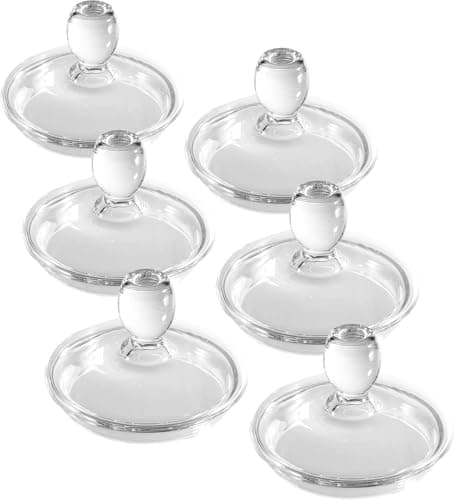
Six nosing lids that sit on a Glencairn — they trap aroma in the bowl while a pour opens up, and they stop a half-finished dram evaporating overnight.
Fits
Glencairn whisky glass
Set size
6 caps
Purpose
Trap aroma while a pour rests
Also useful for
Covering samples, preventing spills
Pros
Lets a pour sit for ten or twenty minutes without losing the volatiles — which is when a lot of whiskeys get interesting
Turns a Glencairn into a sample vessel you can cover and carry to the next room
Low cost per cap, and it upgrades glasses you already own rather than replacing them
A set of six matches a six-glass tasting
Cons
Useless unless you own Glencairns — it is an accessory, not a glass
Easy to mislay; small lids live in the back of a drawer
Does nothing for the ethanol problem, which is the other half of nosing
Adds a washing-up item to every tasting
Best for: Letting a pour rest, or carrying samples without spilling them.
Skip this
The budget traps that look cheap and cost you twice. We'd skip these.
A heavy cut-crystal tumbler bought as a tasting glass
The thick, faceted whiskey tumbler is a beautiful object and it is the right glass for an old fashioned over a big cube — our <a href="/bar-gear/best-whiskey-glasses">whiskey glasses page</a> ranks them for exactly that. It is the wrong glass for assessing a pour neat, because the mouth is as wide as the base and aroma leaves it as fast as it rises. If someone sold you a tumbler as a nosing glass, they sold you the wrong shape.
A long-stemmed copita for use on a bar top
The laboratory copita the Glencairn descends from has a tall, thin stem, and in a tasting room on a felt mat that is fine. On a bar top, next to a game table, with people reaching past it, a long stem is a glass on the floor. The reason the Glencairn has a short solid base rather than a stem is that it was designed to be picked up and put down repeatedly. Buy the stemless shape for a home bar and keep the stemmed ones for a desk.
Giant 12 oz whiskey snifters
A brandy balloon sized at 12 ounces or more is designed for a spirit you warm in your hand over a long time. Fill it with a 1.5 oz whiskey pour and the liquid sits in a shallow puddle too far from the rim for the shape to do anything — you get a lot of empty glass and very little concentrated aroma. Nosing glasses are small on purpose: 5 to 7 ounces total, so a normal pour reaches the widest part of the bowl.
How to choose (and what to skip)
Buy on bowl volume, not on looks
A nosing glass works when the pour reaches the widest part of the bowl, because that is the surface area doing the evaporating. The sweet spot for a 1.5-2 oz dram is a glass of roughly 5 to 7 fluid ounces total capacity. Everything on this page sits in that band, and that is not a coincidence — it is the band the shape works in. A 12 oz snifter does nothing for a small pour, and a 3 oz cordial glass has no room to swirl.
Decide whether you need dishwasher-safe, because almost none of these are
This is the single most practical split in the category. A set of tasting glasses that has to be hand-washed and hand-dried gets used on occasions; a set you can put in the dishwasher gets used on Tuesdays. Only the Schott Zwiesel set here is rated dishwasher-safe, and that rating is most of what the price difference buys. If you know yourself well enough to admit the hand-wash set will stay in the cupboard, pay the difference.
Stem or no stem is a question about your room, not your palate
A stem keeps your hand off the bowl so body heat does not warm the spirit, which is a real effect over a long tasting. A short solid base survives a home bar, which is a real effect over a long year. If your glasses live on a bar top in a game room where people are also throwing darts and racking balls, the stemless shape is the right call — and the Norlan's double wall is the other way to solve the hand-heat problem.
At cask strength, water is the free version of what the aeration glasses sell
If a high-proof pour burns your nose out of a Glencairn, the standard fix among the people who taste for a living is a few drops of water, added and left for a minute. It lowers the ethanol in the headspace and lifts aroma. The Neat and the Norlan are both attempts to get the same result geometrically, and they do change what reaches your nose — but try the free method first and buy the glass if you prefer not to dilute. That order saves money and teaches you more about the whiskey.
Buy matched glasses if you intend to compare anything
Two whiskeys in two different shapes is not a comparison, it is two experiences. The shape changes the result enough that any side-by-side needs identical glassware, which is the real argument for a set of six over two mismatched pairs, and the argument for the flight tray if you compare often. It is also why we rank the six-pack above the two aeration glasses for a bar that hosts.
Count glassware into the bar budget, because it adds up quietly
Nosing glasses are among the cheapest meaningful upgrades on a home bar and they are also the easiest to over-buy: a tulip set, a rocks set, coupes, highballs and wine glasses add up to real money before a single bottle. Our guide to <a href="/guides/what-glassware-do-you-need-for-a-home-bar">what glassware you actually need</a> sets the minimum list, and the <a href="/guides/home-bar-setup-cost">home bar setup cost breakdown</a> shows where glassware sits against the furniture and the fridge.
What a nosing glass is actually doing
Smell is most of taste, and smelling a spirit means getting the volatile compounds above the liquid into your nose at a useful concentration. Two things govern that: how much liquid surface is exposed to air, and how wide the opening is that the vapor escapes through. A tulip maximizes the first and restricts the second — a broad bowl to evaporate from, a narrow neck to deliver through. That is why the shape has survived from the laboratory copita through the Glencairn to the German bar-trade nosing glass largely unchanged: it is not fashion, it is the geometry that works.
The counter-argument is about ethanol, and it is a real one. Alcohol is more volatile than most of the aromatic compounds in whiskey, so in the headspace of a concentrating glass it arrives first and loudest. At 40% ABV this barely matters. At 60% it can flatten everything else into a solvent note, which is the exact problem the Neat glass's flared rim and the Norlan's internal fins are each designed around. Neither design claims to remove ethanol; both aim to disperse more of it before it reaches you.
Glencairn, copita, snifter and tumbler: which is which
A copita is the long-stemmed tulip used in sherry bodegas and tasting labs. The Glencairn is that shape with the stem replaced by a short solid base, launched in 2001 and designed for use rather than laboratory handling. A snifter is a much larger balloon with a short stem, designed for brandy and for warming a spirit in your palm. A tumbler or rocks glass is a straight-sided cylinder designed to hold ice. Only the first two are nosing glasses. The snifter is too big for a whiskey pour and the tumbler does not concentrate anything, which is what makes it the right glass for a cocktail.
How to use one, in four steps
Pour about 1.5 fl oz — enough to reach the widest part of the bowl and no more. Over-filling a nosing glass defeats it.
Swirl once or twice to coat the bowl, then let it stand for a minute. The legs running back down are evaporating, and that is the aroma you are about to smell.
Nose it with your mouth slightly open and the glass below your nose rather than inside it, then move it away and come back. Your nose adapts to a smell within seconds, so short looks beat one long inhale.
If it burns, add two or three drops of water, wait a minute, and nose it again. If you would rather not dilute, this is the point at which an aeration glass earns its money.
Washing them without ruining them
Almost everything on this page is a hand-wash item, and the failure mode is not breakage — it is film. Detergent residue in a small bowl is concentrated right where you are about to put your nose, and it reads as soap in the whiskey. Wash in hot water with very little detergent, or none at all if the glass only held spirit; rinse twice; and dry with a lint-free cloth rather than leaving them to drain, because the thick base of a Glencairn holds a drop of water that dries to a spot. The Norlan's double wall and the flight tray's wooden base both want extra care. The Schott Zwiesel set is the one exception, and if hand-washing six glasses sounds like the reason your tasting glasses stay in the cupboard, that is the set to buy.
What to buy alongside them
Two things actually improve neat pours. The first is a water source you can dose in drops rather than splashes — a pipette or a small bottle, not a jug. The second is large, clear ice for the pours you do want chilled, because a single dense cube dilutes far slower than a handful of small wet ones; our clear ice maker roundup covers both the countertop machines and the directional-freezing trays that make it. Beyond that, the useful next purchase is somewhere to keep the bottles: the decanter sets if the bottle is going on display, or a home bar cabinet if there are more than a few.
Our verdict
Buy the Glencairn four-pack. It is the industry's own glass, it costs very little per glass, and the shape is the one every alternative here is arguing with rather than replacing. Buy the six-pack instead if you pour for other people, and the Schott Zwiesel set if you want the version you can put in a dishwasher and stop thinking about. Add the Neat only after you have tried a few drops of water in a Glencairn and decided you would rather not dilute; add the Norlan because you like how it looks, which is a perfectly good reason to buy a glass, as long as nobody pretends it is the cheapest route to the result.
Frequently asked questions
What is a Glencairn glass and why is it shaped like that?+
It is a tulip-shaped whisky tasting glass launched in 2001, derived from the long-stemmed copita used by master blenders but given a short solid base so it can be used rather than handled in a lab. The wide bowl exposes a large liquid surface to the air and the narrow neck funnels the resulting vapor to one point, so aroma reaches your nose concentrated rather than dispersed.
How much whiskey do you put in a nosing glass?+
About 1.5 fluid ounces, which is a standard dram. The aim is for the liquid to reach the widest part of the bowl — that is the surface area doing the evaporating. Filling a nosing glass higher than that reduces the headspace the shape depends on and makes it harder to swirl without spilling.
Is a Glencairn better than a regular whiskey glass?+
For drinking whiskey neat, yes — the shape concentrates aroma in a way a straight-sided tumbler cannot. For a cocktail or anything over ice, no: a rocks glass is the right tool because it holds ice and you are not trying to concentrate anything. Most home bars want both, and the nosing glasses are the cheaper half of that pair.
Are Glencairn glasses dishwasher safe?+
Most Glencairn listings are sold as hand-wash, so treat them that way. Of the glasses on this page only the Schott Zwiesel Bar Special set is rated dishwasher-safe, which is the main practical reason to pay more for it. Whatever you wash them in, use very little detergent and dry them with a cloth — residue in a small bowl is right under your nose.
What is the difference between a copita and a Glencairn?+
The copita is the original: a tulip bowl on a long thin stem, used in sherry bodegas and tasting rooms. The Glencairn keeps the bowl and replaces the stem with a short solid base. The bowl shape — and therefore what it does to aroma — is essentially the same; the base is what makes the Glencairn survive a home bar rather than a tasting bench.
Do aeration glasses like the Neat and Norlan actually work?+
Both change the shape of the headspace, and reviewers comparing them side by side report that you do smell something different — generally less ethanol burn. What neither maker has published is an independent measurement, so treat the specific claims as design intent rather than proven fact. The free alternative is two or three drops of water in a normal nosing glass, which is what most professional tasters do.
How many nosing glasses should a home bar own?+
Four is the useful minimum and six is better if you host, because any side-by-side comparison needs identical glasses. Two mismatched pairs will not give you a valid comparison, since the shape changes the result. If you compare whiskeys often, a four-glass flight tray keeps the order straight, which matters more than you would expect by the third pour.
Should I add water to whiskey in a nosing glass?+
At cask strength, usually yes. A few drops lower the ethanol in the headspace and let the aromatic compounds through, which is why tasting rooms keep a pipette on the bench. Add drops rather than a splash, wait a minute, and nose it again. At standard 40-43% bottling strength most people find water unnecessary.
Prices and availability shown here come from Amazon's live data and change often; we re-verify them regularly. Bar Bumper is an Amazon Associate and earns a commission on qualifying purchases at no extra cost to you. Read our full disclosure.