Every cocktail recipe is a ratio, and the jigger is the only tool that enforces it. Eight compared on published capacities, whether the markings are inside or implied, and how much you spill getting from bottle to tin.
Updated November 2026 · By Stephen V.
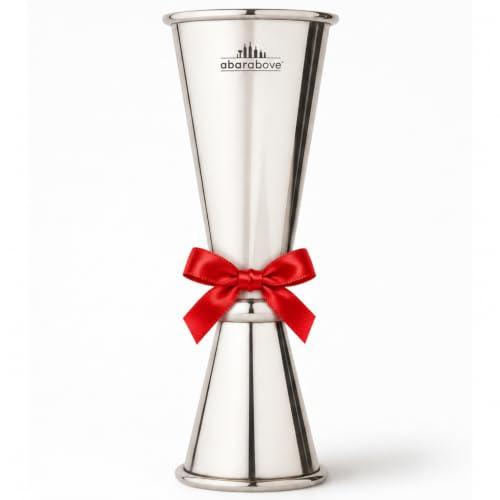
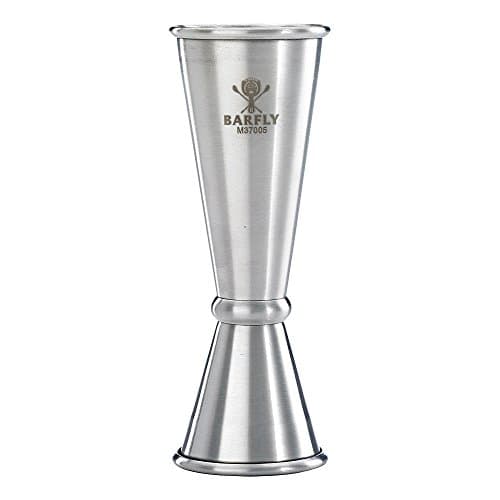
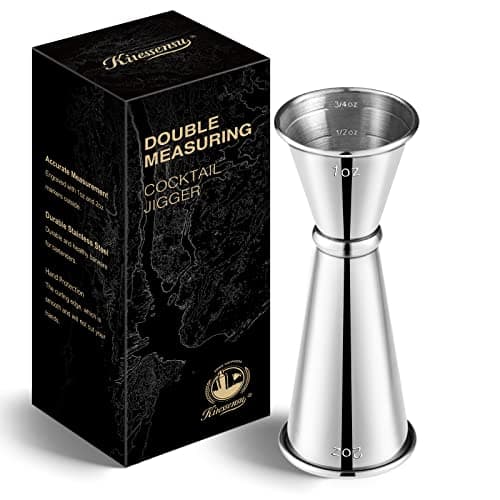
Buy the A Bar Above Japanese-style jigger. It is a double-cone jigger with ten graduations etched inside the two cones rather than the usual two capacities, which means one tool measures everything from a dash of syrup to a two-ounce pour without you doing arithmetic. If you would rather read the measurement from above while you pour, the OXO Steel angled jigger is the pick; if you want the cheapest honest version of the same idea, the KITESSENSU does it for a third of the price; and if you only ever measure 1 oz and 2 oz, the Barfly 1 x 2 is the bar standard and costs almost nothing.
A jigger is the least glamorous thing on a home bar and the one that makes the most difference. Cocktail recipes are ratios — two parts spirit, one part citrus, three-quarters of an ounce of syrup — and a free pour is wrong by a quarter-ounce in both directions. On a two-ounce drink that is a 12% error, which is enough to move a Daiquiri from balanced to sour and back again. Nothing else in a bar tool kit changes the drink that much for under twenty dollars.
How we judged these
Four criteria, in this order. Only the first two change the drink; the last two decide whether you keep using the thing.
How many amounts it actually measures. A plain double jigger gives you two capacities and nothing in between, so three-quarters of an ounce becomes a guess. A jigger with interior graduations gives you four to ten amounts from the same tool. This is the single biggest practical difference in the category, and it is published on the listing — we state the number of markings for every pick.
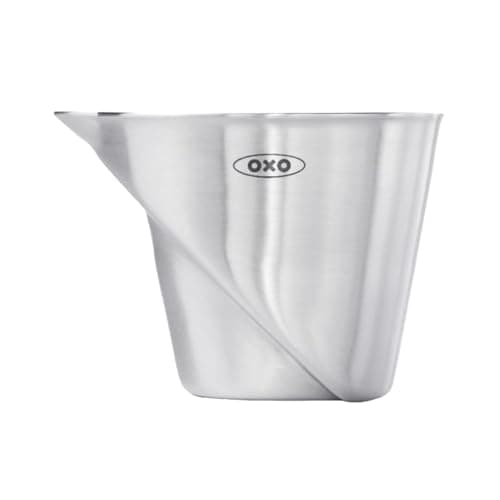
Where the markings are. Etched inside the cone means you read the level as you fill, which is the whole point. Printed on the outside wears off in a dishwasher. Implied by the cone's total volume means no markings at all. An angled interior scale, which OXO uses, lets you read it from above without bending down — a genuine ergonomic difference when the jigger is on a worktop rather than at eye level.
Rim and pour control. A straight, rolled or beaded rim breaks the liquid cleanly and pours into a shaker tin without running down the outside. A thin stamped rim dribbles. This is the difference between a dry bar top and a sticky one, and it is also why bar-supply brands cost more than generic stainless.
Capacity pair, against what you actually pour. The standard American spirit measure is 1.5 oz and the standard modern cocktail pour is 2 oz, so a 1 x 2 oz jigger covers most recipes and a 1 x 1.5 oz jigger covers the other ones. A 0.5 x 1 oz jigger is a second tool for modifiers, not a first jigger. We say which pair each one gives you.
We have not poured through these on a bar shift. The ranking is built from published capacities and graduation counts, stated materials and steel grades, rim and handle design, published dimensions where the maker gives them, and owner-review consensus reported as other people's experience — see how we pick. Prices are pulled live from Amazon with the date we checked them.
The three shapes, and what each one is for
Japanese (double-cone) is two tall narrow cones joined base to base. Tall and narrow means the liquid level moves a long way for a small change in volume, which makes interior graduations readable and accurate. It is what most bartenders use, it pours cleanly, and it is the shape to buy unless you have a reason not to.
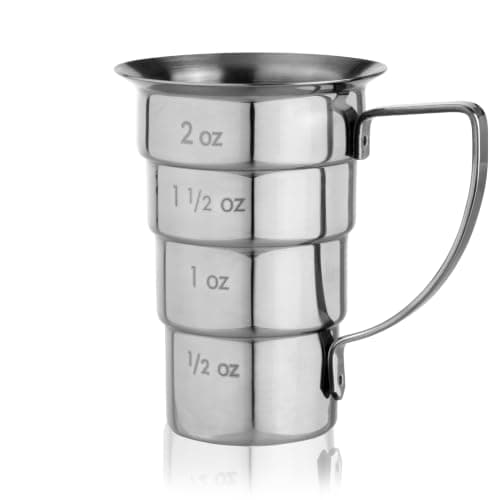
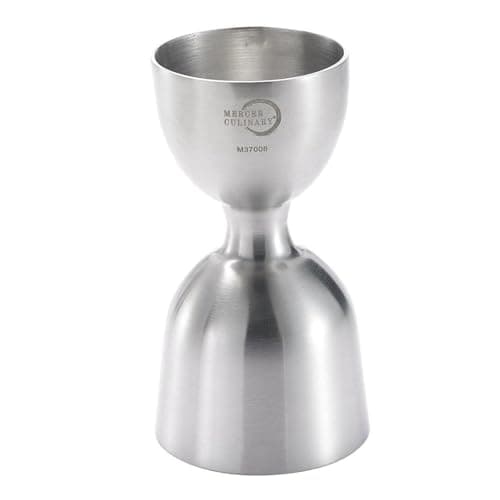
Bell (American) is squatter and wider, with a flared rim. It is more stable on a worktop and harder to knock over, but the wider bowl means the level barely moves between measures, so interior markings are less precise. Stepped jiggers are a single cup with internal steps at set volumes and usually a handle — the easiest shape for a complete beginner to read, and the hardest to pour from accurately because you cannot see the level while tilting.
The short answer
In a hurry? These are the picks we'd buy. Prices are live; tap a card below for the full reasoning.
$15.9920% offPrice as of November 22, 2026·#addisclosure
2
Best markings
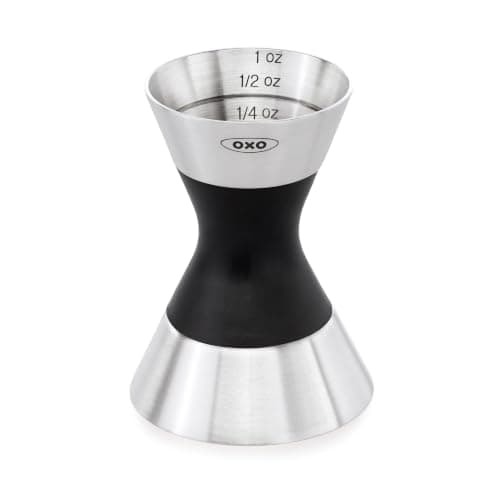
OXO Steel Angled Jigger (2 oz)
A 2 oz jigger with an angled interior scale you read from directly above — the most useful ergonomic idea in the category, from the brand that usually has it.
Measuring on a worktop without bending down to eye level
A 2 oz jigger with an angled interior scale you read from directly above — the most useful ergonomic idea in the category, from the brand that usually has it.
Shape
Single cup, angled interior scale
Capacity
2 oz (published)
Markings
Interior, readable from above
Material
Steel
Pros
Reading the measure from above is a real improvement — you stop crouching to check a level
The angled scale is OXO's own idea carried over from their measuring cups, and it works
A single 2 oz cup covers the common pours without flipping the tool over
Steel construction and OXO's usual finish quality at a mid-range price
Cons
One cup rather than two cones, so the maximum is 2 oz and there is no larger measure
The angled scale is less precise at the very bottom of the cup, where a quarter-ounce sits
Sold as a bulk/no-box listing, so it arrives without packaging — fine, but not a gift
Wider mouth than a Japanese cone means slightly less clean pours into a narrow tin
Best for: Measuring on a worktop without bending down to eye level.
American Metalcraft JG1 Japanese-Style Jigger (1/2 oz / 1 oz)
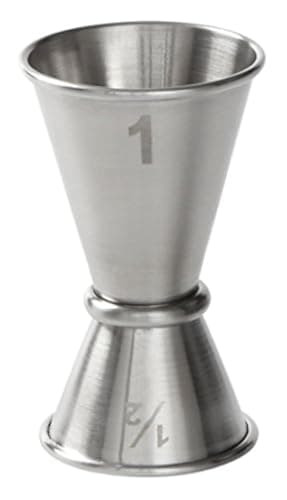
A small 1/2 x 1 oz Japanese jigger with published dimensions, for the modifier measures a big jigger cannot do accurately.
Shape
Japanese double cone
Capacities
1/2 oz / 1 oz (published)
Dimensions
1.75 in diameter x 2.75 in high (published)
Material
Stainless steel
Pros
The cheapest tool here, and the one that fixes the biggest gap in a plain 1 x 2 oz jigger
Publishes its actual dimensions, which almost nothing in this category does
Small cones mean the level moves a long way per quarter-ounce — genuinely accurate at low volumes
American Metalcraft is a foodservice supplier, so this is trade kit rather than a consumer item
Cons
Maxes out at 1 oz — it cannot be your only jigger
No interior markings, so 3/4 oz still has to be judged by eye
Light and small, which means it is the first thing lost in a drawer
Plain utilitarian finish with no gift appeal at all
Best for: Syrups, liqueurs and citrus, alongside a 1 x 2 oz as the main tool.
Skip this
The budget traps that look cheap and cost you twice. We'd skip these.
Plastic jiggers and shot glasses with printed lines
The printing comes off, and once it does the tool is a cup of unknown volume. Plastic also holds citrus oil and smell in a way steel does not. There is no price argument either — the cheapest steel jigger on this page costs about as much as a plastic one.
Jiggers in milliliters only, for US recipes
Almost every American cocktail recipe is written in ounces and fractions of ounces. A 30/60 ml jigger is close enough to 1 and 2 oz to pass, but a 25/50 ml one — common on imported tools — is 15% short on the big measure, which is enough to unbalance a drink. Check the unit before you buy.
Nine-piece jigger sets
You get nine lightweight jiggers in sizes you will never use and no single good one. Buy one accurate jigger with interior markings, or buy a 1 x 2 oz plus a 1/2 x 1 oz, and you have covered every recipe for less money.
Measuring by the shot glass you already own
A shot glass is not a defined volume — they run from 1 oz to 2 oz with no marking and a thick base that hides where the liquid actually sits. If you are going to the trouble of following a recipe, the tool that enforces it costs under ten dollars.
Why a quarter-ounce matters
A classic sour is 2 oz spirit, 0.75 oz citrus and 0.75 oz syrup. Free-pour the spirit and you are realistically within about a quarter-ounce either way, which is 12% of the biggest ingredient in the glass. Do the same on the citrus and the syrup and the errors can either cancel out or stack up, and when they stack the drink is noticeably wrong — thin and sharp, or flat and sweet. Nobody tastes the quarter-ounce. Everybody tastes the drink.
This is the entire argument for the tool, and it is why we rank the number of measurable amounts first. A jigger that only does 1 oz and 2 oz handles the spirit and nothing else, so the 0.75 oz measures that actually carry the balance get estimated anyway. A jigger with interior graduations fixes that with one tool. It is the cheapest accuracy you can buy for a home bar.
What capacities you actually need
Three numbers cover almost everything: 2 oz for the base spirit in a modern recipe, 1.5 oz for the older American standard pour, and 0.75 oz for citrus and syrup. A 1 oz measure is useful for splitting a base between two spirits, and 0.5 oz covers liqueurs and amaro. If a jigger can give you 2, 1.5, 1, 0.75 and 0.5 oz, it is the only one you need.
The practical consequence: a plain unmarked 1 x 2 oz jigger — which is what most people buy and what comes in most bar tool sets — covers two of those five. That is why our top pick is the one with ten graduations, and why the cheapest sensible alternative is a 1 x 2 oz plus the small 1/2 x 1 oz as a second tool. Both routes end up at the same place; one of them costs about six dollars more.
How to use a jigger without making a mess
Fill it to the brim, not to a line, when the cone is the measure — an unmarked Japanese jigger is calibrated to its rim, so a cone filled nine-tenths of the way is short by more than you would guess, because the cone is widest at the top. That single mistake is the most common reason a measured drink still comes out weak.
Hold the jigger over the shaker tin or mixing glass, not over the bar, so a spill lands in the drink rather than on the wood.
Fill to the rim for an unmarked cone, or to the etched line for a graduated one, and stop pouring before you move the tool.
Tip it in one decisive motion. Hesitating halfway is what leaves liquid running down the outside.
Pour the expensive ingredient first when you are learning, so the one you overshoot is the cheap one.
Rinse it between a syrup and a spirit. Residual simple syrup in the cone sweetens the next measure and is invisible.
A bottle pour spout makes all of this easier, because it turns a wide glug into a controllable stream, and a rubber bar mat under the jigger catches what does escape. Neither is essential. Both cost less than a bottle of gin.
Where the jigger sits in a bar tool kit
The jigger is one of four tools that actually matter, and the other three are a shaker, a strainer and a bar spoon. Our cocktail shaker roundup covers the first — the short version is that Boston tins never seize shut and cobbler shakers sometimes do — and the bar tool set page covers buying all four together, which is usually cheaper and usually means a worse jigger. If you buy a set, this page is the upgrade you make first.
Worth knowing before you buy a set: the jigger is the component manufacturers cut costs on, because it is the one buyers do not inspect. A set with a good shaker and a thin unmarked jigger is a common and slightly annoying outcome. Buying the set and then spending ten dollars on a graduated jigger is a perfectly sensible plan, and it is what we would do.
The other half of a measured drink is the ice
Measuring the pour accurately and then shaking it over small, wet freezer ice undoes the work, because dilution is an ingredient too. A drink shaken on cloudy half-melted cubes picks up noticeably more water than the same drink on dense clear ice, and the ratio you just measured moves. Our ice ball mold and clear ice tray roundup covers the cheap freezer route, and the clear ice makers cover the machines.
The same logic applies to what you pour the finished drink into: a 2 oz pour reads completely differently in a 12 oz highball than in a 17 oz cooler, because the glass decides how much mixer goes on top. The jigger controls the spirit; the glass controls the ratio.
Our verdict
Buy the A Bar Above Japanese-style jigger. Ten interior graduations in a heavy double cone means one tool measures every amount a recipe asks for, which is the whole job. Buy the KITESSENSU instead if you want interior markings for the least money, the OXO angled jigger if reading the level from above appeals more than extra graduations, and the Barfly 1 x 2 plus the American Metalcraft 1/2 x 1 if you would rather have two cheap accurate cones than one clever one. Buy the bell jigger for the pour and the longevity, knowing you are giving up every marking to get them.
What a stirred drink needs besides the jigger
The jigger sets the ratio; the vessel sets the dilution. For an all-spirit drink that means a mixing glass rather than a tin, because the point of glass is that you can watch the frost climb and judge when the drink is cold rather than guessing at a stir count. Our mixing glass roundup ranks eight, including the 12-inch bar spoon and the julep strainer that finish the set for the price of a cocktail.
Frequently asked questions
What is a jigger and how big is one?+
A small two-ended steel measure for spirits. There is no single size: the common pairs are 1 oz / 2 oz, 1 oz / 1.5 oz and 0.5 oz / 1 oz. The word is sometimes used to mean 1.5 fluid ounces specifically, which is the standard American spirit pour, but as a tool a jigger is whatever its two cones hold — always read the published capacities.
What size jigger should I buy first?+
A 1 oz / 2 oz with interior markings. Two ounces is the base-spirit pour in most modern recipes, one ounce handles a split base, and the interior graduations cover the 0.75 oz citrus and syrup measures that actually carry the balance. Without markings you only get two of the five amounts a recipe needs.
Do you fill a jigger to the top or to a line?+
To the rim, if the cone itself is the measure. An unmarked Japanese jigger is calibrated to its brim, and because the cone is widest at the top a jigger filled nine-tenths of the way is short by much more than a tenth. If the jigger has etched interior lines, fill to the line you want instead.
Japanese or bell jigger — which is better?+
Japanese for accuracy, bell for durability and pour. The tall narrow cones of a Japanese jigger move the liquid level a long way per quarter-ounce, which is what makes interior markings worth reading. A bell is squatter, far harder to knock over and has the cleanest rim, but the wide bowl makes levels hard to judge.
Are jiggers with interior markings worth the extra money?+
Yes, and it is the one upgrade in this category that changes drinks. A plain jigger gives you two volumes; a graduated one gives you four to ten from the same tool, which covers the 0.75 oz and 0.5 oz measures that modifiers need. The alternative is buying a second small jigger, which costs about the same.
Is a shot glass good enough instead of a jigger?+
No. Shot glasses are not a standardized volume — they run anywhere from 1 to 2 ounces, they rarely carry a marking, and a thick base hides where the liquid actually sits. If you are following a recipe at all, the tool that enforces it costs under ten dollars.
Should I buy a jigger on its own or in a bar tool set?+
A set is usually cheaper, and the jigger is the part manufacturers economize on because buyers do not inspect it. Buying a set for the shaker, strainer and spoon and then adding a good graduated jigger is a reasonable plan, and it is what we would do.
Does a jigger need to be dishwasher safe?+
It helps, but it is not the deciding factor — a jigger that only held spirit and citrus rinses clean in seconds under a hot tap. What does matter is avoiding jiggers with printed exterior markings, because those come off in a dishwasher and leave you with a cup of unknown volume. Etched interior graduations do not.
Prices and availability shown here come from Amazon's live data and change often; we re-verify them regularly. Bar Bumper is an Amazon Associate and earns a commission on qualifying purchases at no extra cost to you. Read our full disclosure.