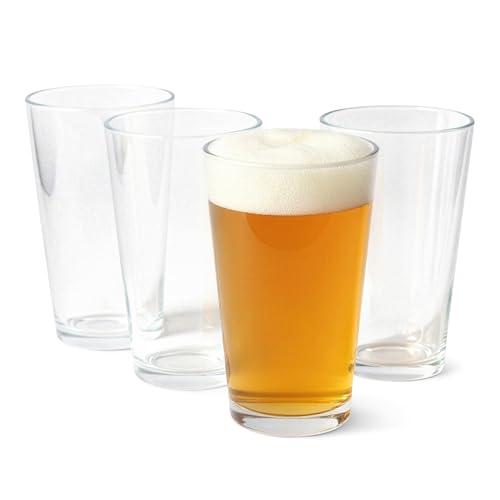
Shape changes head retention and aroma; capacity decides whether a 12 oz bottle looks generous or mean. Nine picks compared on published capacity, glass style and how many beers each one actually suits.
Beer glass shape is not decoration, and it is also not magic. Three things change measurably with shape: how long the head survives, how much aroma reaches your nose, and how much beer you are actually pouring. A pilsner glass is tall, slender and tapered, and its broad top helps maintain a head. A tulip is bulbous with a flared lip, which also helps head retention, and it is the recommended shape for Scottish ales, double and imperial IPAs, barley wines and Belgian ales. A weizen glass is narrow at the bottom and wide at the top, which releases aroma and leaves room for the enormous foam a wheat beer throws.
And the capacity question is the one nobody warns you about. A US pint is 16 US fl oz, about 473 ml. A British imperial pint is 568 ml — a fifth larger, fixed by law. If you buy nonic pints because they look like the pub, a 16 oz bottle fills them two-thirds of the way. If you buy 16 oz American pints, a 500 ml bottle overflows them. Pick the capacity around what you drink, not around the picture.
How we judged these
Four criteria, in this order. The first two decide whether the glass suits the beer; the last two decide whether you keep it.
Published capacity against the bottle or can you actually buy. A 12 oz can wants a 14 to 16 oz glass, so there is room for a head. A 16 oz can or a US pint of draft wants 20 oz. A 500 ml European bottle wants 20 oz and really wants the 25 oz that a weizen glass gives you. We quote the published capacity on every pick and say which pour it fits.
Shape, and how many beers it covers. A straight conical pint will serve anything badly-to-adequately. A tulip, a weizen and a stout glass each serve a narrow band of beers properly. The right answer for most homes is one versatile shape in quantity, plus one or two specific shapes for whatever you drink most - and that is how this list is ordered.
Rim, base and wall thickness. A nonic bulge a couple of inches below the rim improves grip, stops glasses sticking together when stacked and resists rim chips, which is why pubs have used the shape for decades. A thin rim pours more cleanly and chips sooner. A thick base survives a dishwasher rack. We say which each pick has where the listing states it.
Set size and what it costs to replace one. Beer glasses break. A set of six from a maker that sells the same model year after year is a glass you can replace; a one-off novelty set is a set you eventually throw away because you are down to two. Every pick here is a current, repeatable model.
We have not run a blind tasting across these glasses, and anyone who tells you a 16 oz glass makes a beer objectively taste better than another 16 oz glass of the same shape is guessing. The ranking is built from published capacities, stated materials (lead-free crystal, soda-lime glass), the shape the maker names, the maker's standing, and owner-review consensus reported as other people's experience — see how we pick. Prices come live from Amazon with the date we verified them.
The shapes, and the beer each one is for
Conical or "shaker" pint: a straight taper, about six inches tall, narrowing roughly an inch over its height. It stacks, it is cheap, it washes easily, and it holds a head poorly because there is nothing to support the foam. It is the default American beer glass and the right choice when you want four glasses rather than a collection.
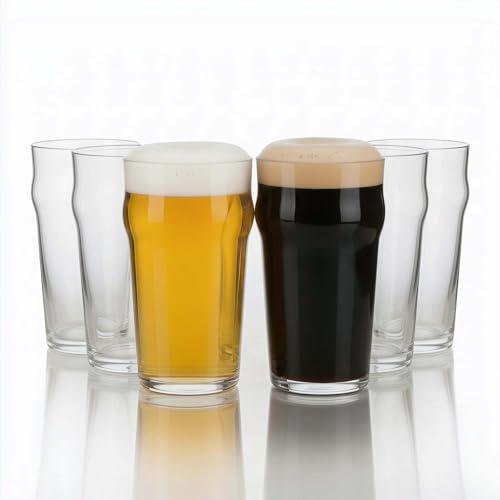
Nonic pint: the same taper with a bulge a couple of inches below the rim. The bulge is functional - better grip, no sticking when stacked, and the rim survives being knocked about. This is the British pub glass, and at 20 oz it is sized for an imperial pint.
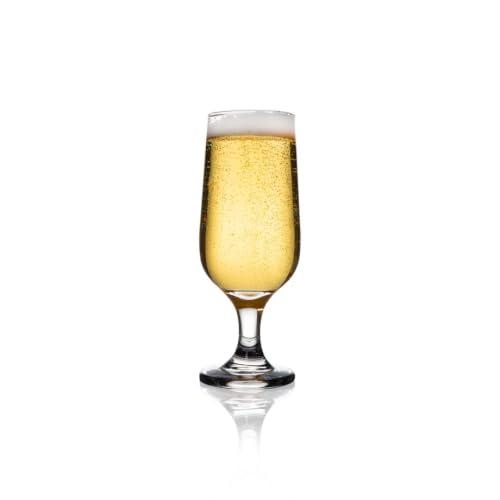
Pilsner: tall, slender, tapered, sold in 200 to 400 ml sizes in most markets and 500 ml in much of Europe. The slender body shows color and carbonation and the broad top helps keep a head on a beer that does not naturally hold one. Right for pilsner, Kolsch, helles and most pale lagers, and it works well enough for a hazy IPA.
Tulip: bulbous like a snifter with a flared lip, which both traps aroma and supports a head. The recommended shape for Scottish ales, double and imperial IPAs, barley wines and Belgian ales - in other words, for beer strong enough that you want a smaller pour.
Weizen: narrow at the base, wide at the top, usually about 500 ml. The flare releases aroma and gives the huge head of a hefeweizen somewhere to go. There is no substitute for this one if wheat beer is what you drink.
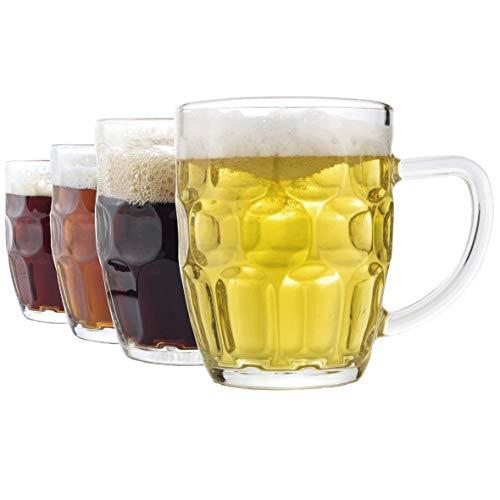
Dimpled mug or stein: a grid of thickened glass with a handle. The dimples help the glass stay in a wet hand during washing, and the handle keeps your palm off the beer. German steins carry fill lines at 0.4, 0.5 and 1 liter; the one-liter Masskrug is the Oktoberfest glass. Head retention is poor and nobody who buys one cares.
Goblet and chalice: large stemmed bowls for heavy Belgian ales and bocks. Goblets are thick-walled, chalices thin-walled, and some chalices are etched on the base to nucleate bubbles and keep a head alive. Lovely, specific, and not where to start.
The short answer
In a hurry? These are the picks we'd buy. Prices are live; tap a card below for the full reasoning.
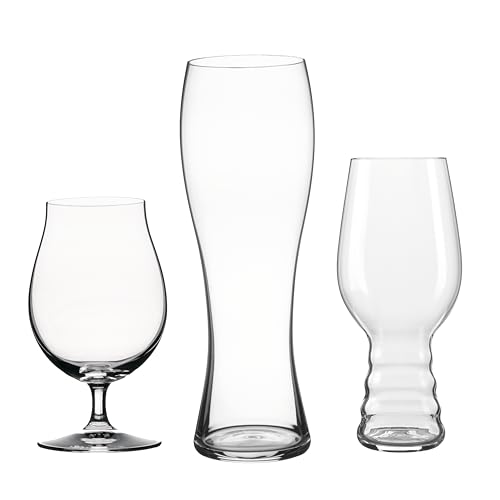
Three German-made crystal glasses, one each for IPA, Belgian ale and wheat beer - the shapes that actually change the beer, from a maker that does this for a living.
Three German-made crystal glasses, one each for IPA, Belgian ale and wheat beer - the shapes that actually change the beer, from a maker that does this for a living.
Quantity
Set of 3
Styles
IPA, Belgian ale, wheat (published)
Material
German-made crystal (published)
Brand
Spiegelau
Pros
Three shapes that each serve a genuinely different beer, rather than three sizes of the same taper
Spiegelau is a German crystal house and its beer range was developed with brewers - this is the serious end of the category
Crystal walls are thinner than soda-lime glass, which is why the rim feels better and the aroma reads more clearly
A wheat glass is included, and there is no substitute for that shape if you drink hefeweizen
Cons
Three glasses means two people and one spare; this is a tasting set, not a party set
Stock read "only 16 left, more on the way" when we checked, so it is not reliably on the shelf
Crystal is thinner and chips more easily than the pub glasses here, and it wants a gentler dishwasher cycle
No capacity published for the individual glasses, so you are trusting the shape rather than sizing a pour
Best for: Someone who buys three different beers at a time.
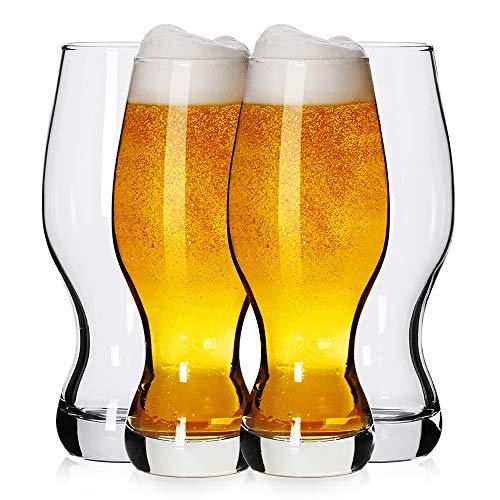
Four 16 oz thick-walled conical pints - the American shaker pint, honestly priced and with nothing to say for itself beyond that.
Capacity
16 oz (published)
Quantity
Set of 4
Style
Conical / shaker pint
Dishwasher
Safe (published)
Pros
16 oz is a US pint, so a 12 oz can pours with a proper head and a 16 oz can fills it to the rim
Thick clear glass, stackable and dishwasher safe - the glass you hand to someone standing on a patio
The cheapest set on this page by a clear margin, and the only one where breaking two is not annoying
A conical pint doubles as a water glass, a highball and a mixing vessel, which no other shape here does
Cons
A straight conical taper is the worst shape on this page for holding a head - there is nothing supporting the foam
No bulge, so wet glasses stick when stacked and the rim chips sooner than a nonic's
Thick walls warm the beer and mute aroma
Generic shape with no style-specific advantage at all; it serves everything equally adequately
Best for: Four glasses that hold a beer, for the least money.
Skip this
The budget traps that look cheap and cost you twice. We'd skip these.
Freezing your beer glasses
A frosted glass looks right and does two things to the beer. The frost melts into it, watering the first inch, and the ice crystals on the wall give dissolved carbon dioxide somewhere to come out of solution - the same nucleation effect that etched chalice bases use deliberately to build a head. The result is a beer that foams hard, goes flat faster and smells of less. Chill the beer, not the glass; if you want a cold glass, rinse it with cold water and pour.
Novelty glasses with a built-in freezer gel wall
Double-walled gel mugs keep a beer cold and are not dishwasher safe, cannot go anywhere near hot water, and have an opaque wall so you cannot see the beer. They are also a sealed plastic-and-gel assembly that eventually fails. A thick-walled stein with a handle does most of the same job and will outlive you.
A 24-piece mixed glassware bundle
The arithmetic looks great and the glasses inside are the thinnest the seller could source in the four most generic shapes. You will use six of them. Buy one honest set in the shape you drink most and add a specific glass or two - our <a href="/guides/what-glassware-do-you-need-for-a-home-bar">home bar glassware guide</a> works out the minimum set that actually covers a bar.
Branded brewery glasses as your main set
Nothing wrong with them - a Guinness glass is a decent tulip pint and a Duvel chalice is a genuinely good chalice. The problem is that they come one at a time, in whatever shape that brewery chose, so after two years you own eleven glasses and no matching four. Collect them on purpose; buy your working glasses as a set.
How many beer glasses does a home bar need?
Four of one versatile shape, plus two of whatever you drink most. That is six glasses and it covers everything short of a party. The versatile four should be a pint - 16 oz if you drink cans, 20 oz if you have a kegerator or buy imperial-sized bottles. The specific two depend entirely on your fridge: a tulip if you buy strong Belgian beer, a weizen if you drink hefeweizen, a stout glass if everything you buy is dark.
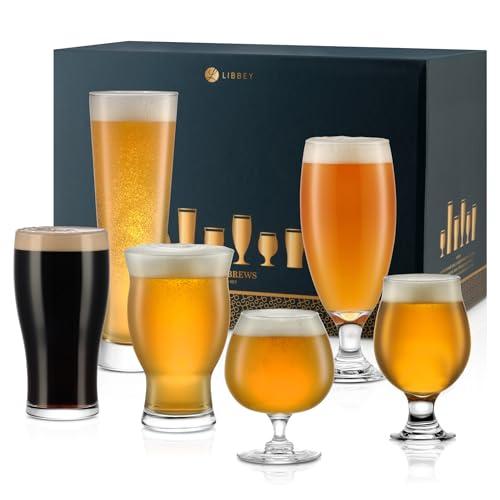
If you would rather make one decision than three, the assorted set of six is the shortcut, and it is why it is our top pick. The trade-off is that you own one or two of each shape rather than four matching glasses, which matters the moment four people want the same beer. For the rest of the glassware a bar needs - the rocks glasses, the stems, the highballs - our glassware guide lays out the whole set and the order to buy it in.
Does glass shape really change how beer tastes?
Partly, and in ways that are easy to overstate. What shape demonstrably changes is foam and aroma delivery. A broad top on a tall tapered glass helps hold a head; a flared lip on a bulbous tulip does the same; a weizen's flare gives a wheat beer's foam room and pushes its aroma up at you. Aroma is most of what we call flavor, so a glass that collects and directs volatiles does change the drinking experience. That is the same reason a snifter exists for brandy.
What shape does not do is improve a beer. A pilsner glass will not fix a stale IPA and a Riedel will not make a macro lager interesting. The honest hierarchy is: fresh beer, then correct temperature, then clean glass, then shape - and the gap between the first three and the fourth is large. If your beer is warm, a better glass is the wrong purchase; a beverage refrigerator or a kegerator is.
Beer-clean glass: the part that actually matters
A glass washed with ordinary dish detergent and dried with a cloth carries a film of fat and lint, and that film kills foam on contact. You can see it: pour a beer, and if bubbles cling to the inside wall in patches rather than rising cleanly, the glass is not clean. A "beer-clean" glass is washed without household detergent, rinsed hot, and left to air dry upside down on a rack - never towel-dried.
This is the single cheapest improvement available to anyone reading this page, and it is why "dishwasher safe" appears in the specs above. A dishwasher with a rinse-aid-free cycle, run without greasy plates in the same load, gets glasses closer to beer-clean than a sink and a towel ever will. Store them upright or on a rack with air underneath, not inverted on a wooden shelf where they trap damp.
Where beer glasses live in a home bar
Beer glasses are the biggest, heaviest and most numerous glasses a home bar owns, which makes storage the real constraint. Six 20 oz pints take more shelf than an entire cocktail glass collection. If your bar is a cart, that is most of a shelf gone - our guide to what to stock on a bar cart works out what actually fits. If it is a cabinet, the home bar cabinet roundup covers the units with real glass storage rather than a decorative rack.
Two practical notes. Keep beer glasses off the top shelf where they are at eye level and easy to knock, because they are the glasses you reach for with a full hand. And if you serve draft, keep the glasses near the tap and not near the oven - a warm glass undoes a cold keg. Our kegerator roundup covers the units, and the CO2 pressure guide covers the setting that decides how much head you get before the glass has any say in it.
Our verdict
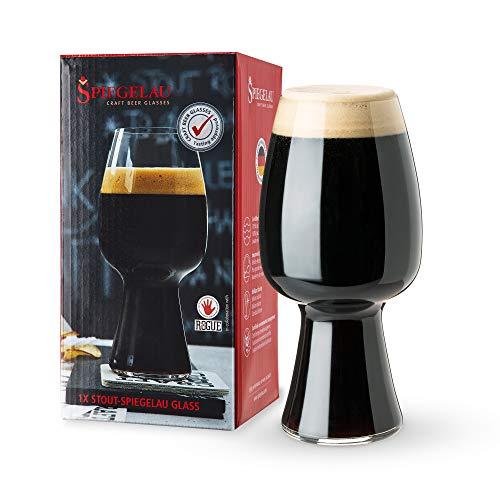
Buy the Libbey Craft Brews six-pack if you want one decision that covers several beers from a maker that keeps its models in production. Buy the Burns 20 oz nonics if you drink draft or imperial pints, and the LUXU 16 oz pilsner glasses if you drink pale beer from 12 oz cans. Add the 9 oz tulips for strong Belgian beer and the Spiegelau stout glass for anything dark - between them they cover every beer that genuinely wants its own shape. Buy the Riedel pair only if you drink attentively, the steins if you want a handle, and the Amazon Basics pints if you want four glasses and no opinions. Then wash whatever you buy without detergent and let it air dry, which will do more for the beer than the choice above it.
If the beer is being drunk in a game room
Beer glasses get used hardest in the room with the board and the table in it, which is also the room where they get knocked over. That argues for thick-walled pints and steins over thin crystal, and for storing them away from the throwing line. If you are kitting that room out, our steel tip darts roundup and our pool cues under $200 page cover the two pieces of gear that go with the glasses.
Frequently asked questions
What is the best all-round beer glass?+
A pint glass, in the capacity that matches what you drink. 16 oz is a US pint and the right size for 12 oz cans and bottles with room for a head. 20 oz matches a British imperial pint of 568 ml and is the right size for draft or 16 oz cans. A nonic pint adds a bulge below the rim that improves grip, stops glasses sticking when stacked and resists chips - which is why pubs have used it for decades.
Should you freeze beer glasses?+
No. Frost melts into the beer and waters the first inch, and the ice crystals on the glass wall give dissolved carbon dioxide somewhere to escape - the same nucleation effect that etched chalice bases use on purpose to raise a head. The beer foams hard, goes flat sooner and gives up less aroma. Chill the beer instead, and rinse the glass with cold water if you want it cool.
What glass should an IPA go in?+
A tall, slender, tapered pilsner-style glass for a standard IPA - the shape shows the carbonation and its broad top helps keep a head. For a double or imperial IPA, use a tulip: it is bulbous with a flared lip, which both traps aroma and supports foam, and it is the shape recommended for the stronger end of the style. The smaller pour a tulip gives you is also appropriate for a beer at 8% and up.
How big is a pint glass?+
It depends which side of the Atlantic the glass came from. A US pint is 16 US fl oz, about 473 ml. A British imperial pint is 568 ml, fixed by UK law, which is a fifth larger. American nonic glasses are often sold at 20 oz so an imperial pour fits with a head. A 500 ml European bottle will not fit a 16 oz glass in one pour.
Why does beer go flat faster in some glasses?+
Two reasons. Shape: a wide mouth and a straight wall give foam nothing to hold onto, while a flared lip or a narrowing top supports it. And cleanliness: any film of fat or lint left by dish detergent or a drying towel kills a head on contact. A glass that looks clean and still produces a flat beer is almost always a detergent film, not the glass's shape.
Do you need a different glass for every beer style?+
No. Four of one good pint shape covers most of what you drink, and two style-specific glasses cover the rest. The shapes genuinely worth owning separately are a weizen for wheat beer, which has no substitute, and a tulip for strong Belgian ales and imperial IPAs. A stout glass is nice and a tulip will stand in for it. Everything beyond that is collecting, not drinking.
Is crystal better than regular glass for beer?+
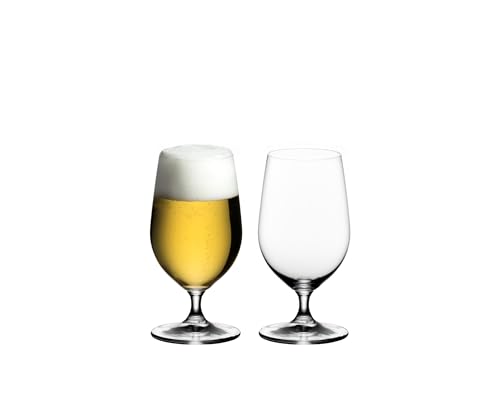
The walls and rim are thinner, which genuinely feels better and lets aroma read a little more clearly. Crystal also chips more easily, costs several times as much per glass and wants gentler washing. For a party set, soda-lime glass is the right answer. For two glasses you drink attentively from, crystal is worth it - which is the split between the Libbey set and the Riedel pair on this page.
What is a beer-clean glass?+
A glass with no residue at all on the inside wall - no dish detergent film, no lint from a towel, no mineral haze. The test is to pour a beer and watch: bubbles clinging to the wall in patches mean residue. Wash without household detergent, rinse hot, and air dry upside down on a rack rather than towel-drying. It is the cheapest improvement you can make to a beer, and it beats upgrading the glass.
Prices and availability shown here come from Amazon's live data and change often; we re-verify them regularly. Bar Bumper is an Amazon Associate and earns a commission on qualifying purchases at no extra cost to you. Read our full disclosure.