Set the fridge first, then the regulator, then balance it with line length. A domestic lager at 2.6 volumes of CO2 and 38 degrees needs about 14 psi, and 3/16-inch line eats 3 psi per foot.
Updated October 2026 · By Stephen V.
Set the kegerator to 36 to 38°F, then set the regulator to the pressure that keg's carbonation level needs at that temperature — for a typical American lager at 2.6 volumes of CO2 and 38°F, that is about 14 psi at sea level. Then make the beer line long enough to resist that pressure: 3/16-inch vinyl line costs about 3 psi per foot, so roughly 4 to 5 feet balances a 12 to 15 psi system.
Almost every kegerator problem is one of those three numbers being wrong, and they have to be set in that order, because pressure follows temperature. Beer holds more dissolved CO2 when it is colder, so the pressure needed to keep a given carbonation level in solution changes with the fridge setting. Set the regulator first and then change the temperature and you have undone the regulator.
The third number is the one nobody is told about, and it causes most of the foam. The pressure pushing the beer out has to be spent on the way to the faucet, or the beer arrives at the tap still under pressure, the dissolved CO2 comes out of solution as it hits the air, and you get a glass of foam. Beer line is what spends it. A balanced system is one where the resistance of the line plus the vertical rise is about equal to the applied pressure, which at that point gives a controlled pour of roughly a gallon a minute.
Everything below is those numbers worked through, plus a diagnostic order for foaming and flat beer. The kegerators in the picks are the ones we would buy to run this setup; prices come live from Amazon with the date we checked them.
The short answer
In a hurry? These are the picks we'd buy. Prices are live; tap a card below for the full reasoning.
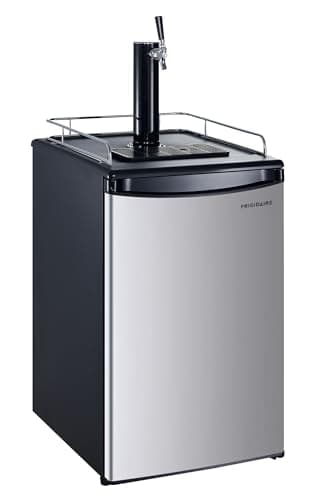
Frigidaire 5.3 cu ft Kegerator with Coupler and Tower Tap
A 5.3 cu ft kegerator supplied with a coupler and tower tap — the least fiddly way to start, from a brand people recognize.
Capacity
5.3 cu ft
Includes
Coupler, tower tap
Taps
1
Brand
Frigidaire
Pros
Coupler and tower included, so there is no parts list to assemble
A recognized appliance brand with a support path
5.3 cu ft handles a sixth-barrel or a quarter-barrel comfortably
Tower taps put the faucet at a comfortable pour height
Cons
A tower adds vertical rise, which adds about 0.5 psi per foot to the balance
Smaller than the full-size cabinets, so not every keg format fits
Supplied line is usually the minimum, not the balanced length
Best for: A first kegerator with the coupler and tower included.
Skip this
The budget traps that look cheap and cost you twice. We'd skip these.
Turning the pressure down to stop foaming
This is the universal first instinct and it is the wrong fix in most cases. Foam is usually a <em>balance</em> problem — too short a beer line for the pressure, or beer that is too warm — not an over-pressure problem. Drop the regulator below what the beer's carbonation level needs and you will get a few better pours, then flat, lifeless beer as CO2 comes out of solution over the following days. Fix the line length or the temperature and leave the pressure where the beer needs it.
Running a nitro stout on straight CO2
Nitrogen-poured stouts are served with a nitrogen/CO2 blend gas through a stout faucet with a restrictor plate, and the setup is not interchangeable with a standard CO2 draft system. Push straight CO2 into a nitro keg at the pressures that system needs and you over-carbonate the beer and lose the pour the beer was built for. If you want nitro, buy the blend gas and the stout faucet; otherwise pour a stout that is sold carbonated.
How to choose (and what to skip)
Step 1: set the temperature, and leave it
36 to 38 degrees Fahrenheit is the home target, and most commercial bars serve between 34 and 38. Set it, give the kegerator a full day to stabilize with the keg in it, and then do not touch it. Every pressure figure on this page is a function of this number, so a kegerator whose temperature wanders cannot be balanced at all. A unit with a digital thermostat is easier to hold steady than a dial.
Step 2: set the regulator to what the beer needs
The pressure is whatever maintains that beer's carbonation level at your temperature. Micromatic's figure for a domestic lager at 2.6 volumes of CO2 and 38 degrees is 14 PSIG at sea level, and most American ales and lagers sit in the same region — a practical home range of 10 to 14 psi covers the large majority of kegs. If a keg came from a brewery, its carbonation level is fixed and your job is to match it, not to choose it. If you carbonated it yourself, the pressure you used to carbonate is the pressure to serve at.
Step 3: balance it with line length, at 3 psi per foot
Vinyl beer line with a 3/16-inch inside diameter has about 3 psi of resistance per foot, and that is the figure that does the work. Add roughly 0.5 psi per foot of vertical rise from the keg to the faucet. For a balanced system you want line resistance plus rise to be close to the applied pressure: at 14 psi with a 2-foot rise, that is about 13 psi of line, or a little over 4 feet of 3/16-inch line. Most kegerators ship with about 5 feet, which is why a stock kegerator pours acceptably at 12 to 15 psi and foams at 20.
Why longer line is the cheap fix
Beer line is one of the least expensive parts of a draft system, and adding a foot or two is the first thing to try when a pour foams at the correct pressure and temperature. It does not reduce the carbonation of the beer — the keg stays at the same pressure — it just spends the pressure gradually along the line instead of all at once at the faucet. The only cost is a slightly slower pour, which is what a good pour looks like anyway.
Altitude and long runs change the numbers
The 14 psi figure is at sea level; at altitude the gauge reading needed for the same dissolved CO2 is lower, because gauge pressure is measured against a lower atmospheric pressure. And if the faucet is on a wall or in another room rather than on the cabinet, you are no longer running a direct-draw system — long runs need wider line, a glycol or air-cooled trunk, and a different balance calculation entirely.
Why pressure and temperature cannot be set separately
Carbonation in a keg is an equilibrium: CO2 moves between the gas at the top and the liquid below until the dissolved amount matches the pressure and temperature. Cold beer holds more CO2 at a given pressure, so if you chill the beer and leave the pressure alone, the beer absorbs more gas — it over-carbonates and then pours as foam. Warm it and leave the pressure alone and CO2 comes out of solution into the headspace — the beer goes flat and the keg pressure rises. This is why the only stable way to run a kegerator is to pick a temperature, hold it, and set the pressure to match. A kegerator that is opened constantly, or sits in a hot garage, fights you on both.
The balance calculation, worked
Set the fridge to 38°F and let it stabilize for 24 hours.
Take the beer's carbonation level. A typical American lager is around 2.6 volumes of CO2; at 38°F that needs about 14 psi at sea level.
Measure the vertical rise from the middle of the keg to the faucet. In a cabinet kegerator this is usually 1 to 2 feet; with a tower, 2 to 3.
Multiply the rise by 0.5 psi per foot. A 2-foot rise is 1 psi.
Subtract that from the applied pressure: 14 minus 1 is 13 psi that the line has to absorb.
Divide by 3 psi per foot for 3/16-inch vinyl line: about 4.3 feet. Round up rather than down — a slightly slow pour is better than a foamy one.
Fixing foam, in diagnostic order
Work through it in this order and stop when it is fixed. One: is the beer at 36 to 38°F, measured in a glass of beer rather than on the dial? Warm beer is the single most common cause and it foams no matter what the regulator says. Two: is the line long enough for the pressure, at 3 psi per foot? A 2-foot line at 14 psi cannot pour cleanly. Three: is the pressure above what the beer needs — 20 psi on a standard lager, say? Four: is the faucet opened fully and quickly, rather than cracked part way? A partly open faucet is a pressure drop and a foam generator. Five: are the lines dirty? Deposits create turbulence and nucleation sites; our kegerator cleaning guide covers that. Six: was the keg shaken or recently moved? Give it a day to settle in the cold.
Fixing flat beer
Flat beer is the rarer problem and has fewer causes. The common one is a regulator set too low — often because somebody turned it down to stop foaming — so CO2 leaves the beer over several days. The second is a leak: a loose keg coupler, a bad gas line clamp or a worn keg lid O-ring will bleed off pressure, and the symptom is a CO2 cylinder that empties far faster than expected alongside beer that keeps going flat. Shut the cylinder valve with the system pressurized and watch the gauge; if it falls, you have a leak, and soapy water on the fittings will find it. The third cause is soap residue in the line or on the glass, which destroys head retention even when the beer is properly carbonated.
One regulator, two kegs
If you run a dual-tap kegerator, a single regulator feeds both kegs at the same pressure, and that is fine as long as both beers want a similar carbonation level — most American lagers and ales do. It is not fine if one of them is a highly carbonated wheat beer or a low-carbonation English ale. The fix is a secondary regulator, which takes the single supply and lets you set each line independently. That is also the setup you want if you carbonate your own beer, because force-carbonating one keg at a high pressure while serving another at 12 psi is otherwise impossible.
Is this the hobby you want?
Worth saying plainly: a kegerator is the most maintenance-heavy appliance on a home bar. The pressure and temperature are a one-time setup and then stable, but the line cleaning is every two weeks and it is not optional. If that sounds like more than you want from a drinks fridge, our is a kegerator worth it page is honest about the whole commitment, and a beverage refrigerator full of bottles needs none of it.
Frequently asked questions
What PSI should a kegerator be set to?+
Set the temperature first — 36 to 38 degrees Fahrenheit — then set the regulator to whatever that beer's carbonation level needs at that temperature. For a domestic lager at 2.6 volumes of CO2 and 38 degrees, Micromatic's figure is about 14 PSIG at sea level, and a practical home range of 10 to 14 psi covers most commercial kegs.
How long should a kegerator beer line be?+
Long enough to resist the applied pressure. Vinyl line with a 3/16-inch inside diameter has about 3 psi of resistance per foot, plus about 0.5 psi per foot of vertical rise. At 14 psi with a 2-foot rise that is roughly 4 to 5 feet of line. Most kegerators ship with about 5 feet, which is why they pour acceptably at 12 to 15 psi.
Why is my kegerator beer so foamy?+
In order of likelihood: the beer is too warm, the line is too short for the pressure, the pressure is set above what the beer needs, the faucet is not being opened fully, the lines are dirty, or the keg was recently moved. Check the temperature in a glass of poured beer rather than on the dial — warm beer is the most common cause by a wide margin.
Should I turn the CO2 down to stop foam?+
Usually no. Foam is normally a balance problem rather than an over-pressure problem, and dropping the regulator below what the beer needs will give you a few good pours and then flat beer as CO2 leaves solution. Fix the temperature or add a foot or two of beer line instead, and leave the pressure where the beer wants it.
What temperature should a kegerator be?+
36 to 38 degrees Fahrenheit for a home setup; commercial bars generally serve between 34 and 38. Set it, let the kegerator stabilize for a day with the keg inside, and then leave it alone — every pressure figure depends on it, so a wandering temperature cannot be balanced.
Does a balanced draft system mean no foam?+
It means the pressure pushing the beer is spent along the line rather than released at the faucet, which is the condition for a controlled pour of roughly a gallon a minute. Balance eliminates the most common foam cause, but it will not rescue warm beer, a dirty line or a half-opened faucet.
Why does my beer keep going flat?+
Either the regulator is set too low — often because someone turned it down to fight foam — or there is a gas leak. Shut the CO2 cylinder valve with the system pressurized and watch the gauge; if it falls, soapy water on the fittings will find the leak. A CO2 tank that empties unusually fast is the other tell.
Can you run two kegs at different pressures?+
Only with a secondary regulator. A single regulator feeds both taps at the same pressure, which is fine when both beers want a similar carbonation level and wrong when one is a highly carbonated wheat beer or a low-carbonation ale. A secondary regulator is also what lets you force-carbonate one keg while serving another.
Prices and availability shown here come from Amazon's live data and change often; we re-verify them regularly. Bar Bumper is an Amazon Associate and earns a commission on qualifying purchases at no extra cost to you. Read our full disclosure.