Red wants 55 to 65 F, white 45 to 50, sparkling 40 to 45. The numbers, why stability beats precision, and what to do with an opened bottle.
Updated October 2026 · By Stephen V.
Set a red wine fridge to 55 to 65 F — around 60 F suits most reds, with lighter styles at the lower end and full-bodied reds at the upper. Whites and rosés want 45 to 50 F, and sparkling wine 40 to 45 F. For long-term storage of anything, 55 F is the single best number. If you keep both reds and whites in one cabinet, that is the case for a dual-zone fridge; if you only have one zone, set it to 55 and finish whites in the kitchen fridge for an hour before serving.
The important thing about those numbers is that they are bands, not targets. Stability matters more than precision. A cabinet held steadily at 58 F does wine far more good than one that swings between 52 and 64 trying to hit 55, because it is the repeated expansion and contraction that pushes air past the cork and ages wine prematurely. If you are choosing between a cooler that hits an exact number and one that holds a steady one, hold steady.
A note on why a kitchen refrigerator is the wrong place for wine: it runs around 37 to 40 F, which is too cold for every wine except sparkling at the moment of serving. Over months that cold dries corks, and the compressor vibration keeps the sediment unsettled. For a bottle you will open tonight it is harmless. For anything resting more than a couple of weeks it is the thing a wine fridge exists to fix.
The fridges below are the ones from our registry that hold these bands, placed after the sections that explain the numbers. We have not tested them; the ranking draws on published temperature ranges, zone configuration and capacity, plus owner-review consensus reported as other people's experience — see how we pick. Prices come live from Amazon with the date we verified them.
The short answer
In a hurry? These are the picks we'd buy. Prices are live; tap a card below for the full reasoning.
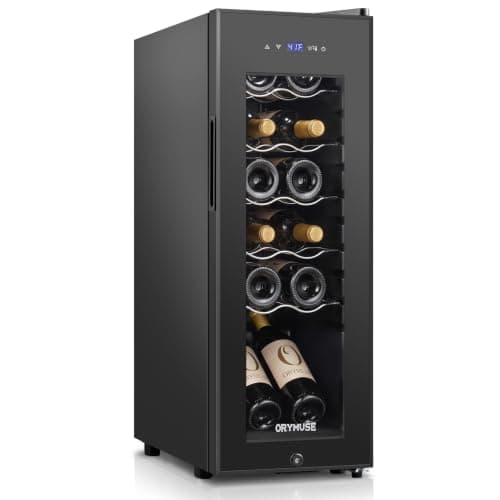
A compressor cooler with a 41 to 64 F range in 10.7 inches — set it to 55 and it is a proper small cellar.
Capacity
12 bottles
Range
41-64 F
Cooling
Compressor
Width
10.7 in
Pros
41 to 64 F covers every band on this page as a single setting
Compressor cooling holds its set point in any room
Narrow enough to fit where other coolers do not
Cons
Single zone, so one temperature for everything
Twelve bottles is one case
Compressor hum is audible in a quiet room
Best for: Holding everything at a steady 55 F in a small space.
How to choose (and what to skip)
Red wine: 55 to 65 F, and roughly 60 for most bottles
Served too warm, a red tastes of alcohol and the fruit goes flat; served too cold, the tannins harden and the aromatics shut down. Lighter reds — pinot noir, gamay, lighter Italian styles — are best around 55 to 58 F. Medium-bodied reds sit near 60. Full-bodied reds — cabernet, syrah, barolo — show best at 62 to 65. Note that all of those are below normal room temperature, which is why 'room temperature red' is a misnomer in a heated house.
White and rose: 45 to 50 F
Light, crisp whites — sauvignon blanc, pinot grigio, most roses — are best around 45 to 48 F. Fuller whites with oak, such as a richer chardonnay, open up nearer 50 to 54. Below about 42 F a white's aromatics largely disappear, which is why a bottle straight from a kitchen fridge often tastes of nothing for the first ten minutes in the glass.
Sparkling: 40 to 45 F
Colder than any still wine, both because the cold holds the bubble and because it keeps the pressure down when the cork comes out. Champagne and other traditional-method sparkling wines are often better nearer 45 F than 40 — cold enough to stay lively, warm enough to taste. Below 40 you are chilling the flavor out of it.
Long-term storage: 55 F and steady
For anything you are keeping rather than drinking, 55 F (about 12 to 13 C) is the classic cellar temperature and the single best compromise across all styles. Just as important: hold it steady, keep humidity moderate so corks do not dry out, keep bottles on their sides so the cork stays wet, and keep the cabinet out of direct light. Stability, darkness and a wet cork are the three things that actually preserve wine.
Dual zone: when it is worth the lost capacity
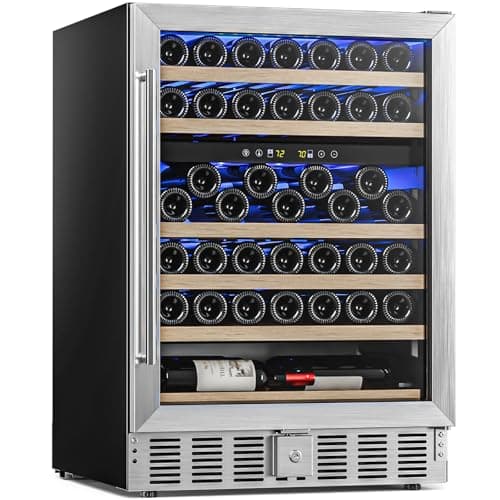
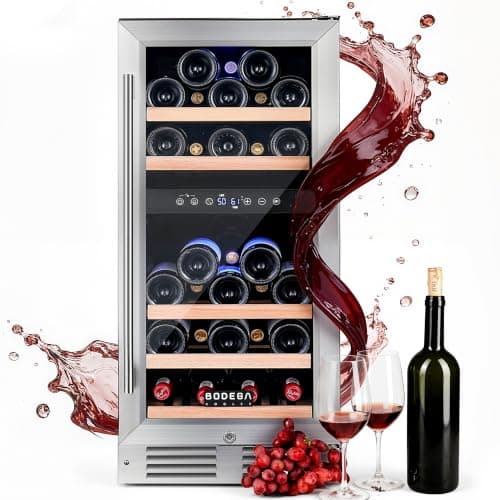
A dual-zone fridge splits the cabinet into two independently set compartments, typically a cold zone around 40 to 50 F and a cellar zone around 55 to 65. It is worth it if you genuinely keep both reds and whites and want both ready to serve. It is not worth it in a narrow 15-inch cabinet where two zones leave six bottles each, and it is not worth it if you mainly store rather than serve — for storage, a single zone at 55 F is correct for everything.
Red wine fridge temperature, in one table
Light reds: 55 to 58 F. Medium reds: 58 to 62 F. Full-bodied reds: 62 to 65 F. Long-term storage of any red: 55 F. If you want a single setting for a red-only cabinet, use 58 to 60 — it is within serving range for almost everything and close enough to cellar temperature to store well.
Two practical notes. A bottle taken out of a 58 F cabinet warms a degree or two in the glass within minutes, so erring slightly cool is better than erring warm. And "room temperature" is not a serving instruction in a modern heated house — a living room at 72 F serves red noticeably too warm, which flattens the fruit and pushes the alcohol forward.
Red wine fridge after opening: how long does it keep?
An opened red keeps about three to five days re-corked and kept cold, and the cold is the part people get wrong. Oxidation is what spoils it, and the reaction slows markedly at lower temperatures — so an opened red belongs back in the wine fridge at its storage temperature, or even in the kitchen fridge, rather than standing on the counter. Take it out twenty minutes before the next glass.
Lighter reds fade fastest; full-bodied, tannic reds hold longest. Fortified wines keep for weeks. If you regularly open a bottle and do not finish it, a vacuum stopper or an inert-gas spray extends the window by a few days, and both are cheaper than the wine they save.
Why stability matters more than the exact number
Every time a cabinet's temperature swings, the wine and the air in the bottle expand and contract, and that movement works air past the cork. Repeated over months, it ages the wine faster than a steady temperature a few degrees off ideal would. This is also the real argument against storing wine in a kitchen, a garage or anywhere else with a daily temperature cycle, and the real argument for a thermoelectric cooler only where the room itself stays cool.
Do you need a dual-zone wine fridge?
Only if you want reds and whites both at serving temperature in the same cabinet. For storage, you do not: 55 F is correct for everything, and a single zone gives you more usable bottle space for the same cabinet width. The honest test is how you drink. If you open whatever is open and serve it straight from the cabinet, dual zone is genuinely useful. If you plan ahead by an hour, a single zone at 55 plus a short spell in the kitchen fridge does the same job for less money and more capacity. Our undercounter wine fridge page has the dual-zone built-ins and the small wine fridge page the compact single zones.
Humidity, light and bottle orientation
Three things besides temperature. Humidity around 50 to 70 percent keeps corks from drying; most wine coolers manage this adequately without a humidity control. Light degrades wine, particularly sparkling and light whites, which is why wine fridge doors are tinted and why the cabinet should not face a window. Orientation: store bottles on their sides so the wine keeps the cork wet. A dried cork lets air in, and that is the failure that ruins a bottle you were saving.
Setting up a new wine fridge
Let it stand upright for a few hours before switching on if it has been transported on its side, set your temperature and leave it empty for a day to confirm it holds, then load it. Give a freestanding unit a few inches of air behind and above, keep it away from an oven or a radiator, and check in a week that the display and a separate thermometer agree — cheap coolers are sometimes a few degrees out, and knowing the offset is worth more than trusting the panel.
A beverage fridge is not a wine fridge
A beverage cooler runs around 38 to 50 F with can-spaced upright shelves, which is too cold for red wine and the wrong orientation for cork. It is fine for a bottle of white you are about to open. For anything resting, the appliance you want is a wine cooler — our wine fridge vs beverage fridge comparison goes through the differences in full.
If the fridge cannot hold the temperature
Setting a target is only useful if the unit can reach it. Thermoelectric coolers — the quiet, cheap kind — only pull about 20°F below the room they sit in, so in a warm kitchen in August they simply cannot get to 55°F. Our cheap wine fridge roundup explains that limit and which budget units use a compressor instead.
Frequently asked questions
What temperature should a red wine fridge be?+
55 to 65 F, with around 58 to 60 as the best single setting for a red-only cabinet. Lighter reds show best at 55 to 58, medium-bodied around 60, and full-bodied reds at 62 to 65. All of those are below normal room temperature in a heated house, which is why 'room temperature red' usually means serving it too warm.
What is the best wine fridge temperature overall?+
55 F (about 12 to 13 C) for storage of anything — it is the classic cellar temperature and the right compromise across every style. For serving, whites and roses want 45 to 50, sparkling 40 to 45, and reds 55 to 65. Holding your chosen temperature steady matters more than hitting an exact figure.
How long does red wine keep in the fridge after opening?+
Three to five days re-corked and kept cold. Cold slows oxidation, so an opened red belongs back in the wine fridge — or even the kitchen fridge — rather than on the counter, and should come out twenty minutes before the next glass. Lighter reds fade fastest; tannic, full-bodied reds hold longest.
Can you store red wine in a regular fridge?+
For a few days, yes, and it is the right place for an opened bottle. For long-term storage, no: a kitchen fridge runs 37 to 40 F, which is too cold for red, it dries corks over months, and compressor vibration keeps sediment unsettled. That combination is exactly what a wine fridge is designed to avoid.
Do I need a dual-zone wine fridge?+
Only if you want reds and whites both ready to serve from the same cabinet. For storage a single zone at 55 F is correct for everything and gives you more bottle space for the same width. In a narrow 15-inch cabinet, two zones leave very few bottles in each, so single zone is usually the better choice there.
Should wine bottles be stored on their side?+
Yes, for anything with a natural cork — lying down keeps the wine against the cork so it stays wet, and a dried cork lets air in. Screw-cap bottles can be stored either way. Keep the cabinet out of direct light and hold humidity around 50 to 70 percent, which most wine coolers manage without a dedicated control.
Prices and availability shown here come from Amazon's live data and change often; we re-verify them regularly. Bar Bumper is an Amazon Associate and earns a commission on qualifying purchases at no extra cost to you. Read our full disclosure.