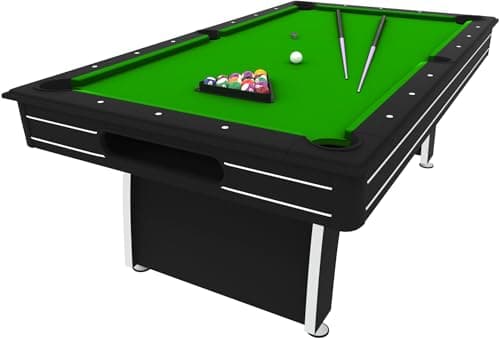
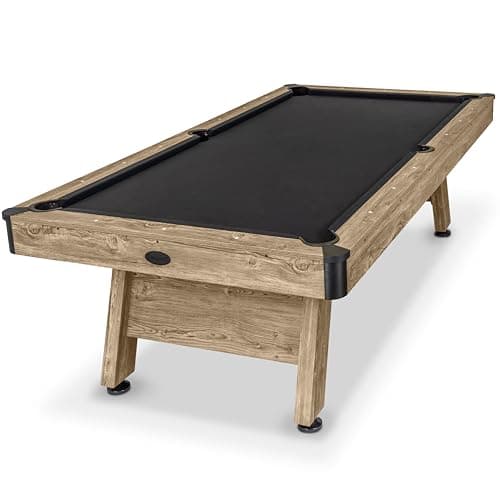
Two different games on two different tables, and only one of them fits in a normal house. The size comparison, the pocket difference, and a straight verdict.
Updated October 2026 · By Stephen V.
For a home game room, buy a pool table. A full-size snooker table is 12 by 6 feet and needs a room roughly 22 by 16 feet to play properly — it is a club table, not a house table. A 7-foot pool table needs about 17 by 13 feet and fits in a normal basement or garage, which is why the Fat Cat Tucson 7-foot and the rest of our pool table picks are the realistic answer for almost everyone asking this question.
The short version of the difference between pool tables and snooker tables: snooker is played on a much larger table, with smaller balls, into rounded pockets that are tighter relative to the ball, over far longer distances. It is a more demanding game with a higher skill ceiling and a much bigger space requirement. Pool — eight-ball and nine-ball, played on what the trade calls an American table — uses bigger balls, straight-cut pockets with more generous openings, and tables from 7 to 9 feet.
A note on the words, because the search terms blur them. "Pool table vs billiards table" is usually the same question: in American usage "billiards" is a loose umbrella for pool, and a "billiard table" sold in the US is a pool table. In British usage "billiards" means English billiards, played on a snooker table. If a listing says billiards and quotes 7, 8 or 9 feet, it is a pool table.
We have not played on these tables. The comparison below uses published table dimensions and the governing bodies' standard specifications for each game, plus the real listings in our registry for the pool side — see how we pick. Full-size snooker tables are sold through specialist dealers rather than on Amazon, so there is no price here to quote for one; the pool prices come live with the date we verified them.
The short answer
In a hurry? These are the picks we'd buy. Prices are live; tap a card below for the full reasoning.
$999.9920% offPrice as of October 13, 2026·#addisclosure
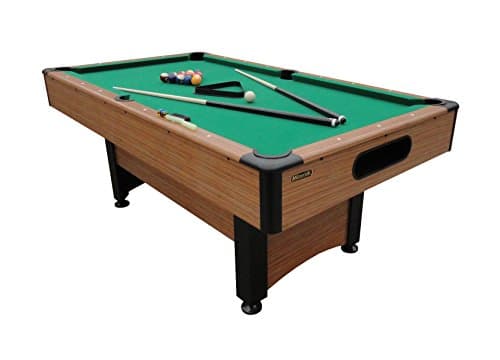
Mizerak Dynasty Space Saver 6.5 ft Billiard Table
A 6.5-foot table built for a room that will not take a 7-footer — the honest answer when the size comparison says no to both.
Size
6.5 ft
Game
Pool
Design
Space-saver frame
Room needed
~16 x 12 ft with 57-in cues
Pros
The smallest size that still plays a credible game of pool
Fits rooms where 7-foot tables leave no cue draw on one side
Cheapest route into a real cue sport
Cons
Short rails change how the game plays
Not a long-term table for anyone who gets good
Still needs about 16 by 12 feet
Best for: A room that cannot give up 17 by 13 feet.
Skip this
The budget traps that look cheap and cost you twice. We'd skip these.
Buying a full-size snooker table for a domestic room
A 12 by 6-foot snooker table needs about 22 by 16 feet of floor for a full cue draw on every shot, and the slate bed runs to several hundred pounds in multiple pieces that need professional installation and leveling. Almost no house has the room or the floor loading. If you want to play snooker at home, a 9-foot pool table with tighter pockets or a dedicated smaller snooker table is the realistic route.
Assuming a pool table can be converted to snooker
It cannot, in any way that plays properly. Snooker needs the larger bed, rounded pocket profiles and the smaller 2-1/16-inch balls. You can buy snooker balls and play on a pool table, and people do, but the pockets are the wrong shape and the dimensions are wrong, so the game that results is neither pool nor snooker.
How to choose (and what to skip)
Size comparison: the numbers that decide it
A full-size snooker table is 12 ft by 6 ft (playing surface roughly 11 ft 8.5 in by 5 ft 10 in). Home pool tables are 7, 8 or 9 ft, where the figure is the long side and the playing surface is roughly that by half. Add about 5 feet of clearance on every side for a 57-inch cue: snooker needs around 22 by 16 ft, a 7-ft pool table around 17 by 13 ft, an 8-ft around 18 by 14 ft. That single calculation settles the question for most rooms.
Pockets: the difference you feel first
Snooker pockets have rounded, radiused jaws and the opening is tight relative to the 2-1/16-inch ball — a ball near the cushion can be effectively unpottable. Pool pockets are cut with straight jaws and a wider opening relative to the 2-1/4-inch ball. This is why pool is the more forgiving game to learn and snooker is the more punishing one to master, and it is a bigger practical difference than the table size.
Balls and cues are not interchangeable
Snooker uses 2-1/16-inch balls (21 of them plus a cue ball) and cues with tips around 9 to 10 mm. Pool uses 2-1/4-inch balls (15 plus a cue ball) and tips around 12 to 13 mm. Snooker cues are also typically a little longer. None of it crosses over properly, so budget for the right set for whichever table you buy.
Slate versus MDF matters more than the game you choose
Every real snooker table has a slate bed, which is part of why they are club furniture. Home pool tables come both ways: MDF beds are lighter, cheaper and will never play dead flat; slate plays true and needs a floor that can carry it. If you care about how the table rolls in year five, the bed material is the spec to spend on — more than the extra foot of length.
What to buy if you want snooker specifically
Either a 9-foot pool table fitted with tighter pockets, or a smaller purpose-built snooker table (6 ft and 7 ft models exist) from a specialist dealer. Those are not Amazon products, so check the price with the dealer rather than trusting a number online. What does not work is trying to make a 7-foot MDF pool table behave like a snooker table.
Pool table vs snooker table size comparison
This is the whole argument, so here it is plainly. Snooker is standardized at 12 by 6 feet. Pool tables sold for homes are 7, 8 or 9 feet on the long side. A snooker table is therefore not slightly bigger than a pool table — it is half again the length of the common 8-foot home pool table and covers roughly twice the floor once you add cue clearance. A room that comfortably holds an 8-foot pool table will not hold a snooker table at all.
The second number people miss is the drop. A snooker table's slate bed weighs several hundred pounds in multiple sections, and it has to be installed and leveled in the room by people who do that for a living. A 7-foot MDF pool table is a weekend assembly job for two people. For a house, that difference is as decisive as the dimensions.
Pool table vs snooker table pockets
Look at the jaws. Snooker pockets are rounded, with radiused shoulders, and the aperture is tight for the 2-1/16-inch ball — a ball sitting on the cushion can be unpottable from most angles, which is the basis of snooker's safety play. Pool pockets have straight-cut jaws and a wider mouth relative to the larger 2-1/4-inch ball, so the same shot drops. This is why beginners sink balls on a pool table within minutes and can play a full frame of snooker without potting much at all.
Which game is actually better?
Snooker has the higher ceiling. Longer tables, tighter pockets and 21 object balls make for a deeper game with more positional nuance, and it stays interesting for decades. Pool is faster, far more accessible, and much better suited to a room with other people and drinks in it — a frame of eight-ball takes minutes, a frame of snooker can take the better part of an hour. For a home bar or game room, that difference in pace matters more than the depth does.
If the appeal of snooker is the long potting rather than the format, a 9-foot pool table gets you most of the way there in a room that can take it, and it will still host a quick game when guests arrive.
What about bumper pool?
Worth knowing about if neither of these fits. A 54-inch bumper pool table needs about 11 by 11 feet because it uses 48-inch cues, which is roughly a third of the floor a snooker table wants, and it is a real game rather than a toy. Our bumper pool vs pool comparison covers that trade in full, and the bumper pool roundup has the tables.
Measure before you choose
Tape out the floor. Mark the table footprint, then add 5 feet on every side for a 57-inch cue, or 4 feet 9 inches if you are prepared to keep a short cue for the tight side. If what is left fits inside your walls, buy that table. If it does not, drop a size — a smaller table you can play every shot on beats a bigger one you cannot. Our guide to how much space a pool table needs has the figures for every size, and the high-quality pool table guide covers what to spend on once the size is settled.
Frequently asked questions
What is the difference between a pool table and a snooker table?+
Size, pockets and balls. A snooker table is 12 by 6 feet with rounded, tight pockets and 2-1/16-inch balls; home pool tables are 7 to 9 feet with straight-cut, wider pockets and 2-1/4-inch balls. Snooker is the larger, more demanding game; pool is the one that fits in a house and can be learned in an evening.
Is a snooker table bigger than a pool table?+
Considerably. A full-size snooker table is 12 by 6 feet against 7, 8 or 9 feet for a home pool table, and with cue clearance added it needs roughly 22 by 16 feet of floor versus about 17 by 13 for a 7-foot pool table. That is close to twice the room.
Can you play pool on a snooker table?+
You can set up pool balls on one, but it plays badly: the table is far longer than pool is designed for and the pockets are cut for smaller balls, so pool's 2-1/4-inch balls sit awkwardly in the jaws. The games are designed around their own tables and neither converts cleanly to the other.
Is a billiards table the same as a pool table?+
In American usage, effectively yes — a billiard table sold in the US at 7, 8 or 9 feet is a pool table. In British usage, billiards means English billiards, which is played on a snooker table. If a listing quotes a size in the 7-to-9-foot range, treat it as a pool table.
Which should I buy for a home game room?+
A pool table, almost certainly. A 7-foot table fits a typical basement or garage with full cue clearance, costs a fraction of a snooker table, assembles without a professional installer, and suits the short games a room with guests in it actually plays. Buy a snooker table only if you have a dedicated 22 by 16-foot room and a floor that can carry a slate bed.
Are snooker and pool cues the same?+
No. Snooker cues have narrower tips (around 9 to 10 mm) for the smaller ball and are often slightly longer; pool cues run around 12 to 13 mm. Using a pool cue for snooker makes fine positional play harder, and using a snooker cue for pool risks miscues on the bigger ball.
Prices and availability shown here come from Amazon's live data and change often; we re-verify them regularly. Bar Bumper is an Amazon Associate and earns a commission on qualifying purchases at no extra cost to you. Read our full disclosure.