Written for a room that cue clearance rules out, not a room that the table rules out. Five options for apartments, small basements and tight dens, sized honestly.
Updated October 2026 · By Stephen V.
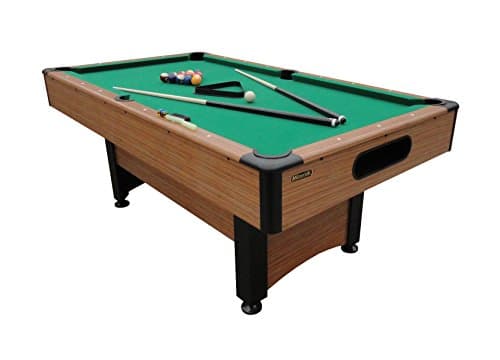
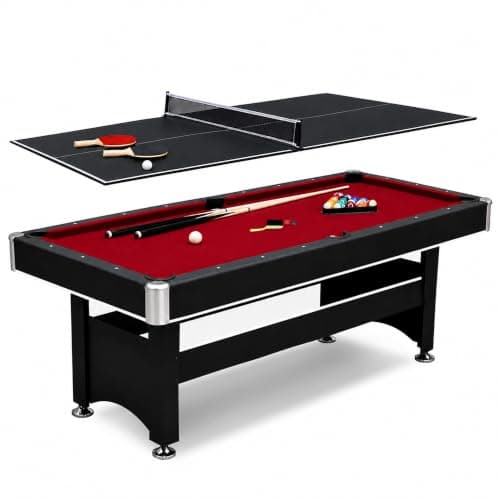
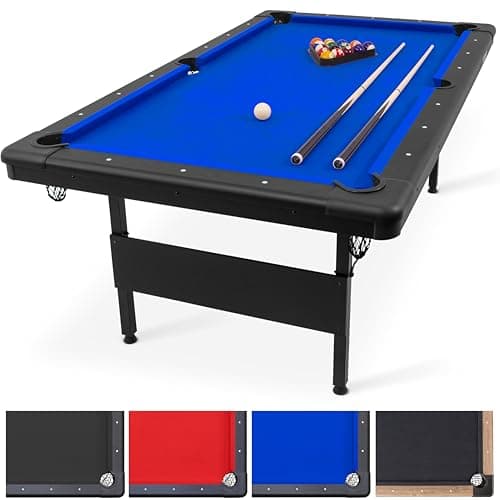
For a small room the Mizerak Dynasty Space Saver is the pool table to buy: at 6.5 feet it is the shortest table here that still plays like pool, and it is built for a room that cannot give up a dedicated 13 by 16-foot footprint. If you have a little more width, the Hathaway Spartan 7-foot is the better table; the Fat Cat Tucson is the 7-foot pick with a folding option; the GoSports portable table is the apartment answer; and a bumper pool table is the honest recommendation when the room is genuinely too small for pool at all.
The thing nobody tells apartment buyers: the table is never the problem. Cue clearance is. A standard cue is 58 inches long, and you need roughly that much space between the table edge and the wall to make a normal shot. So the room a pool table needs is the table plus about five feet on every side.
In numbers, with a 58-inch cue: a 7-foot table (roughly 78 by 39 inches of play) wants about 16 by 13 feet of room. A 6.5-foot space-saver table wants closer to 15 by 12 feet. An 8-foot table wants about 17 by 14 feet. If your room is under about 12 feet in its shorter dimension, no full pool table will play properly in it — and that is the point at which a shorter cue, a portable table or bumper pool becomes the right answer rather than a compromise.
We have not played on these tables. The ranking is built from published playing dimensions, bed construction, frame type and folding method, plus owner-review consensus reported as other people's experience — see how we pick. Prices come live from Amazon with the date we verified them.
The short answer
In a hurry? These are the picks we'd buy. Prices are live; tap a card below for the full reasoning.
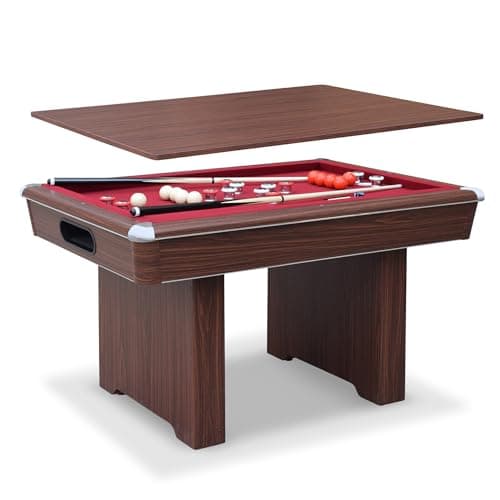
Hathaway Renegade II 54-in Bumper Pool Table (3-in-1)
A 54-inch bumper pool table with a reversible top — the game designed from the start for a room pool cannot fit, and the better buy below 12 feet.
Size
54 in
Game
Bumper pool, 3-in-1
Room needed
~11 x 9 ft
Brand
Hathaway
Pros
Designed for a small room rather than squeezed into one
Short cues are standard, so clearance stops being the issue
Reversible top adds other games in the same floor space
Plays properly in rooms where a pool table cannot
Cons
It is bumper pool, not pool — a different game with no pockets to run
Serious pool players will not be satisfied by it
The 3-in-1 top is a compromise on all three games
Best for: A room under about 12 feet wide.
Skip this
The budget traps that look cheap and cost you twice. We'd skip these.
Measuring for the table instead of the cue
A 7-foot table is about 6 feet 6 inches long, so a 9 by 7-foot room looks like it fits. It does not. A 58-inch cue needs roughly 5 feet of swing room off every rail, which turns a 7-foot table into a 16 by 13-foot room requirement. Mark the table footprint on the floor with tape, then stand at each rail with a broom handle. That five-minute test prevents the most expensive mistake in this category.
Assuming short cues solve a room that is far too small
A 48-inch cue buys back about 10 inches of clearance per side, which genuinely rescues a borderline room. What it cannot do is rescue a room that is 3 feet short — you will be playing one-handed and jacked up on half your shots, which stops being fun quickly. Below about 12 feet of width, a bumper pool table or a portable table gives you more actual playing than a cramped full table does.
How to choose (and what to skip)
Do the tape test before you choose a size
Mark the playing footprint of the table you are considering on the floor with masking tape, then walk around it with a broom handle held as a cue. You will know within a minute whether the room works, and you will discover the one corner the doorway ruins. This is the single most useful thing you can do before buying, and it costs nothing.
Work out your clearance from the cue you will use
The room requirement is table length plus twice your cue length, give or take. With a 58-inch cue that is about 5 feet per side; with a 48-inch cue it is about 4 feet 2 inches. Short cues are a legitimate solution in a tight room and most small-table buyers end up with a pair for the awkward side.
Then decide between 6.5 ft and 7 ft honestly
7 feet is the standard home size, which means cloth, covers and accessories are cheap and easy to source and the table holds its value. 6.5 feet and below is a specialty size. If your room can carry 7 feet, take it. If it cannot, a 6.5-foot space saver is a much better answer than a 7-foot table you cannot shoot on. Our guide to <a href="/guides/how-much-space-do-you-need-for-a-pool-table">how much space a pool table needs</a> has the full table of sizes.
Check the route in, not just the room
A 7-foot table arrives as a frame, a bed and rails, and the bed is the awkward piece — heavy, rigid and wider than some basement stairwells. Measure the narrowest point on the delivery route, including the turn at the bottom of the stairs. Portable and folding tables are the obvious answer when the route is the binding constraint rather than the room.
Decide what the room does when you are not playing
A fixed table in a multi-purpose room ends up covered in laundry, and a table that has to be set up each time ends up unused. Be honest about which failure mode you would rather have. A cover turns a fixed table into a usable surface, which is often the better compromise than folding.
Can you fit a pool table in an apartment?
A permanent one, rarely. Most apartment living rooms are under 13 feet in their shorter dimension once furniture is accounted for, and that is the measurement a 7-foot table needs. There are three honest routes. A portable table that comes out for the evening and packs away. A bumper pool table, which is designed around a small footprint and uses short cues as standard. Or short cues on a 6.5-foot table, if your room is borderline rather than genuinely small. What does not work is a full-size table bought on the table's dimensions and discovered to be unplayable after assembly.
The weight problem in an upstairs room
A slate-bed pool table is extremely heavy — the bed alone can run several hundred pounds on a 7-foot table, concentrated over a small area. On a ground floor or a basement slab, that is a non-issue. In an upstairs apartment or over a finished basement ceiling, it is worth thinking about, and it is one of the reasons portable and non-slate tables exist. If the table is going above ground level, a lighter non-slate bed or a portable table is the safer choice, and you lose less than you would think at these smaller sizes.
What a smaller table actually costs you
Positional play, mostly. On an 8 or 9-foot table, getting the cue ball to the right place for the next shot is most of the game. On a 6.5 or 7-foot table everything is closer, so more shots are makeable from where the ball happens to stop, and the game becomes more about potting than planning. That makes small tables more fun for casual players and less interesting for anyone improving. You also lose some of the roll: shorter tables in this price bracket often use thinner beds, which show their seams sooner than a full slate bed does. Our guide to what makes a high quality pool table covers which of those specs are worth paying for.
Bumper pool: the small-room game
If your room is under about 12 feet wide, bumper pool deserves a serious look rather than a consolation glance. It is a real cue game on a 54-inch table, it uses short cues by design, and the pegs make it tactically interesting in a way that a cramped pool table is not. A lot of people who buy a bumper pool table for a small den end up playing more than they would have on a pool table they had to apologize for. The bumper pool versus pool comparison lays out the difference, and what size bumper pool table you need has the room math.
A note on 6-foot tables
Below 6.5 feet, the pockets and ball size on most tables stop being proportional to a standard set of balls, and the game starts to feel cramped rather than compact. A 6-foot table is a fine family purchase and a poor pool purchase. If the choice is between a 6-foot table and a bumper pool table for the same money and footprint, the bumper pool table is almost always the better game — it was designed for that size instead of reduced to it.
Frequently asked questions
What size pool table fits in a small room?+
A 7-foot table needs about 16 by 13 feet of room with a standard 58-inch cue; a 6.5-foot space-saver table needs about 15 by 12 feet. Below roughly 12 feet of width, no full pool table will play properly — at that point a portable table, short cues, or a bumper pool table are the options that actually work.
Can you put a pool table in an apartment?+
A permanent full-size one, usually not — most apartment rooms are under the 13 feet of width a 7-foot table needs for cue clearance. A portable table that packs away, or a 54-inch bumper pool table built for short cues, are the two routes that genuinely work in an apartment. Weight is also worth considering above ground level.
How much clearance do you need around a pool table?+
About the length of your cue on every side — roughly 5 feet with a standard 58-inch cue, or about 4 feet 2 inches with a 48-inch short cue. This is the measurement that decides whether a room works, and it is why a table that physically fits a room can still be unplayable in it.
Do short cues really help in a small room?+
Yes, for a borderline room. A 48-inch cue buys back roughly 10 inches of clearance per side, which is often exactly the difference between awkward and fine. It will not rescue a room that is several feet too small, and most small-table owners keep a pair of short cues just for the tight side of the table.
Is a smaller pool table worth buying?+
For casual and family play, yes. A 6.5 or 7-foot table keeps everything within reach, so more shots are makeable and games move faster. What you lose is positional play, which is the part of pool that gets interesting as you improve — so a small table is a great first table and a limiting long-term one.
What is the best alternative to a pool table in a small space?+
A bumper pool table. It plays on a 54-inch table in roughly 11 by 9 feet of room, uses short cues as standard, and was designed for small rooms rather than shrunk to fit one. For a room under about 12 feet wide it will get played far more than a cramped pool table would.
Prices and availability shown here come from Amazon's live data and change often; we re-verify them regularly. Bar Bumper is an Amazon Associate and earns a commission on qualifying purchases at no extra cost to you. Read our full disclosure.