A cue is the only piece of a pool room you hold, and the cheapest one worth owning beats every warped house cue on the wall. Eight compared on published weight, tip diameter, joint and shaft material.
Updated November 2026 · By Stephen V.
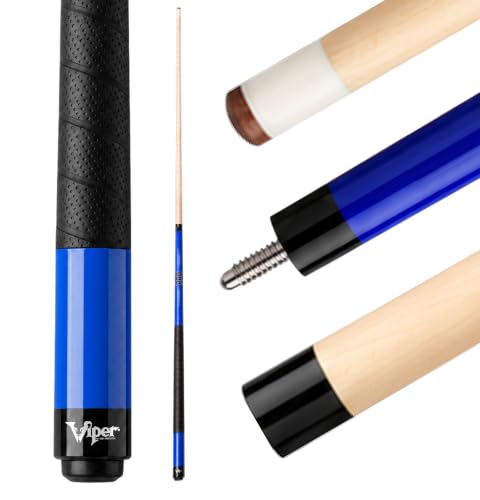
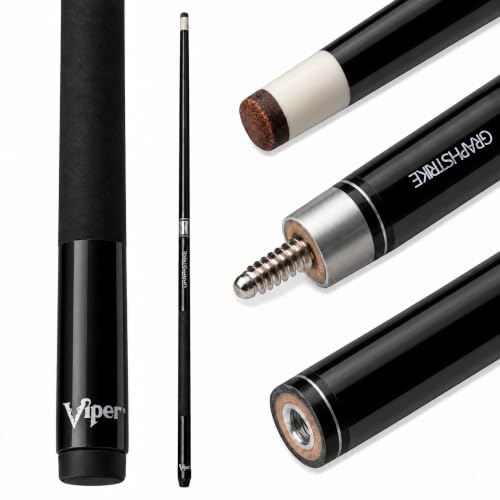
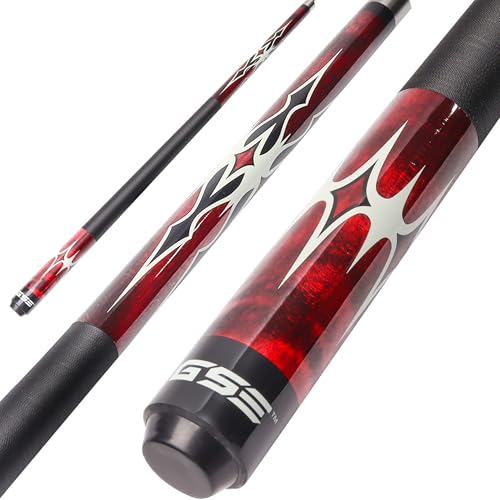
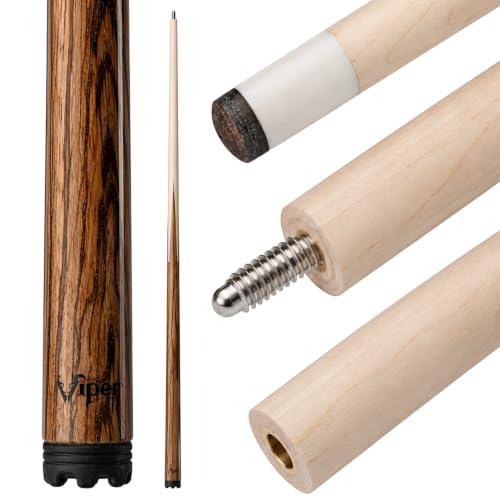
Buy the Viper Revolution Sure Grip Pro at 19 oz. Nineteen ounces is the most common pool cue weight and the one professionals average, 58 inches is the standard length, and Viper is the brand that sells more cues at this price than anyone. If you want an American-made cue with a real warranty behind the shaft, the McDermott Lucky L9 is the step up and arrives with a case. If you need four cues so nobody has to wait, the GSE four-cue set is the cheapest honest way to kit out a table, and the Viper Graphstrike is the budget pick that will never warp.
The cue is the one piece of a pool room you actually hold, and it is the piece most people never replace. A table bought with "cues included" almost always comes with two uniform-taper one-piece sticks of unspecified weight, and after a damp winter in a basement at least one of them has a bow you can see by rolling it on the slate. A cue that is not straight makes you aim off-center without knowing it, which is a far bigger handicap than any difference between the cues on this page.
The good news is that this is a cheap problem to fix. A perfectly serviceable two-piece maple cue costs about as much as a round of drinks, and the step up to a cue with an American maker's name and a warranty on the shaft costs about as much as a cheap dartboard. Nothing here needs to be a lifetime purchase to be worth making.
How we judged these
Four criteria, in this order. The first two are published on every listing and decide whether the cue suits you; the last two decide whether it stays straight and whether it is pleasant to use.
Weight, against what you play. Pool cues are commonly sold between 17 and 21 oz, and 19 oz is the most common weight — it is also roughly where professionals average. A heavier cue moves the cue ball with less effort and suits a breaking stroke; a lighter cue is easier to accelerate and easier to control on soft shots. We give the published weight for every pick, and say which ones are sold in a choice of weights.
Length and tip diameter. Pool cues average about 58 to 59 inches and tips run roughly 12 to 14 mm. A smaller tip puts spin on the ball more readily and is less forgiving of a sloppy hit; a larger tip is the safer first cue. Length only becomes a decision in a tight room, where a 48-inch short cue is the answer rather than a different 58-inch cue — we cover that below.
Shaft material, because it decides whether the cue stays straight. Hard maple is the traditional and still the best-feeling material, and it is also the one that moves with humidity. Fiberglass or graphite over a wood core is noticeably less lively but close to immune to warping, which in an unheated basement or garage room is the more important property. We say which each pick is.
Joint and ferrule, because that is where a cheap cue gives itself away. A steel pin and collar in a 3/8-10 or 5/16x18 joint screws together flat and stays tight; a plastic-collared joint develops a hinge you can feel. We quote the joint spec where the listing publishes it and say where it does not.
We have not played a season with each of these cues. The ranking is built from published weights, lengths, tip diameters, joint specs and stated shaft materials, the maker's standing in the category, warranty terms where a maker publishes them, and owner-review consensus reported as other people's experience — see how we pick. Prices are pulled live from Amazon with the date we checked them.
Maple, fiberglass or composite: the choice that actually matters
Hard maple is what most quality cues are made of, usually with a fiberglass or phenolic ferrule and steel joint collars. It transmits the hit better than anything else at this price and it is the material every serious player chooses. It is also wood: it responds to the humidity of the room it lives in, and a maple cue stored flat under a damp basement sofa for two years will not be straight when you find it.
Fiberglass and graphite over a wood core trade some of that feel for stability. The sensation at the tip is slightly deadened and experienced players notice it immediately, but the cue does not care that the room went from 40% to 80% humidity in June. If the table is in a garage, a basement without climate control or a vacation house that sits empty, this is the sensible material and it is also the cheapest.
Carbon fiber shafts are the current high end and are genuinely low-deflection, but they start well above anything on this page and they are not the first upgrade a home player needs. If the cue you own is straight and the tip is in good condition, the next thing that improves your game is the cloth and the lighting, not the shaft. Our pool table felt roundup and pool table light roundup cover both.
The short answer
In a hurry? These are the picks we'd buy. Prices are live; tap a card below for the full reasoning.
$99.985% offPrice as of November 22, 2026·#addisclosure
Quick picks
#
Product
Best for
Score
Price
1
Best overall
Viper Revolution Sure Grip Pro 58-in Pool Cue (19 oz)
A 58-inch two-piece at the 19 oz weight most players settle on, from the brand that dominates this price band - the default answer unless you have a reason to spend more.
A first real cue for a home table, at the standard weight
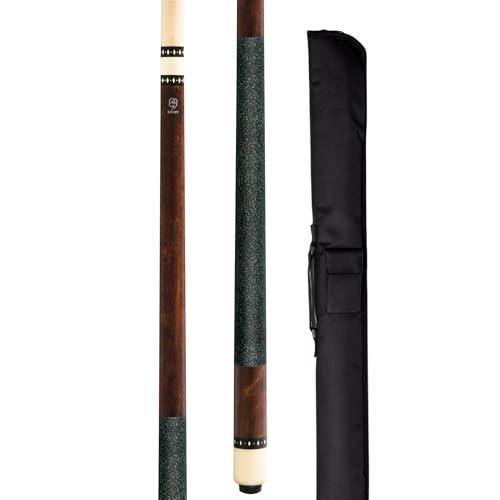
McDermott's entry series, built in Wisconsin and sold with a soft case - the cheapest route to a cue from a maker whose name means something in a pool hall.
Somebody who plays weekly and wants an American maker behind the shaft
Viper Revolution Sure Grip Pro 58-in Pool Cue (19 oz)
A 58-inch two-piece at the 19 oz weight most players settle on, from the brand that dominates this price band - the default answer unless you have a reason to spend more.
Length
58 in (published)
Weight
19 oz (published)
Type
Two-piece
Series
Viper Revolution Sure Grip Pro
Pros
19 oz is the most common pool cue weight and roughly the professional average - a safe choice you will not grow out of
Viper (GLD Products) is the highest-volume cue brand in this price band, which means spare tips and ferrules are easy to find
Two-piece construction, so it travels and stores upright in a rack instead of lying flat and bowing
Sold in several weights and colors on the same listing, so you can match a second cue to it
Cons
The listing does not publish the tip diameter or the joint spec, so you are buying on the brand rather than the numbers
The grip section is the model's selling point but the listing does not state the wrap material
Mid-price cues like this come with a factory tip that most players replace within a year of regular play
At this price the shaft is bulk-manufactured maple, not a graded or matched blank
Best for: A first real cue for a home table, at the standard weight.
McDermott's entry series, built in Wisconsin and sold with a soft case - the cheapest route to a cue from a maker whose name means something in a pool hall.
Series
McDermott Lucky L9
Weight
Sold in a weight choice (21 oz listed)
Included
1x1 soft case
Maker
McDermott Cue, US
Pros
McDermott is a long-established American cue maker, and the Lucky series is its deliberately affordable line
Arrives with a 1x1 soft case, which is both the cheapest insurance against warping and a thing you would otherwise buy separately
Available across the normal weight range on the same listing rather than in one fixed weight
A real maker's name on the butt also means the cue holds some resale value, which no generic cue does
Cons
Roughly triple the price of the Viper for a cue that will not make an intermediate player noticeably better
The Lucky line is McDermott's budget range - it does not carry the shaft technology of their G-series cues
The listed variant is 21 oz, which is at the heavy end; check the weight selector before ordering
Maple shaft, so it still needs storing upright in a dry room like any wooden cue
Best for: Somebody who plays weekly and wants an American maker behind the shaft.
GSE 58-in Canadian Maple Hardwood Pool Cue (21 oz)
Canadian maple with a published 12 mm tip and a steel quick-release joint, at a price where almost everything else is composite.
Shaft
Canadian maple hardwood
Weight
21 oz (published, other weights listed)
Tip
12 mm leather (published)
Joint
Stainless steel quick-release (published)
Pros
Real maple at roughly the price of a composite cue - the feel difference is immediate
Publishes the tip diameter, tip material and joint type, which is more than most cues here disclose
A 12 mm tip is at the fine end of the normal range, so it takes spin readily
Sold in a range of weights and finishes under the same listing
Cons
Maple at this price is bulk-milled, so straightness out of the box is less consistent than on a maker's cue - roll it on the table before you play with it
21 oz is heavy for a general-purpose cue; pick a lighter variant unless you want it for breaking
A quick-release joint is convenient but has more moving parts than a plain pin
No case included, and a maple cue is the one that most needs one
Best for: Wanting the feel of a wooden cue without paying for a maker's name.
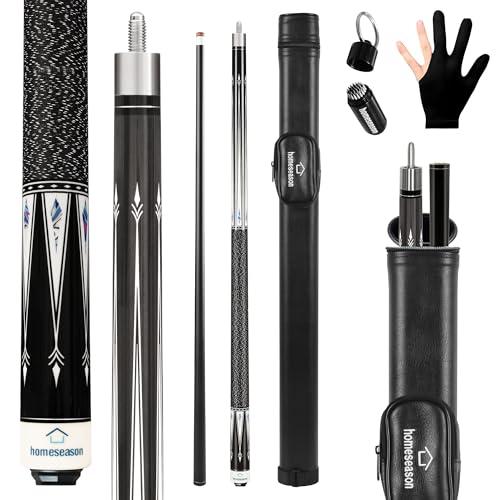
HomeSeason 58-in Low-Deflection Pool Cue with Leather Case (19 oz)
A 58-inch maple cue with a published 13 mm tip and a leather carry bag included - the cheapest way to own a cue that is also stored properly.
Shaft
Maple wood
Weight
19 oz (published)
Tip
13 mm (published)
Included
Leather carry bag
Pros
Cue plus bag for less than most cues alone, and the bag is the thing that keeps a maple shaft straight
Publishes weight and tip diameter, and 13 mm is the forgiving middle of the range
Sold as a low-deflection shaft with a nylon thread grip, so the butt is not bare lacquer
19 oz standard weight makes it a sensible single cue rather than a specialist one
Cons
HomeSeason is a marketplace brand with no track record in billiards, so treat the low-deflection claim as marketing
A soft bag protects against knocks and humidity, not against being leaned on
No published joint spec
The included bag is sized for this cue, not for a cue plus a break cue
Best for: Buying one cue, one case and nothing else.
Skip this
The budget traps that look cheap and cost you twice. We'd skip these.
One-piece house cues as your only cues
Pool halls stock one-piece uniform-taper cues because they are cheap and nobody owns them. They are also the cues most likely to be bowed, because they get leaned against walls and stored flat. If your table came with two of them, roll each one across the slate and watch the gap under the middle - then budget for one real cue.
Carbon fiber shafts, as a first upgrade
Carbon fiber is genuinely low-deflection and genuinely expensive, and it starts well above anything on this page. If your cue is straight and your tip is in shape, better cloth and better lighting over the table will do more for your game than a shaft will. Come back to carbon fiber when you have run out of other things to improve.
Cue sets with a case, balls, chalk and a bridge for one low price
The bundle price is low because every component is the cheapest version of itself, and the cue is the part they economize on hardest. Buy the cue on its own merits and add accessories separately - our pool table accessories roundup covers the ones worth having.
Buying a 48-inch cue because the room is small
A short cue is for the specific shots where a wall or a radiator is behind you, not for general play - the shorter lever makes every long shot harder. Keep one 48-inch cue for the tight corner and play the rest of the game with a 58. If every shot in the room is cramped, the table is too big for the space, which is a different problem.
What weight cue should you buy?
Nineteen ounces, unless you have a reason. Pool cues are commonly sold from 17 to 21 oz and 19 oz is both the most common weight and roughly where professionals average, which is not a coincidence — it is the weight that moves the cue ball enough on a firm shot without taking control away on a soft one. Go to 20 or 21 oz if you break with your playing cue and want the extra mass, and down to 18 oz if you are small-framed or you play a lot of delicate safety shots.
What matters more than the number is that you play the same weight every time. The reason a warped, unknown-weight house cue hurts your game is not that any one of its properties is wrong; it is that the next cue off the wall is different, so your stroke never calibrates. Owning one cue at a known weight fixes more than any individual specification on this page.
Tip diameter, and when to care about it
Pool cue tips run roughly 12 to 14 mm, and they are always specified in millimeters even in the US. A larger tip around 13 to 14 mm has more contact area and is more forgiving of a hit that is not quite where you aimed, which makes it the right first cue. A finer tip near 12 mm puts spin on the ball more readily and punishes a sloppy stroke more obviously — useful once you are deliberately using side spin, unhelpful before that.
Tips are also the one part of a cue that is meant to wear out. A leather tip on a cue played weekly will go glassy and stop holding chalk within a year or so, and replacing it costs a few dollars. That is worth knowing before you spend extra on a cue because its factory tip is described as premium: the factory tip is temporary on every cue here.
Why you want a separate break cue
The break is the one shot where you deliberately hit the cue ball as hard as you can, and a soft leather playing tip is the wrong tool for it — it compresses, it mushrooms over the ferrule, and it wears out several times faster than the rest of the cue's life would suggest. A dedicated break cue solves this with a hard phenolic tip and more mass, and it costs less than re-tipping a good cue twice.
This is only worth doing if you actually break hard. On a home table where the break is a firm push rather than a full swing, one cue is fine and the tip will last. If you play eight-ball properly with a full rack and a real break, the second cue pays for itself in tips and in not putting the dings on the cue you care about.
Storing a cue so it stays straight
Maple is wood, and wood moves with the moisture in the room. Three rules cover almost all of it: store it vertically, so gravity is not asking the shaft to bow; keep it out of a damp or unheated room, which means not the garage wall and not the basement floor; and do not leave it in a car, where a summer afternoon will cook the ferrule glue. A soft case or a wall rack handles the first two, which is why the cue-and-case bundle on this page scores as well as it does.
A wall rack is the cheapest storage that also keeps the cues out of the way, and the pool table accessories roundup covers the eight-cue racks, chalk, covers and ball sets a finished table needs. If the cues in question came with a 54-inch bumper pool table rather than a full-size, the shorter cues it uses are a different product entirely — the bumper pool accessories list is the right page for those.
How many cues does a home table need?
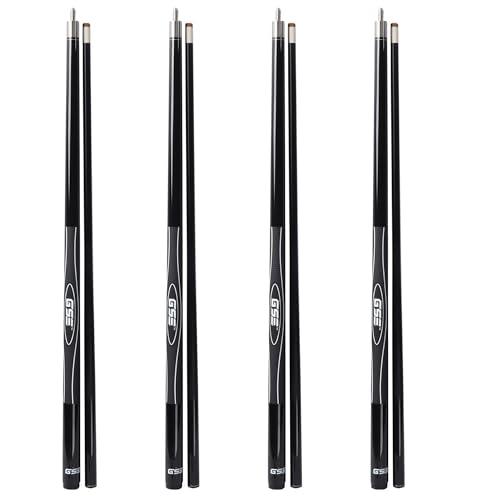
Two, if two people play; four if you host. The practical failure at a party is not that the cues are bad, it is that there are two of them and four people waiting, so somebody plays with a warped stick and everybody takes longer. The four-cue composite set exists for exactly that and costs less than a single mid-price cue, which is why it is on this page above several better-feeling cues.
If you are buying the table at the same time, bear in mind that the included cues are rarely worth keeping and the room dimension, not the cue, decides whether the table works at all. Our pool table roundup ranks the tables, how much space you need for a pool table gives the clearance figures with a 58-inch cue in hand, and the cheap pool table roundup covers the sub-1,000-dollar end.
Our verdict
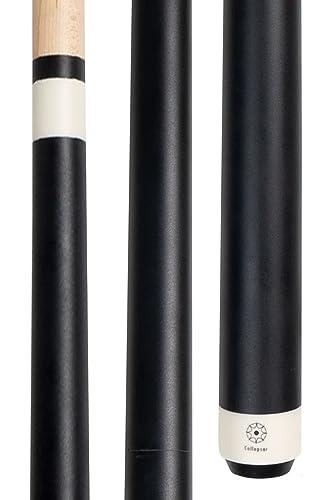
Buy the Viper Revolution Sure Grip Pro at 19 oz: standard weight, standard length, two-piece, from the brand with the deepest spares supply in this price band. Buy the McDermott Lucky L9 if you play weekly and want an American maker and a case in the box. Buy the GSE four-cue set if the problem is guests rather than performance, the Graphstrike if the room is a garage and the budget is 30 dollars, and the Collapsar break cue alongside whichever you choose if you break hard. The HomeSeason cue and bag is the pick if you want one purchase to cover both the cue and storing it properly.
If your budget stops at $200
Most of the cues above sit inside that cap, and two hundred dollars turns out to be the point where a cue stops getting meaningfully better for a table at home — the next real step is a low-deflection or carbon-fiber shaft, which is roughly double. Our best pool cues under $200 page ranks ten picks by what each price step actually buys: graded hard maple instead of generic hardwood, a published joint spec instead of none, a weight you chose instead of one you were sent.
Frequently asked questions
What weight pool cue is best for a beginner?+
19 oz. Pool cues are commonly sold between 17 and 21 oz and 19 oz is the most common weight, which is also roughly where professionals average - it has enough mass to move the cue ball on a firm shot without costing you control on a soft one. Go heavier only if you intend to break with the same cue.
How long is a standard pool cue?+
58 inches, with pool cues averaging about 57 to 59 inches overall. A 48-inch short cue is a specialist tool for shots where a wall is behind you, not a smaller version of a normal cue - the shorter lever makes long shots harder, so keep one short cue for the tight corner rather than playing the whole game with it.
Are expensive pool cues actually better?+
Up to a point, and the point arrives early. Moving from an unknown-weight warped house stick to any straight two-piece cue at a known weight is a large improvement. Moving from a 60-dollar brand-name cue to a 150-dollar one buys better materials, a warranty and resale value rather than a noticeably better shot. Carbon fiber shafts are a real technical step and a much larger bill.
Maple or fiberglass pool cue - which should I buy?+
Maple if the room is climate-controlled, fiberglass or graphite composite if it is not. Hard maple transmits the hit better and is what most quality cues are made of, but it moves with humidity and can bow. Composite shafts feel deadened by comparison and are close to immune to warping, which in a garage or an unheated basement is the property that matters.
What is a sneaky Pete cue?+
A plain, usually wrapless two-piece cue made to look like a cheap one-piece house stick. The style exists because a cue that looks unremarkable attracts no attention in a bar, and it has stayed popular because a wrapless butt has nothing on it to wear out or go sticky.
Do I need a break cue?+
Only if you break hard. The break is the one shot where you hit the cue ball at full power, and a soft leather playing tip compresses and mushrooms under it. A dedicated break cue with a hard phenolic tip and extra weight takes that abuse instead, and costs less than re-tipping a good cue twice. On a home table where the break is a firm push, one cue is fine.
How do I stop my pool cue from warping?+
Store it vertically in a rack or a case, keep it out of damp and unheated rooms, and never leave it in a car. Wooden shafts move with the moisture in the air, and a cue stored flat for months will take a set. If a cue is already bowed, roll it on the table bed to see how bad it is - a visible gap under the middle means it is costing you shots.
What tip size should a pool cue have?+
Pool cue tips run roughly 12 to 14 mm, always quoted in millimeters. A 13 mm tip is the forgiving middle and the right first cue; 12 mm takes spin more readily and punishes a loose stroke. Whatever you buy, treat the factory tip as a consumable - a leather tip on a weekly-played cue goes glassy within about a year and costs a few dollars to replace.
Prices and availability shown here come from Amazon's live data and change often; we re-verify them regularly. Bar Bumper is an Amazon Associate and earns a commission on qualifying purchases at no extra cost to you. Read our full disclosure.