Scale is the reason an ice maker slows down and ice starts tasting of the machine. Five cleaners and descalers ranked on published nickel-safe status, dosing, format and what each one is actually for.
Updated November 2026 · By Stephen V.
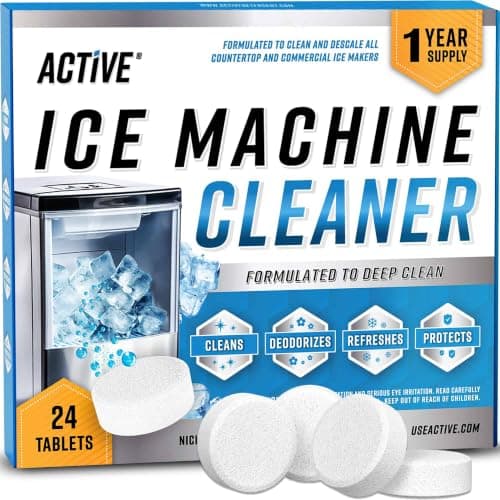
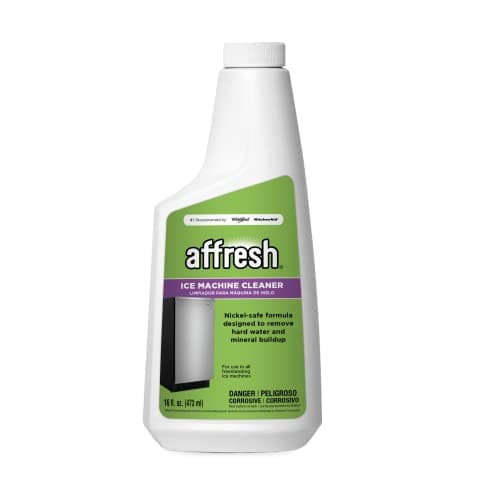
Buy the ACTIVE Ice Machine Descaler Tablets. A tablet is a pre-measured dose, which removes the one thing people get wrong about descaling - how much to use - and the listing publishes that the formula is nickel-safe, which is the single specification that matters on a home ice maker. Twenty-four tablets is years of monthly cleans. The budget pick is Affresh Ice Machine Cleaner, the cheapest nickel-safe liquid here and the one most likely to be the brand your manual names.
There are two different jobs here and most people only do one of them. Descaling removes mineral scale - the chalky white film that limescale leaves on the evaporator, the water lines and the reservoir. Sanitizing kills the slime and mold that grows in a warm wet plastic reservoir. A descaler does not sanitize and a sanitizer does not descale, and an ice maker left alone long enough needs both. Every pick on this page is a descaler or a cleaning kit; two of them publish a sanitizing claim as well, and that is noted where it exists.
How we judged these
Four criteria. The first one is a hard gate - a product that fails it does not belong near an ice maker at all.
Published nickel-safe status. The evaporator plate in most ice makers is nickel-plated, and a strong acid descaler eats nickel plating. "Nickel safe" is a formulation claim the manufacturer publishes, and every machine manual we have read insists on it. We only rank products whose listing states it, or that are sold specifically for ice machines by a manufacturer who does.
Dosing, and how hard it is to get wrong. A tablet is a dose. A liquid is a measurement, which means a cap, a ratio and a reservoir volume you have to know. Both work; the tablet is harder to get wrong, and an overdosed acid descaler is how plating gets damaged.
What it is actually sold to do. Descaler, sanitizer, or both. A brush set cleans what a chemical cannot reach - the reservoir corners, the pump intake, the chute - and is not a substitute for either. We say plainly which job each product does rather than letting a long listing imply all three.
Cost per clean, not cost per bottle. A cheap 16-ounce bottle that takes four ounces a clean is four cleans. A tablet pack of twenty-four is twenty-four. We compare on the number of cleans the listing publishes, which reorders the page against a straight price comparison.
We have not run a scale-removal test with a control sample, and anyone claiming one descaler dissolves limescale measurably faster than another at the same dilution is guessing. The ranking is built from published nickel-safe statements, published dose counts and formats, what each product is sold to do, manufacturer instructions, and owner-review consensus reported as other people's experience — see how we pick. Prices come live from Amazon with the date we verified them. For the procedure rather than the product, our step-by-step on how to clean an ice maker covers the full cycle.
Why scale is the thing that kills ice makers
Hard water carries dissolved calcium and magnesium. When the water freezes and the rest evaporates, those minerals stay behind as limescale on every surface the water touched. On an evaporator plate, scale is an insulating layer - it slows heat transfer, so the machine runs longer to make the same ice and the cycle time creeps up. That is why a two-year-old ice maker feels slow: almost always it is scaled, not failing.
The second symptom is taste. Scale is porous and it holds whatever was in the water, and the reservoir behind it grows a biofilm that the ice then carries into a drink. If your ice has started tasting faintly of the machine, that is the reservoir rather than your water supply - and it is a clean, not a replacement. Monthly is the cadence most manuals ask for; every three months is the realistic cadence that still keeps a machine healthy, and a nugget machine with a lot of plastic in the water path wants the shorter interval.
The short answer
In a hurry? These are the picks we'd buy. Prices are live; tap a card below for the full reasoning.
ACTIVE Ice Machine Descaler Tablets (24 tablets, nickel-safe)
Twenty-four pre-measured nickel-safe descaling tablets - the format that removes dosing error from the job, at a cost per clean nothing else here matches.
$23.9515% offPrice as of November 22, 2026·#addisclosure
ACTIVE Ice Machine Descaler Tablets (24 tablets, nickel-safe)
Twenty-four pre-measured nickel-safe descaling tablets - the format that removes dosing error from the job, at a cost per clean nothing else here matches.
Format
Tablets (24)
Nickel safe
Yes (published)
Job
Descale
Cleans
24 (one tablet each)
Pros
A tablet is a dose, so there is no cap to misread and no ratio to work out against a reservoir volume you do not know
Published nickel safe, which is the hard requirement for the plated evaporator in almost every home ice maker
Twenty-four tablets at a monthly cadence is two years of cleaning in one purchase - the lowest cost per clean on this page by a wide margin
Tablets store dry and indefinitely, unlike a part-used bottle of acid solution under a sink
Cons
A descaler only: it removes mineral scale and makes no sanitizing claim, so a machine with a slimy reservoir needs a second step
A fixed dose is wrong for an unusually large reservoir, where a liquid you can measure up is the more flexible tool
Tablets dissolve slowly in cold water, so the soak takes longer than a liquid on the same machine
The listing does not publish the active acid, so you cannot cross-check it against a manual that names one
Best for: Anyone who wants the dose decided for them.
The cheapest nickel-safe liquid descaler here, from the brand most appliance manuals name by name - the safe default if you are not sure what to buy.
Format
Liquid, 16 fl oz
Nickel safe
Yes (published)
Job
Descale
Maker
Affresh (Whirlpool brand)
Pros
The lowest price on this page for an actual descaler, which makes it the right first purchase if you have never cleaned the machine
Published nickel safe and sold specifically for ice machines rather than as a general descaler pressed into service
Affresh is Whirlpool's appliance-care brand, so it is frequently the product an ice maker or refrigerator manual names - which matters if you ever need the warranty
A liquid can be measured up or down, which a tablet cannot, so it suits an oversized reservoir
Cons
A single 16-ounce bottle is a handful of cleans, so the cost per clean is far higher than the tablets
Needs measuring, and an overdose of any acid descaler is the way plating gets damaged
Descaler only - no sanitizing claim
A part-used bottle of acid solution is one more thing stored under a sink
Best for: The cheapest nickel-safe clean, and the brand a manual is most likely to name.
$7.9815% offPrice as of November 22, 2026·#addisclosure
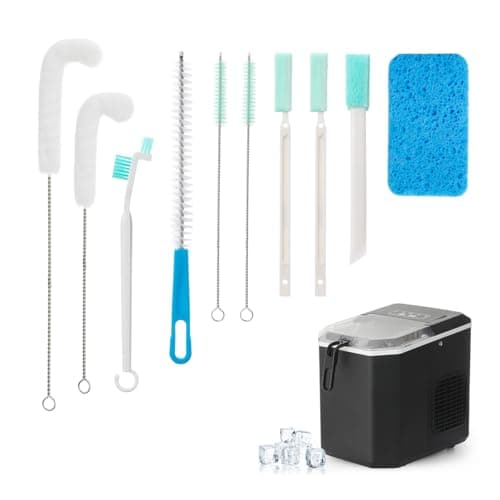
AIEVE Ice Maker Cleaning Brush Set (10 pieces)
Ten brushes sized for the places a descale cycle cannot touch - the cheapest thing on this page and the one that makes the chemical work.
Format
Brush set (10 pieces)
Job
Mechanical cleaning
Use
Reservoir, intake, chute, seals
Chemicals
None
Pros
A descale cycle circulates solution through the water path and does nothing about biofilm in a corner the pump does not pull from - a brush does
Ten sizes means something fits the chute, the pump intake and the lid seal, which are the three spots that smell first
Cheapest item on the page by a long way, and it never runs out
No chemicals at all, so it is the safe thing to hand someone who is nervous about acid near an appliance
Cons
Not a cleaner: brushes remove nothing mineral, so this is an addition to a descaler rather than an alternative to one
Nylon bristles on a soft plastic reservoir will scuff it if you scrub hard, and scuffs hold biofilm
Ten pieces means eight you never use for this job
Needs the machine partly disassembled to be worth anything, which not every ice maker allows
Best for: The corners, the pump intake and the chute, which no chemical reaches.
Skip this
The budget traps that look cheap and cost you twice. We'd skip these.
Plain white vinegar on a nickel-plated evaporator
Vinegar is the internet's default answer and it is a real descaler, but it is an uncontrolled one: household vinegar is roughly five percent acetic acid with no dilution guidance for an appliance, and manufacturers of nickel-plated evaporators routinely tell you not to use it. On a plastic reservoir it is mostly harmless; on the plated plate where the ice actually forms, it is how people void a warranty. Use a product that publishes nickel safe.
Bleach anywhere in an ice maker
Bleach sanitizes and does not descale, so it solves the wrong half of the problem, and it corrodes stainless and aluminium components while leaving a taste that takes many cycles to clear. If the reservoir needs sanitizing, use a product sold as an ice machine sanitizer and follow its rinse instructions. Never mix it with an acid descaler.
Descaling and then skipping the rinse cycles
This is the mistake that makes people think the cleaner was bad. Acid residue left in the water path goes into the first few batches of ice, which then taste sharp and chemical. Every manufacturer's instruction ends with running and discarding two or three full batches, and that step is not optional - it is the difference between a clean machine and ice nobody will put in a drink.
Cleaning only when the ice tastes wrong
By the time taste changes, scale has been slowing the evaporator for months and the reservoir has a biofilm. A clean every one to three months takes fifteen minutes and keeps the cycle time where it started. The cheapest way to make an ice maker last is to put the clean in the calendar, not to wait for a symptom.
How often should you clean an ice maker?
Monthly is what most manuals ask for; every three months is the interval that actually gets done and still keeps a machine healthy. Two things shorten it: hard water, and a nugget machine. Hard water lays scale down faster, and a nugget maker has a longer plastic water path with an auger in it, which gives biofilm more surface to grow on than a simple bullet-ice tray.
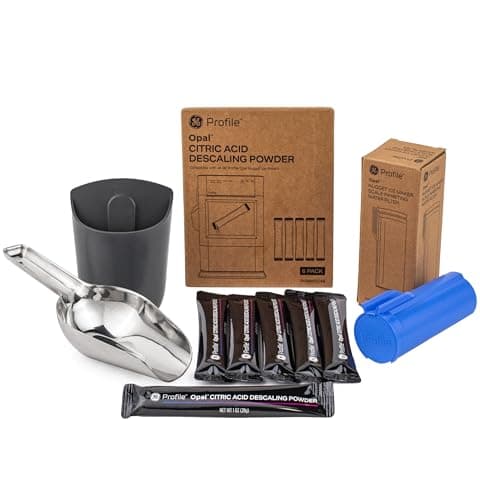
Two things lengthen it: a filter and a dry machine. A scale-inhibiting filter upstream of the reservoir slows mineral deposition rather than removing it, and it is the only preventive product here - which is most of the argument for the GE Opal kit if you own that machine. Draining and drying a machine you are not using for a fortnight stops the biofilm clock entirely.
Descaler, sanitizer or both?
A descaler is an acid. It dissolves the calcium and magnesium carbonate that hard water leaves on the evaporator and in the lines, and it does nothing about bacteria. A sanitizer kills the biofilm in the reservoir and does nothing about minerals. The honest answer for a machine that has never been cleaned is that it needs both, in that order, with full rinse cycles after each.
For a machine on a monthly or quarterly cadence, a nickel-safe descaler plus a brush through the reservoir and chute is enough, because the biofilm never gets established. That combination is also the cheapest thing on this page: tablets and brushes together cost less than one of the kits.
What a clean actually looks like
Unplug the machine, drain the reservoir, and lift out anything removable - the basket, the scoop, the drain plug. Mix the descaler to the published dose and fill the reservoir with it. Run a full ice cycle so the solution goes everywhere the water goes, then let it soak for the time the instructions state rather than the time you have. Dump the solution, brush the reservoir corners, the pump intake and the chute, then run two or three complete ice cycles with clean water and throw every cube away.
That is the whole procedure and it takes about fifteen minutes of attention spread across an hour. Our full guide to cleaning an ice maker walks through it machine type by machine type, including what changes on a nugget maker and what to do with an undercounter unit you cannot move. If you are also cleaning draft lines in the same room, the kegerator cleaning guide is the companion job.
Our verdict
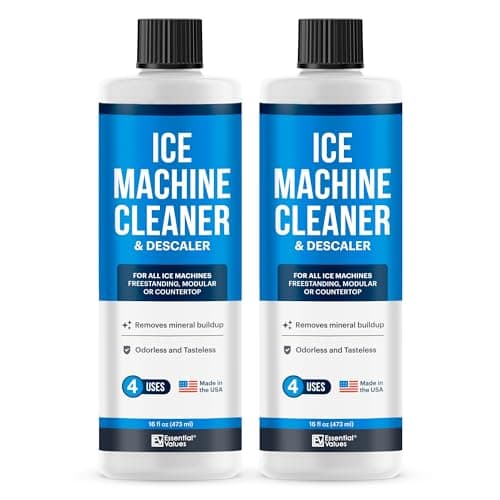
Buy the ACTIVE tablets: nickel safe, pre-dosed, and two years of cleans in one box. Buy Affresh if you want the cheapest single clean or your manual names the brand, the Essential Values two-pack if you have more than one machine, and the GE Opal kit only if you own an Opal - on any other machine the filter in it is dead weight. Add the brush set to whichever you choose, because it costs almost nothing and it reaches the parts the chemical never will.
Worth saying plainly: a scaled machine is not a broken machine. If your nugget maker has slowed down or your ice has picked up a flavour, clean it before you shop for a replacement. If it is genuinely at the end of its life, our most reliable ice maker page is built around the machines that keep going.
Frequently asked questions
What is the best ice machine cleaner?+
A nickel-safe descaler in a pre-measured format. We rank the ACTIVE descaling tablets first because each tablet is a dose, the listing publishes nickel-safe status, and twenty-four tablets is years of monthly cleaning in one purchase. Affresh is the cheapest nickel-safe liquid and the brand most appliance manuals name, which makes it the safe default if you are buying one bottle.
Can you use vinegar to clean an ice maker?+
On a plastic reservoir, mostly yes. On the nickel-plated evaporator plate where the ice actually forms, manufacturers routinely tell you not to - household vinegar is an uncontrolled acid with no appliance dilution guidance, and it can attack plating. Use a product that publishes nickel-safe status instead; they cost a few dollars and they keep the warranty intact.
How often should an ice maker be descaled?+
Most manuals ask for monthly. Every three months is the realistic interval that still keeps a machine healthy, and it should be shorter if your water is hard or your machine is a nugget maker, because a nugget machine has a longer plastic water path for biofilm to grow in.
Does descaling fix a slow ice maker?+
Usually, yes. Scale on the evaporator plate is an insulating layer, so the machine has to run longer to freeze the same water and the cycle time creeps up. A machine that has got slower over a year or two is almost always scaled rather than failing, and a proper descale plus rinse brings the cycle time back.
What is the difference between an ice machine cleaner and a sanitizer?+
A cleaner or descaler is an acid that dissolves mineral scale and does nothing to bacteria. A sanitizer kills the biofilm in the reservoir and does nothing to minerals. A machine that has never been cleaned needs both, in that order, each followed by full rinse cycles. Never mix the two.
Why does my ice taste bad after cleaning?+
Almost always because the rinse cycles were skipped or cut short. Acid residue left in the water path goes straight into the next few batches and tastes sharp. Run two or three complete ice cycles with clean water after any descale and discard every cube - the taste disappears with the residue.
Prices and availability shown here come from Amazon's live data and change often; we re-verify them regularly. Bar Bumper is an Amazon Associate and earns a commission on qualifying purchases at no extra cost to you. Read our full disclosure.