Two players, five balls each, two pockets and eight bumpers in a cross. You shoot at the pocket at the far end, your marked ball has to go first, and there is no cue ball.
Updated October 2026 · By Stephen V.
Bumper pool is a two-player game on a small table with two pockets and a cross of bumpers in the middle. Each player has five balls and sinks them in the pocket at the far end of the table — the one at the opponent's side. Your marked ball must go in first. There is no cue ball: you strike your own balls directly. First player to sink all five wins.
That paragraph is the whole game, and it is why bumper pool gets taught in about ninety seconds. The rest of this page is the detail: how the balls start, the unusual simultaneous break, what counts as a foul, and the one penalty that catches everybody — sinking your own ball in the wrong pocket.
Before the rules, the equipment, because two numbers matter. The table is rectangular, or sometimes octagonal, with the two pockets set opposite each other at the centers of the rails. The bumpers sit in a cross at the middle of the table, eight of them, two to each arm, with further bumpers set around each pocket. The balls are five red and five white, with one ball in each set marked by a circle in the opposite color — and they are smaller than pool balls, about 2-1/8 inches across, which is why a pool set cannot replace them.
If you are reading this because you are deciding whether to buy a table, the three below are the ones we would own, and the prices come live from Amazon with the date we checked them. If you already have a table, skip to the rules.
The short answer
In a hurry? These are the picks we'd buy. Prices are live; tap a card below for the full reasoning.
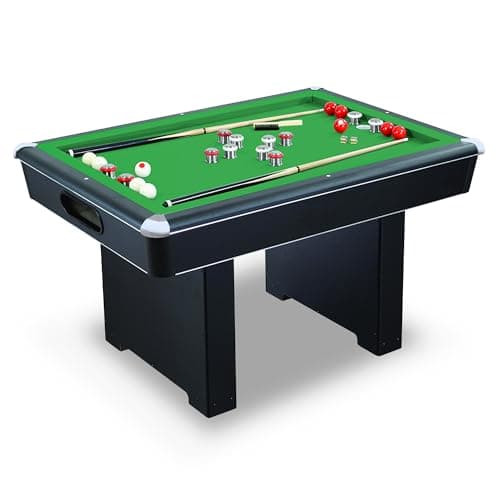
A 54-inch slate-bed bumper pool table — the full-size version of the game with a playing surface that stays flat, which is what makes bank shots repeatable.
A 54-inch slate-bed bumper pool table — the full-size version of the game with a playing surface that stays flat, which is what makes bank shots repeatable.
Size
54 in
Bed
Slate
Type
Dedicated bumper pool
Brand
Hathaway
Pros
Slate stays flat, and bumper pool is a game of banks — a sagging bed ruins it
54 inches is the full size, so the cross of bumpers sits at proper distances
A dedicated table rather than a convertible top, so nothing to lift or store
Ball return means you are not fishing balls out by hand between racks
Cons
The most expensive pick here, and it does only one thing
Needs about 11 by 11 feet of room with 48-inch cues
Slate is heavy; plan the route into the room before it arrives
Best for: A dedicated bumper pool table that plays true.
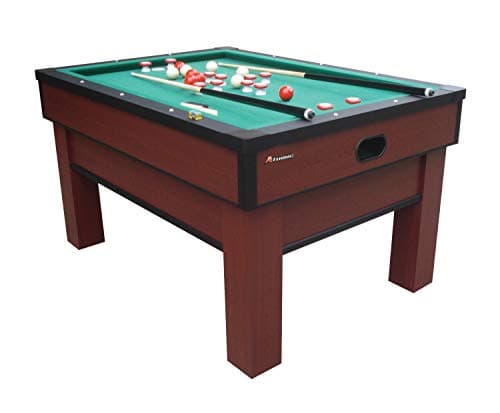
Atomic's classic dedicated bumper pool table — no convertible top, no slate, just the game at the bottom of the real price range.
Type
Dedicated bumper pool
Top
Fixed (no conversion)
Brand
Atomic
Suits
Dens, basements, game rooms
Pros
Cheapest dedicated table here, with none of the compromises of a tabletop set
Fixed top means nothing to lift, store or scratch
A real cabinet and real bumpers, which the under-$300 tabletop versions are not
Atomic is a known game-table brand rather than an unbranded import
Cons
Not slate, so the bed's flatness over a decade is less certain
Single-purpose, in a room where a convertible might earn its keep
Fewer accessories included than the Hathaway tables
Best for: A straightforward bumper pool table at the lowest sensible price.
How to choose (and what to skip)
The object of the game
Be the first player to sink all five of your balls into your scoring pocket, which is the pocket at the far end of the table — the one on your opponent's side. Your marked ball (the one with a circle of the opposite color) must be sunk before any of your other four count.
There is no cue ball
This is the rule that surprises everyone who comes from pool. You strike your own balls directly with the cue, and any of your five may be the one you hit. You must always hit one of your own balls first, and the ball must contact a bumper or another ball before it drops, so you cannot simply roll a ball straight into the pocket from close range.
The opening break is simultaneous
Both players shoot at the same time, each playing their own marked ball, banking it off the cushion to their right and aiming for their scoring pocket at the far end. This is the only shot in the game played simultaneously. After the break, play alternates.
Pot and continue, miss and hand over
A turn is one shot. Sink one of your own balls in your scoring pocket and you shoot again; miss and the turn passes to your opponent. That is the whole rhythm of the game, and it is what makes a run of three or four balls feel like something.
The wrong-pocket penalty is the one that decides games
Sink one of your own balls in the wrong pocket — your opponent's — and your opponent gets to drop two of their balls into their scoring pocket. If it is your last ball that goes in the wrong pocket, you lose the game outright. Sinking one of your opponent's balls carries no penalty at all, which is worth knowing because it changes how you play a cluster.
How the game is set up
Each player takes one set of five balls and arranges them on the five spots near the rail at their own end, around their own end's pocket, with the marked ball placed directly in front of that pocket. The conventional arrangement is two balls on each side of the pocket with the marked ball centered in front of it. Red and white sit at opposite ends. Note what this means: your balls start next to the pocket you are not shooting at, and the length of the table plus the bumper cross sits between you and the pocket you want.
The break, shot by shot
Both players set up at the same time and shoot their marked ball together, banking off the cushion to their right. The bank is not optional decoration — it is the only way to get around the bumper cross on the opening shot. If a player sinks their marked ball on the break, they shoot again; if both do, both continue. From there play alternates, one shot per turn, and the marked-ball-first rule means that a player who has not yet sunk their marked ball has only one legal target, which is the main reason the opening exchange matters.
Fouls and what they cost
Hitting an opponent's ball first. You must contact one of your own balls first; doing otherwise ends your turn.
Potting without contacting a bumper or a ball. The ball must touch something before it drops, which rules out tapping a ball in from an inch away.
Jump shots. Not permitted. A jumped ball is replaced, with the position chosen by the opponent.
Knocking a ball off the table. Your opponent's ball is replaced, and you place one of your own balls in the bumper cross — a genuinely bad outcome, because a ball in the cross is hard to extract.
Sinking your own ball in the wrong pocket. Your opponent drops two of their balls into their own pocket. If it was your last ball, you lose.
Sinking an opponent's ball in a pocket. No penalty to you, but your opponent is credited with it, so it is a gift either way.
Three tactics that win more games than potting ability
First, get your marked ball out of the way early. Until it drops, nothing else you sink counts, and an unresolved marked ball sitting in front of your own pocket is also the ball most likely to get knocked in there by accident. Second, use the cross. The eight bumpers in the middle are not just obstacles — a ball played into the cross at the right angle comes out on a line that is very hard to cover, and the cross is also where you park a ball you do not want your opponent to have a clear shot past. Third, play the far cushions. Because you are shooting the length of the table at a pocket in the middle of the far rail, a double off the side cushions is often a better percentage shot than trying to thread the cross directly.
Octagonal tables and three-in-one tops
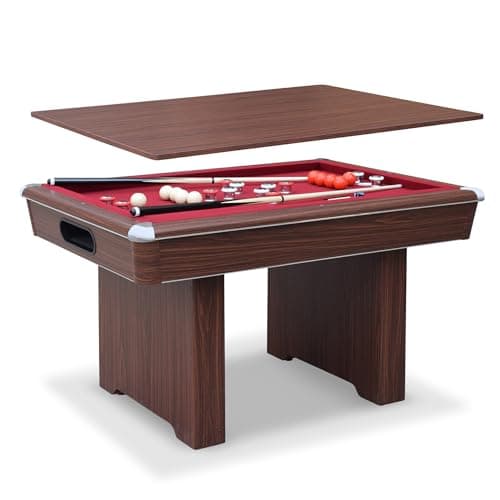
The rules above are the same on an octagonal table — the shape changes the cushion angles, not the game. The pockets are still opposite each other, the cross is still in the middle, and the marked-ball rule is unchanged. What an octagonal cabinet does change is the room: an octagon in the middle of a floor needs clearance all the way round rather than at two ends, so it usually wants more space than a rectangular table of the same play length. Convertible three-in-one tables, which are what a lot of people actually buy, play the same game with a reversible poker and dining top over the bed. Our best bumper pool tables roundup covers both kinds, and what size bumper pool table do I need has the room figures.
What you need to play, beyond the table
Almost nothing, which is part of the appeal. Ten regulation balls, two 48-inch cues — not the 57 to 58-inch pool cue, which will not clear the wall on a 54-inch table — and chalk. Most tables include all three. The things worth adding later are a cover, a cue rack and cloth care, and our bumper pool accessories page covers which of those are worth buying and which are pool-table products that do nothing here. If you are still comparing the game against a full-size table, what is a bumper pool table makes the case for each.
Frequently asked questions
What are the basic rules of bumper pool?+
Two players, five balls each, two pockets and a cross of eight bumpers in the middle. Each player sinks their balls in the pocket at the far end of the table, and must sink their marked ball first. There is no cue ball — you strike your own balls directly, must hit one of your own first, and the ball must touch a bumper or another ball before it drops. First to sink all five wins.
Which pocket do you shoot at in bumper pool?+
The pocket at the opposite end of the table from where your balls start — the one on your opponent's side. Your own balls are racked around the pocket at your end, which is the pocket you must avoid, because sinking one of your own balls there hands your opponent two balls.
What is the marked ball in bumper pool?+
One ball in each set of five is marked with a circle in the opposite color — a white spot on a red ball, or a red spot on a white one. It starts directly in front of your own end's pocket and it must be the first of your balls you sink. Until it drops, nothing else you pot counts.
How do you break in bumper pool?+
Both players break at the same time, each shooting their own marked ball and banking it off the cushion to their right, aiming for their scoring pocket at the far end. It is the only simultaneous shot in the game. Sink your marked ball on the break and you shoot again.
What happens if you sink your ball in the wrong pocket?+
Your opponent gets to drop two of their balls into their own scoring pocket. If the ball you sink in the wrong pocket is your last one, you lose the game outright. Sinking one of your opponent's balls, by contrast, carries no penalty to you — but it counts for them.
Is there a cue ball in bumper pool?+
No. Unlike every common pool game, bumper pool has no designated cue ball — you strike your own balls directly with the cue, and any of your five can be the one you shoot. You just have to hit one of your own balls first, and it must contact a bumper or another ball before it is pocketed.
How many bumpers are on a bumper pool table?+
Eight are arranged in a cross at the center of the table, two to each arm, with additional bumpers set around each of the two pockets. The cross is the obstacle that makes the game a banking game rather than a potting game.
Can you play bumper pool with four people?+
Yes, as two teams of two. The rules are unchanged: each team owns one color, each team shoots at the far pocket, and partners alternate turns within the team. It is the usual way the game gets played at a party, and it is why a bumper pool table seats a room better than a full-size pool table does.
Prices and availability shown here come from Amazon's live data and change often; we re-verify them regularly. Bar Bumper is an Amazon Associate and earns a commission on qualifying purchases at no extra cost to you. Read our full disclosure.