Written for a room that already has the big table. Seven games ranked on how often they actually get played, not on how good they look in the box.
Updated October 2026 · By Stephen V.
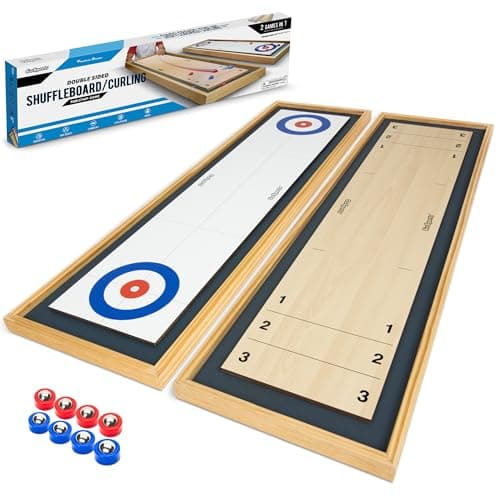
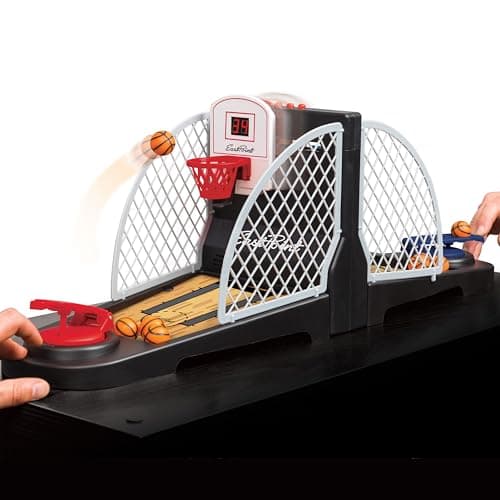
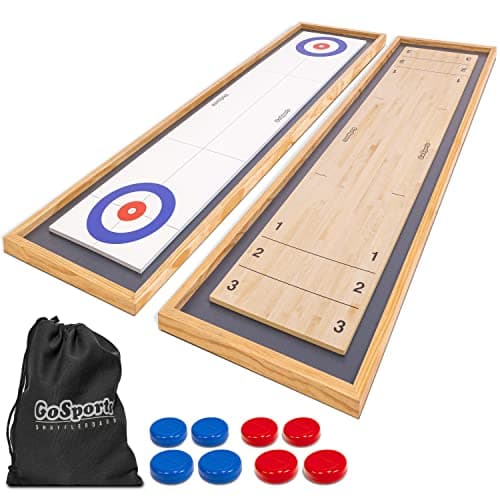
If you are filling a game room and want the one game that will get played most, buy the GoSports shuffleboard and curling tabletop set: it is two genuinely different games on one board, it works on any table, it takes about a minute to learn, and it suits four-year-olds and adults equally. After that, a proper poker chip set is the best value in the room; the EastPoint arcade basketball is the one children will not leave alone; and the Mortal Kombat countercade is the step up to a real arcade machine.
The test this page is built on is simple: how many times will this get played in a year? That question demotes a lot of impressive-looking games. Anything with a long rulebook gets played once. Anything that needs exactly four players gets played rarely. Anything that takes ten minutes to set up gets played less than something you can start in ten seconds.
What survives that test tends to share three traits: it is learnable in a minute, it works with two players or six, and it lives out in the room rather than in a cupboard. Games that stay visible get played; games in boxes on a shelf do not. That is worth more than any amount of design quality.
We have not play-tested these as a set. The ranking is built from published sizes, player counts, what is in the box and how each game sets up, plus owner-review consensus reported as other people's experience — see how we pick. Prices come live from Amazon with the date we verified them.
The short answer
In a hurry? These are the picks we'd buy. Prices are live; tap a card below for the full reasoning.
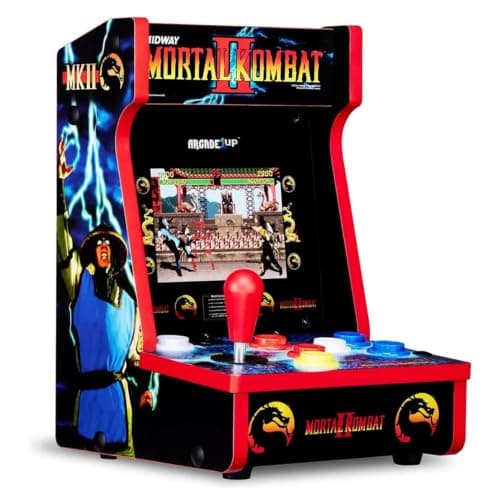
Arcade1Up Mortal Kombat II Countercade (3 games, 7-in screen)
A real countertop arcade cabinet with proper clicking controls — the one entry here that is a machine rather than a game.
Type
Countercade
Screen
7 in
Games
3
Floor space
None
Pros
Real microswitched arcade controls, not rubber buttons
Needs no floor space — it sits on a counter or a bar
Always on and always ready, like the basketball game
Looks like a games room ought to look
Cons
The most expensive item on this page
Three games, and fighting games suit two sets of controls
A 7-inch screen is a one-player view
Best for: A room with a counter and a bit of budget left.
Skip this
The budget traps that look cheap and cost you twice. We'd skip these.
Anything with a rulebook longer than a page
Game rooms are not board game clubs. The games that get played in them are picked up in the ten minutes between other things, by people holding a drink, often with somebody who has never played before. A game that requires one person to teach everyone else for twenty minutes gets played once, however good it is. Keep the heavy games on a shelf for dedicated evenings and fill the room with things that start in ten seconds.
Games that need exactly four players
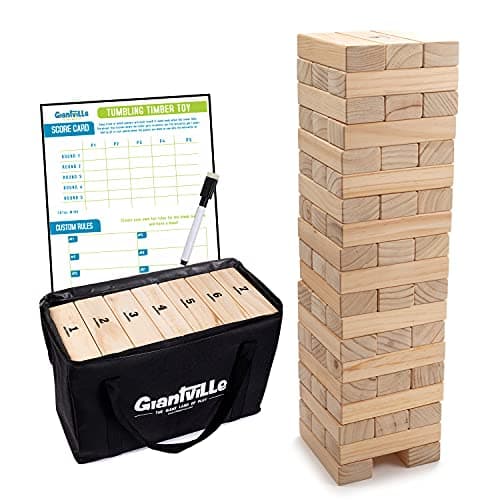
The commonest number of people in a game room is two, and the second commonest is five. A game that works only at four sits unused most of the time. Everything at the top of this page scales — shuffleboard works at two or six, the tumbling tower works with any number, poker chips work with whatever turns up. That flexibility is worth more than theme or production quality.
How to choose (and what to skip)
Buy for the player count you actually have
Count the evenings honestly: mostly two people, occasionally a crowd. Games that stretch across that range get played; games tuned to one specific number do not. Two-player arcade games and open-ended games like the tumbling tower cover the two extremes, and tabletop shuffleboard covers the middle.
Favor games that live out in the room
This is the single best predictor of whether a game gets played. A board in a box on a shelf requires a decision; a board sitting on the table requires none. Tabletop shuffleboard, arcade basketball and a countercade are all permanently visible and all get played far more than their quality alone would explain. If a game has to be put away, it will be.
Mix fast games with one long one
A good game room has several ten-second-start games and one thing that fills an evening — usually cards, which is why a proper chip set earns its place. The short games cover the gaps and the long game is the plan. Buying three long games and no short ones leaves a room that feels empty most of the time.
Check what the game needs to sit on
Tabletop games need a table, and the 6-foot shuffleboard needs a big one. Before buying, work out which surface each game will live on and whether that surface is free. A game that has to displace something else every time is a game that stays in the cupboard. If surfaces are the constraint, our <a href="/game-tables/best-game-table-and-chairs-set">game table and chairs roundup</a> covers tables that fold away.
Spend on the thing used weekly, not the thing used yearly
The chip set and the shuffleboard board will see more hours than anything else in most rooms, and both are inexpensive. If budget is limited, cover those first and leave the arcade machine for later — an arcade cabinet is a wonderful thing and it is not what makes a room get used. The <a href="/game-tables/best-cheap-arcade-machines">cheap arcade machine roundup</a> covers the cabinets when you get there.
What makes a game get played
Three things, and none of them is how good the game is. Time to start: under about ten seconds and people will play it idly; over a minute and they will not. Flexible player count: a game that works at two and at six fits real evenings. Visibility: a game sitting out gets picked up, a game in a box gets remembered occasionally. Score any game you are considering against those three and the answer is usually obvious before you look at the price.
The games a room actually needs
A well-used game room generally has four kinds of thing. A big table — pool, bumper pool, air hockey, whatever the room could take. A sliding or throwing game like shuffleboard or cornhole, which is the most-played category because it needs no explanation. A card setup, meaning chips and decks, for the evenings that are planned rather than incidental. And one always-on machine — an arcade cabinet, an electronic basketball game, a dartboard — that someone can start alone while waiting for other people. Rooms that have all four get used most nights; rooms with three big tables and nothing else do not.
Tabletop shuffleboard, and why it wins
It is the game that scores best on every criterion above. Setup is placing a board on a table. The rules are "slide the puck, closest to the far end wins", which takes one demonstration. It works at two players and at six, and it genuinely works across ages — a child can beat an adult, which very few skill games allow. The 2-in-1 boards add curling, which plays differently enough to count as a second game. If a room can only have one small game, this is it. The full-size shuffleboard tables are the next step if the room and budget allow.
Why a chip set matters more than it looks
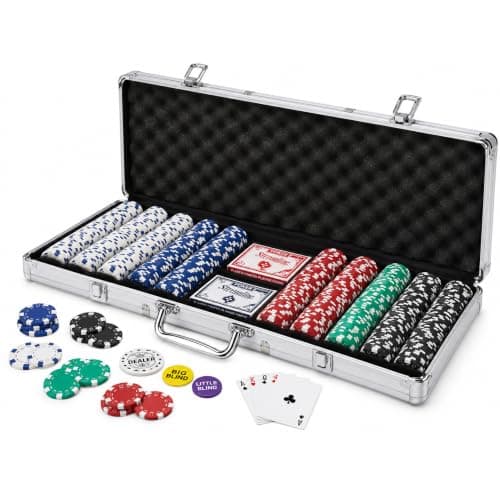
Weighted clay-composite chips change how card games feel in a way that is out of proportion to what they cost. Light plastic chips slide, stack badly and feel like a toy; 11.5-gram chips stack properly, shuffle in the hand and make a game feel like an occasion. A 500-chip set also covers a full table without anyone running short, and the case keeps them from migrating into kitchen drawers. For a room where cards are a regular thing, this is the best money on this page — and it pairs with a small poker table if you want the padded rail too.
Games for children in the same room
A game room that children also use wants games where the skill gap is narrow and the equipment survives enthusiasm. The sliding games qualify on both counts, and so do magnetic and sticky-ball dart games — they give children the dartboard experience without steel tips in the wall, and our dart board game roundup covers those properly. What does not work is anything with small parts that need counting, or anything where an adult's practice makes the game unwinnable for a child. That second point is the real reason tabletop shuffleboard gets played in family rooms and more sophisticated games do not.
Frequently asked questions
What are the best games for a game room?+
Tabletop shuffleboard first — it sets up in seconds, needs no rules explanation, works at two players or six, and suits children and adults equally. After that, a weighted poker chip set for card nights, and one always-on machine such as tabletop arcade basketball or a countertop arcade cabinet that someone can start on their own.
What makes a game room game actually get played?+
Three things: it starts in under about ten seconds, it works with a flexible number of players, and it lives out in the room rather than in a box on a shelf. Games that need a rules explanation or an exact player count get played once or twice a year, no matter how good they are.
What games work in a game room with children?+
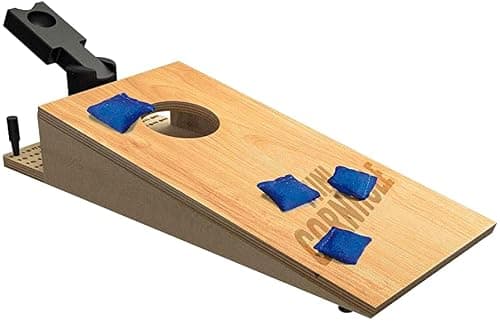
Sliding and throwing games — tabletop shuffleboard, mini cornhole — because the skill gap between a child and an adult stays narrow, and the equipment survives enthusiasm. Magnetic or sticky-ball dart games give the dartboard experience without steel tips. Avoid anything where an adult's practice makes the game unwinnable for a child.
Is a tabletop shuffleboard worth it compared to a real table?+
For most rooms, yes. A full shuffleboard table is 9 to 22 feet long and a serious commitment of floor space; a 6-foot tabletop version keeps enough distance for touch and judgment to matter, and packs into a bag. The small 2-in-1 boards are more casual but get played more often because they fit anywhere.
How many games does a game room need?+
Four kinds rather than a specific number: one big table, one sliding or throwing game, a card setup with chips, and one always-on machine someone can start alone. Rooms with all four get used most nights. Rooms with three large tables and nothing small tend to sit empty between planned occasions.
Are weighted poker chips worth the extra over plastic ones?+
Yes, and it is the cheapest upgrade in a game room. Light plastic chips slide, stack badly and feel like a toy; 11.5-gram clay-composite chips stack cleanly and make a card game feel like an occasion. A 500-chip set with a case also keeps the chips together instead of scattered through drawers.
Prices and availability shown here come from Amazon's live data and change often; we re-verify them regularly. Bar Bumper is an Amazon Associate and earns a commission on qualifying purchases at no extra cost to you. Read our full disclosure.