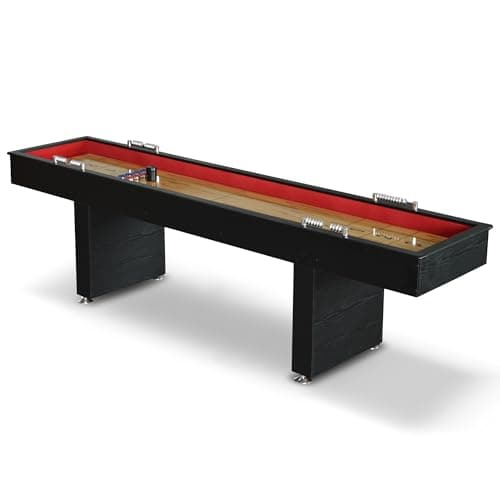
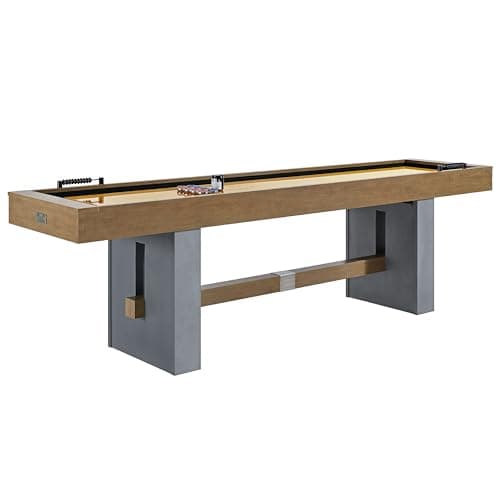
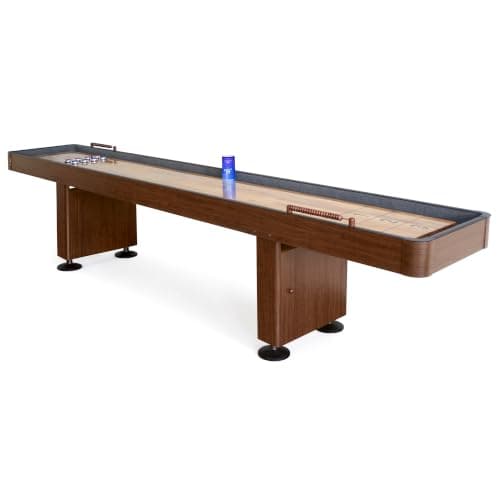
Tournament tables are 22 feet. Home tables start at 9. Here is every length, how wide they are, and how to pick one by the room you actually have.
Updated October 2026 · By Stephen V.
A tournament shuffleboard table is 22 feet long and 20 inches wide at the playfield. Home tables are made at 9, 12, 14, 16, 18 and 20 feet, and the two sizes most houses buy are 9 feet and 12 feet. To play comfortably you want the table length plus about 2 feet of standing room at each end, so a 9-foot table needs roughly 13 feet of floor and a 12-foot table about 16 feet. Width is the easy part: almost every table is 30 to 40 inches wide overall, and you want 2 feet clear along one side.
That is the answer. The rest of this guide is about which length to choose, because unlike a pool table, shuffleboard scales down gracefully — a 9-foot table plays a real, satisfying game. The question is not "how close to 22 feet can I get" but "what is the longest table my room takes without the ends being cramped".
Length changes the game, not just the footprint. On a long table the puck has time to settle and the drift of the board matters; the game becomes about reading the surface and controlling weight over distance. On a 9-foot table everything happens faster, the shots are shorter and the game is more about touch than about reading drift. Both are good. They are just different, and that is worth knowing before you choose by room size alone.
Our shuffleboard table roundup has the tables themselves. This page is the sizing decision, and the registry picks below are placed after the sizing sections so you can choose a length first and a table second. We have not played on these tables; the figures are the published dimensions and the standard specifications for the game — see how we pick.
The short answer
In a hurry? These are the picks we'd buy. Prices are live; tap a card below for the full reasoning.
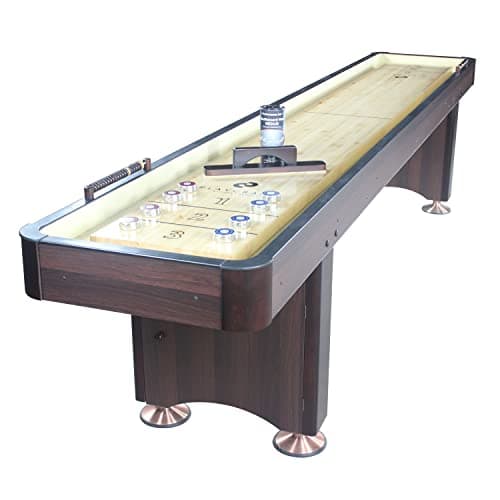
Playcraft Woodbridge Shuffleboard Table with Storage Cabinet
A shuffleboard table with a storage cabinet in the base — the practical choice for a room that is also used for other things.
Type
Table with storage cabinet
Storage
Pucks, wax, accessories
Brand
Playcraft
Finish
Furniture-grade
Pros
Integrated storage keeps pucks and wax off every other surface in the room
Furniture-grade finish suits a living space rather than a games shed
Playcraft is a specialist shuffleboard maker
Cons
The cabinet adds depth to the footprint
Dearer than a plain table of the same length
Still needs the full length plus standing room
Best for: A room where the pucks and wax need somewhere to live.
How to choose (and what to skip)
Every shuffleboard table length, and the room it needs
9 ft table — about 13 x 5 ft of floor; the common apartment and small-den size. 12 ft — about 16 x 5 ft; the most popular home size and the first length where drift really matters. 14 ft — about 18 x 5 ft. 16 ft — about 20 x 5 ft; the length serious home players aim for. 18 ft — about 22 x 5 ft. 20 ft — about 24 x 5 ft. 22 ft (tournament) — about 26 x 5 ft, which is a dedicated room. Add 2 ft of standing space at each end and 2 ft of clear walking room along one side to every figure.
How wide is a shuffleboard table?
The playfield on a tournament table is 20 inches wide, and overall table width across the cradle and gutters runs about 30 to 40 inches depending on the model. That is narrower than people expect and it is why shuffleboard fits rooms a pool table cannot: it needs length and almost no width. In a 10-foot-wide room a 16-foot shuffleboard table is comfortable and a 7-foot pool table is not.
What size shuffleboard table should I get?
Measure the longest clear wall run in the room, subtract 4 feet for standing room at the ends, and buy the longest standard table that fits what is left. If that calculation gives you 12 feet, buy a 12-foot table rather than a 14-foot one you will play badly. If it gives you under 11 feet, buy a 9-foot table — it is a real game and the alternative is a tabletop set.
Why the best shuffleboard table length for a home is usually 12 or 14 feet
Twelve feet is where the board's drift becomes a genuine part of the game, which is the thing experienced players care about, and it fits a normal basement or a long living room. Fourteen feet is noticeably better again and is the point where most rooms start to struggle. Below 12 the game is faster and shorter; above 16 you are into dedicated-room territory. Most households that buy 9 feet because of the room and then move house buy 14 next time.
Check the playfield thickness while you are checking the length
Length decides the game; playfield thickness decides whether the table holds its shape. Home tables run around 1.5 to 2.5 inches of hardwood; tournament tables are 3 inches. A thicker board resists the cupping and warping that humidity causes, which is the main failure mode for a shuffleboard table and the reason climate adjusters exist on better models.
How long should a shuffleboard table be?
As long as the room allows after you subtract 2 feet of standing room at each end. That is the whole rule. Practically, it produces one of three answers for most houses: 9 feet if the clear run is 13 to 15 feet, 12 feet if it is 16 to 17, and 14 feet if it is 18 or more. Beyond that, 16 to 22-foot tables are for dedicated rooms and clubs, and the step from 16 to 22 changes the game more than any other step in the range.
The mistake to avoid is squeezing. A 14-foot table in a 16-foot room means players stand with their backs against the wall at both ends, which makes the delivery stroke awkward and the game less fun. One length down, played properly, beats one length up, played cramped — every time.
How wide is a shuffleboard table, and how much side room?
The playfield is 20 inches on a tournament table, and overall width across the cradle runs 30 to 40 inches. Add about 2 feet of clear floor along at least one long side so people can walk the length of the table and read the board. You do not need clearance on both sides; one is enough, and that is why a shuffleboard table can live against a wall where a pool table cannot.
This is the single biggest practical advantage shuffleboard has over every other game table. It needs length and almost no width, so it fits corridors, long basements, finished garages and the long wall of a living room — rooms that a pool table is simply the wrong shape for.
What size shuffleboard table for a home: by room
Apartment or small den (13 to 15 ft run): 9 feet. Typical finished basement (16 to 17 ft): 12 feet. Long basement or finished garage (18 to 20 ft): 14 feet. Dedicated games room (22 ft plus): 16 feet or longer, and at that point consider 18 or 20 if you want the game to behave like the tournament version. A 22-foot table needs about 26 feet of floor, which is a specific room rather than a spare one.
Does length change how the game plays?
Considerably. Over 16 or 22 feet, the slight concave curve built into a shuffleboard playfield — the drift — has distance to act, so the puck moves off a straight line and reading that becomes the skill. Over 9 feet it barely registers, and the game is about delivery weight and touch instead. Experienced players prefer longer tables for exactly that reason; beginners often enjoy the shorter ones more, because scoring happens faster.
Playfield thickness and climate adjusters
A shuffleboard playfield is a solid hardwood board with a polymer finish, and its enemy is humidity. Home tables run 1.5 to 2.5 inches thick; tournament boards are 3 inches. Thicker resists cupping better. Better tables also have climate adjusters — threaded fittings along the underside of the board that let you pull a developing curve back out. If a table is going in a basement or a garage, those are worth looking for, because that is where humidity swings most.
What you need besides the table
Pucks (eight, four of each color), shuffleboard wax — the fine silicone beads the pucks slide on, which is a consumable — and a board brush. Wax is the one people underestimate: the board needs sweeping and re-waxing regularly or the pucks stop sliding true, and different wax speeds change the game noticeably. Our shuffleboard roundup covers the accessories alongside the tables.
If no length fits
A tabletop shuffleboard set on a dining table is a genuine fallback and a real game at short range; it is not the same thing and nobody should pretend otherwise. The other option in a short room is to change games entirely: darts needs a patch of wall and about 8 feet of standing room, and a bumper pool table needs roughly 11 by 11 feet. Both fit rooms shuffleboard does not.
Frequently asked questions
How long is a shuffleboard table?+
A tournament table is 22 feet long. Home tables are made at 9, 12, 14, 16, 18 and 20 feet, and 9 and 12 feet are the two most houses buy. Add about 2 feet of standing room at each end: a 9-foot table needs roughly 13 feet of floor and a 12-foot table about 16 feet.
How wide is a shuffleboard table?+
The playfield is 20 inches wide on a tournament table, and overall width across the cradle and gutters is about 30 to 40 inches depending on the model. You want roughly 2 feet of clear floor along one long side — not both — which is why shuffleboard fits narrow rooms that a pool table cannot.
What size shuffleboard table should I get?+
Measure the longest clear run in the room, subtract 4 feet for standing room at the ends, and buy the longest standard length that fits. That usually means 9 feet for a 13-to-15-foot run, 12 feet for 16 to 17, and 14 feet for 18 or more. A shorter table played properly beats a longer one played cramped.
What is the best shuffleboard table length for a home?+
Twelve or 14 feet, if the room allows. Twelve feet is the point at which the board's drift becomes a real part of the game, which is what experienced players want, and it fits a typical basement. Nine feet is a genuine game and the right answer for an apartment; 16 feet and up needs a dedicated room.
Is a 9-foot shuffleboard table too short?+
No — it plays a real game, just a faster one. Over 9 feet the playfield's built-in drift barely has distance to act, so the game becomes about delivery weight and touch rather than reading the board. Beginners often enjoy it more because scoring happens quickly. Players who improve tend to want more length eventually.
How much space do you need around a shuffleboard table?+
About 2 feet of standing room at each end for the delivery stroke, and about 2 feet of clear walking space along one long side. You do not need clearance on both sides, which is the key difference from a pool table and the reason shuffleboard works in long, narrow rooms.
Prices and availability shown here come from Amazon's live data and change often; we re-verify them regularly. Bar Bumper is an Amazon Associate and earns a commission on qualifying purchases at no extra cost to you. Read our full disclosure.