Written for a budget. Six home arcade machines from countertop up, ranked on cost against screen size, game count and how much floor they take.
Updated October 2026 · By Stephen V.
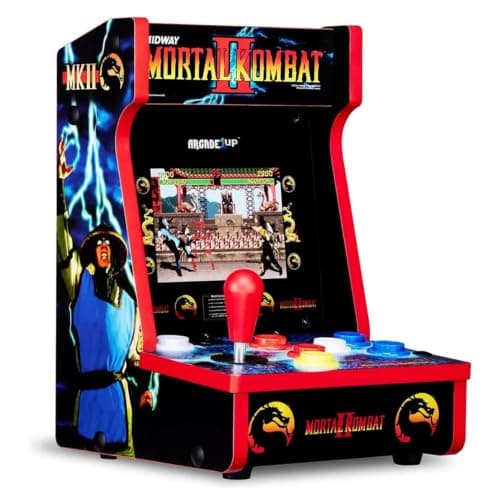
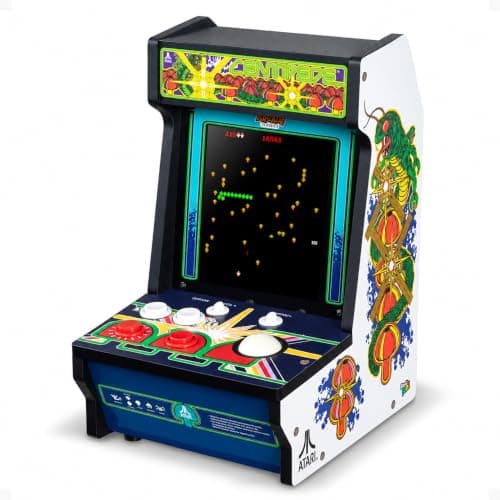
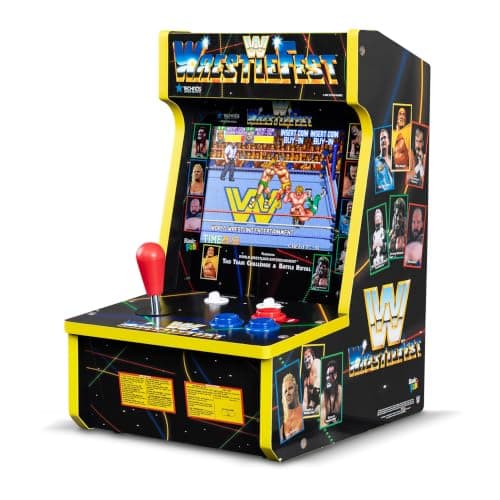
The cheapest arcade machine worth putting in a game room is the Arcade1Up Mortal Kombat II Countercade: a licensed cabinet with real arcade controls and a 7-inch screen for well under two hundred dollars. If you want a bigger picture for not much more, the Arcade Classics counter-series machines (WWE and Atari Centipede) step up on games per dollar; the Pac-Man Jr free-standing unit is the cheapest machine that stands on the floor; and the Arcade1Up Mortal Kombat Classic SE and Pac-Man Deluxe are the cheapest full-height cabinets.
Buying arcade on a budget means understanding what the price buys, because the range here runs from about $160 to about $500 and the difference is almost entirely screen size and whether it stands up. A countercade is a small cabinet that sits on a counter or a bar. A counter-series machine is the same idea with a bigger screen. A deluxe cabinet is full height with a riser, a light-up marquee and a bigger panel. The games inside are often the same licenses.
The decision that actually matters for a budget buyer: where is it going to live? A countercade on a bar top costs a third of a full cabinet and takes no floor, and in a finished game room next to a pool table that is often the right answer. A full cabinet is a piece of furniture and needs a wall and a power outlet. Decide that first and the shortlist halves.
We have not played these machines. The ranking is built from published screen sizes, game counts, control-panel descriptions, cabinet dimensions and license lists, plus owner-review consensus reported as other people's experience — see how we pick. Prices come live from Amazon with the date we verified them.
The short answer
In a hurry? These are the picks we'd buy. Prices are live; tap a card below for the full reasoning.
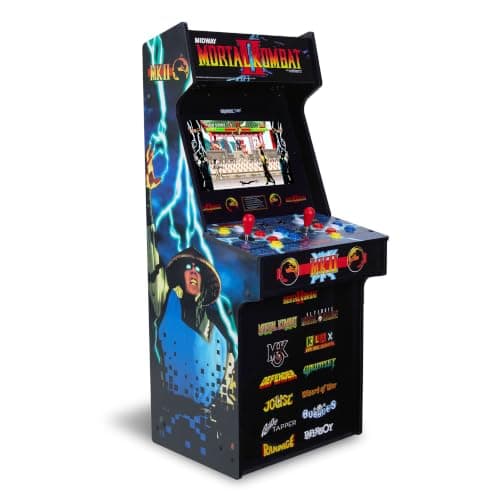
Arcade1Up Mortal Kombat II Countercade (3 games, 7-in screen)
A licensed Mortal Kombat II countercade with a proper joystick and button layout for under two hundred dollars — the cheapest machine here that feels like an arcade cabinet.
A bar top or a shelf, on the smallest budget that still gets real controls
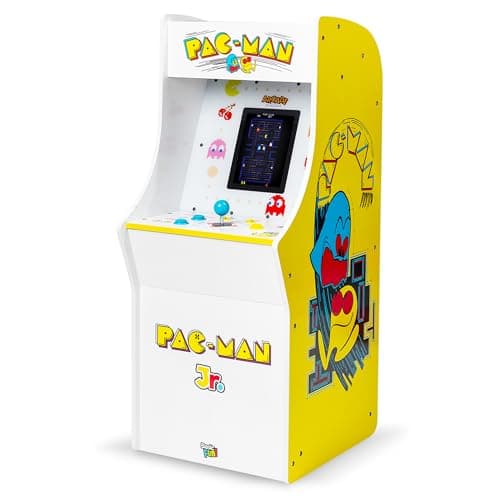
Arcade Classics Pac-Man Jr Free-Standing Arcade Machine (3 games)
A free-standing Pac-Man Jr cabinet for around three hundred dollars — the cheapest arcade machine here that reads as furniture rather than an appliance.
Wanting a machine that stands on the floor without full-cabinet money
Arcade1Up Mortal Kombat II Countercade (3 games, 7-in screen)
A licensed Mortal Kombat II countercade with a proper joystick and button layout for under two hundred dollars — the cheapest machine here that feels like an arcade cabinet.
Type
Countercade
Screen
7 in LCD
Games
3
Controls
Arcade joystick + buttons
Pros
Cheapest licensed cabinet here with genuine arcade controls
Sits on a bar or counter, so it costs no floor space
Arcade1Up is the established name in home cabinets
Mortal Kombat II is the right game for a bar
Cons
A 7-inch screen is small for two-player fighting
Three games only
Needs a counter it can live on permanently
Best for: A bar top or a shelf, on the smallest budget that still gets real controls.
Arcade Classics Pac-Man Jr Free-Standing Arcade Machine (3 games)
A free-standing Pac-Man Jr cabinet for around three hundred dollars — the cheapest arcade machine here that reads as furniture rather than an appliance.
Type
Free-standing
Games
3
Licence
Pac-Man
Placement
Floor
Pros
Stands on the floor, which is what most people picture when they say arcade machine
Pac-Man suits every age in the house
Cheapest floor-standing unit on this page
Cons
Three games
Junior-height cabinet, so adults stoop slightly
Needs floor space and a nearby outlet
Best for: Wanting a machine that stands on the floor without full-cabinet money.
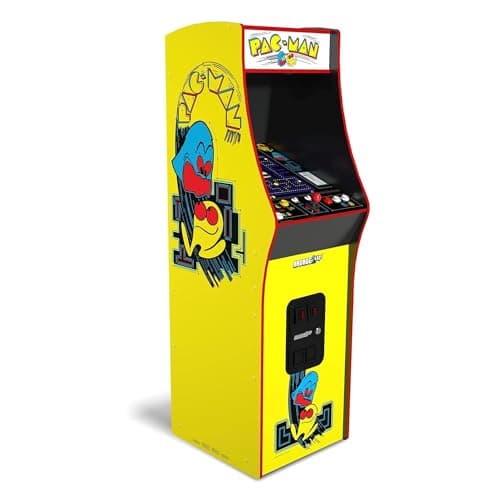
Fourteen classic games in a deluxe full-height cabinet — the broadest catalog here and the only one that genuinely suits every age in the house.
Type
Deluxe full-height cabinet
Games
14 classics
Licence
Pac-Man and classics
Brand
Arcade1Up
Pros
Fourteen classic titles with the widest age appeal on this page
Deluxe cabinet with marquee and riser — it looks the part
The machine most likely to still be used in year three
Cons
The most expensive pick here
Full-height cabinet needs a dedicated spot against a wall
Assembly is an evening
Best for: One machine for a whole household, bought once.
Skip this
The budget traps that look cheap and cost you twice. We'd skip these.
Handheld 'mini arcade machines' bought as a game room centerpiece
The $20 to $40 handheld retro units are toys with a 2.8-inch screen and membrane controls. They are fine as a stocking filler and they are not an arcade machine in any sense that will satisfy somebody who went looking for one. If the budget genuinely stops below $100, a countercade saved up for is a far better outcome than a handheld bought now.
Multicade cabinets with implausible game counts and no license list
A cabinet advertising thousands of games is usually running an emulator with a ROM set nobody has licensed, which is why no titles are named. Beyond the legal question, build quality and support on these are unpredictable and the screen is often the cheapest part. Licensed cabinets name their games; that naming is the quality signal.
How to choose (and what to skip)
Decide countertop or floor before you compare prices
This is the fork that explains the whole price range. A countercade sits on a bar or counter and costs $160 to $200. A free-standing or full cabinet needs a floor position and a wall, and costs $300 to $550. In a game room already holding a table, the countertop option is often the better buy — it costs no floor and sits where people are standing anyway.
Screen size is what you are paying for
Game counts vary from 3 to 15 across this page and the prices do not track them closely. Screen diagonal does: 7 inches on a countercade, around 15 to 17 on full cabinets. If two people are going to play a fighting game together, the screen is the spec that decides whether it is fun. If it is a single-player Atari cabinet on a bar, 7 inches is fine.
Count the games you will actually play
Three well-chosen licensed titles beat fifteen you do not recognize. Look at the actual list: a Pac-Man and classics cabinet has broad household appeal, a fighting-game cabinet is for people who like fighting games, and a sports-license machine is a bar novelty. Budget buyers consistently over-weight the game count and under-weight the catalog.
Check the control panel, not the artwork
Real arcade feel comes from a microswitched joystick and concave arcade buttons. Every pick here has them; many cheaper lookalikes do not, using membrane pads behind a plastic panel instead. If a listing shows artwork in detail and never shows the panel close up, that is what it is hiding.
Allow for the riser and the outlet
Full-height cabinets are usually full height because of a riser section, and some ship it separately. Measure the ceiling height if it is going in a basement with ductwork. And every machine needs a permanent outlet within reach — nobody enjoys an arcade machine on an extension lead across a game room floor.
How cheap can an arcade machine be?
About $160 for a licensed countercade with real arcade controls, and that is a genuine floor rather than a bargain-hunting target. Below it the market is handheld retro toys with small screens and membrane buttons, which are a different product. Between $160 and $300 you get counter-series cabinets with more games and slightly bigger screens. From $300 to $550 you get free-standing and full-height cabinets with 15-inch-plus screens, proper two-player panels and marquees.
The best value on this page, measured in hours of use per dollar, is the countercade at the bottom and the Pac-Man deluxe at the top. The middle of the range is where buyers most often spend more than they needed to for a screen that is still small.
Where a cheap arcade machine goes in a game room
On the bar, if there is one. An arcade machine at standing height next to a drink is used constantly; the same machine in a corner with no surface near it is used at parties. If the room has a home bar cabinet or a counter run, a countercade on top of it is the highest-use placement in the room and the cheapest. A full cabinet wants a wall of its own, ideally where the screen is not facing a window.
Think about the cue envelope too. In a room with a pool table, anything standing on the floor has to live outside the roughly 17 by 13-foot rectangle you need for cue draw — which is another argument for putting the machine on a counter.
What you give up buying cheap
Screen size, mainly. Then game breadth, cabinet rigidity, and the light-up marquee that makes a cabinet look like a cabinet. What you do not give up on any licensed pick here is the control feel — microswitched sticks and concave buttons are standard across the range, and that is the part that decides whether the machine plays like an arcade. That is why the cheap end of this category is better value than the cheap end of most.
Licensed cabinets versus multicades
A licensed cabinet names its games because somebody paid for them: three to fifteen titles, listed. A multicade advertising thousands of games names none of them, because the collection is an unlicensed ROM set. Set the legal question aside and the practical one remains — nobody plays four thousand games, the screens on those units are usually the cheapest component, and there is no support when something fails. For a budget buyer especially, a licensed cabinet is the safer purchase.
Two-player or not
If the machine is for a room where people gather, two-player matters more than the game count. Fighting games and sports titles need two panels and a screen big enough for both players to see what is happening, which pushes you to the full cabinets. Single-player classics — Pac-Man, Centipede, Galaga — work perfectly on a small counter screen with one person at a time, which is why they are the right catalog for the cheapest machines.
Buying one as a present, or buying the room instead
If the machine is a gift rather than a purchase for yourself, the decision changes — floor space and theme matter more than value. Our arcade game gift guide explains countercades versus full cabinets in plain English for someone who is not an arcade fan. And if a cabinet is more than the room needs, the best game room games covers the cheaper things that get played more often.
Frequently asked questions
What is the cheapest arcade machine worth buying?+
A licensed countercade at around $160 to $200 — a small cabinet with a 7-inch screen, a real microswitched joystick and arcade buttons, that sits on a bar or counter. Below that price the market is handheld retro toys with membrane controls, which is a different product entirely.
How much does a home arcade machine cost?+
Roughly $160 to $200 for a countercade, $180 to $300 for a counter-series cabinet with more games, and $380 to $550 for a free-standing or full-height cabinet with a 15-inch-plus screen and a two-player panel. The price tracks screen size far more closely than it tracks game count.
Are cheap arcade machines any good?+
The licensed ones are better than the price suggests, because the control panel — a microswitched stick and concave buttons — is the same across the range. What you give up at the cheap end is screen size, game breadth and cabinet rigidity, not the feel of the controls. That makes this an unusually good category to buy cheap in.
Should I buy a countercade or a full cabinet?+
A countercade if the room already has a bar or counter it can sit on, because it costs a third as much and uses no floor. A full cabinet if two people will play together — the bigger screen and the proper two-player panel are what make shared play work, and they are the real reason to spend the extra.
Are machines advertising thousands of games legitimate?+
Usually they are running unlicensed emulated ROM sets, which is why no titles are named. Beyond the licensing question, screens and support on those units are unpredictable, and nobody plays thousands of games. Licensed cabinets list their titles, and that list is the quality signal worth buying on.
Where should an arcade machine go in a game room?+
On the bar or counter if there is one — a machine at standing height next to a drink gets used daily, and it keeps the floor clear. If it stands on the floor, keep it outside the pool table's cue envelope (roughly 17 by 13 feet for a 7-foot table), give it a permanent outlet, and avoid facing the screen at a window.
Prices and availability shown here come from Amazon's live data and change often; we re-verify them regularly. Bar Bumper is an Amazon Associate and earns a commission on qualifying purchases at no extra cost to you. Read our full disclosure.