A cabinet is the one dartboard accessory that does two jobs at once: it stops darts marking the wall, and it makes the board disappear when the room is being used for something else.
Updated October 2026 · By Stephen V.
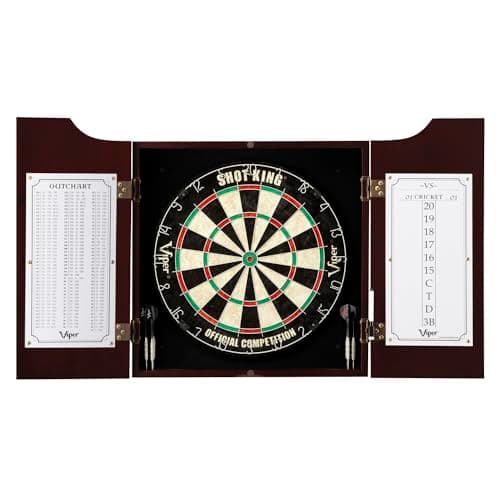
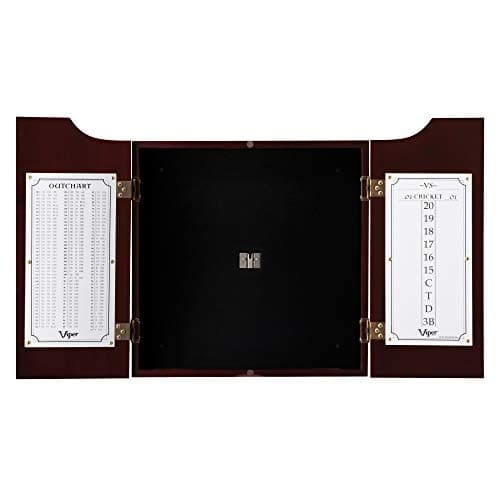
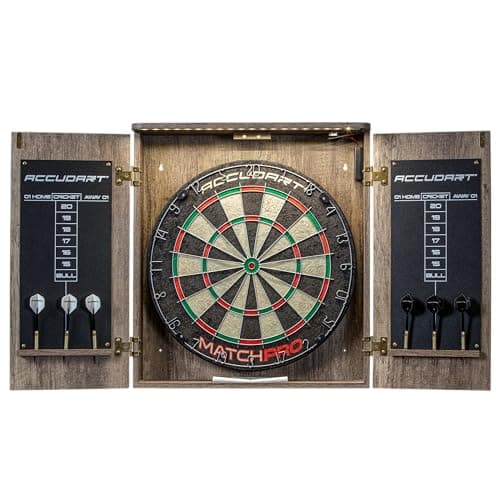
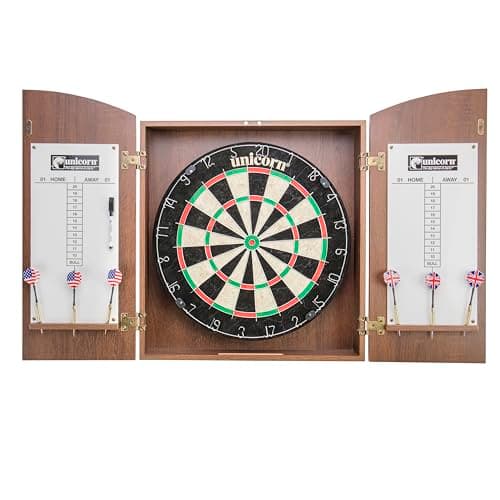
The best dartboard cabinet is the Viper Hudson All-in-One: a solid wood cabinet that arrives with a sisal board already fitted, a chalk scoreboard inside the doors and dart storage, so one box is the whole wall. If you already own a board you like, the plain Hudson cabinet is the same furniture without it; the Accudart Match Pro adds automatic LED lighting; and the Unicorn Oxford set is the cheapest route to a cabinet with a real bristle board and darts in the box.
A cabinet earns its place in a room that is not only a games room. Open, it is a backboard that takes the stray darts your wall would otherwise take. Closed, it reads as a cupboard, which is the entire reason people put one in a living room or a finished basement that has guests in it. Nothing else in darts does both jobs.
The things that separate cabinets are mundane: how far the open doors reach either side of the board, whether there is a scoreboard and whether it is chalk or dry-erase, how the darts are held, whether the hinges will still be straight in five years, and whether a board comes with it at all. Depth matters too — a cabinet stands the board off the wall, which moves your throw line.
We have not assembled these cabinets side by side. The ranking is built from published construction, dimensions, included contents and scoreboard type, plus owner-review consensus reported as other people's experience — see how we pick. Prices come live from Amazon with the date we verified them.
The short answer
In a hurry? These are the picks we'd buy. Prices are live; tap a card below for the full reasoning.
Viper Hudson All-in-One Dart Center (cabinet + sisal board)
Solid wood cabinet, sisal board already fitted, scoreboard inside the doors and dart storage — the complete answer for a room that is not a dedicated games room.
Unicorn Oxford Dartboard Cabinet Set (board + darts)
Unicorn's entry cabinet set with an official-size self-healing bristle board, a rotatable number ring and darts — the least you can spend and still have the right parts.
$178.9943% offPrice as of October 13, 2026·#addisclosure
Viper Hudson All-in-One Dart Center (cabinet + sisal board)
Solid wood cabinet, sisal board already fitted, scoreboard inside the doors and dart storage — the complete answer for a room that is not a dedicated games room.
Build
Solid wood
Board
Sisal bristle, included
Scoring
Scoreboard inside doors
Storage
Dart holders
Pros
The board is fitted and aligned, so there is no separate mounting job
Open doors cover enough wall either side to catch realistic misses
Closed, it looks like a cabinet rather than a dartboard under a towel
Solid wood rather than wrapped particle board
Cons
Heavier than it looks — it wants two people and a wall stud
The included board is recreational rather than tournament wire
Cabinet depth pushes the board forward, so measure the throw line again
$69.9917% offPrice as of October 13, 2026·#addisclosure
Unicorn Oxford Dartboard Cabinet Set (board + darts)
Unicorn's entry cabinet set with an official-size self-healing bristle board, a rotatable number ring and darts — the least you can spend and still have the right parts.
Brand
Unicorn
Board
Official size bristle, included
Number ring
Rotatable metal
Included
Darts
Pros
A real sisal board with a rotatable ring at the bottom of the cabinet market
Darts included, so nothing else is needed on day one
Unicorn badge means replacement rings and parts are findable
The cheapest way to stop darts hitting drywall
Cons
Lighter cabinet construction than the solid wood Hudson
Narrower doors cover less wall either side
Included darts are a starter set
Best for: A first dart wall on a fixed budget.
Skip this
The budget traps that look cheap and cost you twice. We'd skip these.
Assuming a cabinet protects the whole wall
It protects the wall it covers, and open cabinet doors are usually around a foot of coverage either side of the board. A dart that misses the board badly — the kind thrown late in an evening — goes past the doors. If the wall behind is plaster you care about, a cabinet plus a surround is the honest answer, and a surround is the cheaper half of that pair. Our <a href="/darts/best-dartboard-surround">dartboard surround picks</a> cover the ones that work with a cabinet rather than against it.
Forgetting the cabinet moves your throw line
Regulation distance is measured from the face of the board, not the wall. A cabinet stands the board forward by its own depth, so the oche moves forward by the same amount. It is only a couple of inches, but it is exactly the kind of couple of inches that makes a practiced throw feel wrong. Measure 7 ft 9¼ in from the board face after the cabinet is hung, and mark the floor then.
How to choose (and what to skip)
Decide first whether the board is included
This is the biggest price swing in the category and the easiest thing to get wrong. A cabinet with a board costs more but is a single purchase that arrives aligned; a bare cabinet is the right buy if you already own a board worth keeping. If you own a tournament board like a Blade 6, buy the bare cabinet — do not pay again for a recreational board you will take straight back out.
Measure the door swing, not just the cabinet
A dartboard cabinet needs its doors open to be useful, which means it needs clear wall on both sides. Most cabinets roughly double their width when open. Check that neither door will foul a corner, a light switch, a radiator or a doorway, because a cabinet that cannot open fully is just a shelf with a board in it.
Chalk or dry-erase is a real preference
Chalk scoreboards look right and are what most solid-wood cabinets come with; they also produce dust and need a cloth. Dry-erase is cleaner and easier to read, and the marker dries out if the cabinet sits unused for a month. Neither is better — but check which one you are buying, because owners who wanted the other one are the most common mild complaint in the category.
Hang it into a stud, with help
A loaded cabinet is a substantial object on a wall, and the fixing is the part people regret. Find a stud, use the hardware the cabinet came with, and get a second person for the lift so the bracket takes the weight square. Drywall anchors alone will hold a bare cabinet and will eventually sag under a cabinet with a board, darts and doors in it.
Then fix the lighting
Almost every home dart wall is lit from behind the thrower, which puts your shadow over the board at the exact moment you are aiming. A lit cabinet like the Accudart solves it in one purchase; otherwise, a dedicated ring light is the single biggest improvement you can make to an existing setup. Our <a href="/darts/best-dartboard-light">dartboard light roundup</a> has the picks.
Cabinet or surround: which do you actually need?
A surround is a ring of foam or cork that hugs the board and catches near misses; a cabinet is furniture that holds the board, catches near misses with its doors and hides everything when closed. If the board lives in a dedicated games room or garage where nobody minds looking at it, a surround is cheaper, lighter and covers the near-miss zone better. If the board lives anywhere a guest sits down, the cabinet wins because it closes. Plenty of good setups use both: a surround inside a cabinet is the belt-and-braces answer, and it is what we would do on a plaster wall.
What dartboard cabinet size do you need?
Internally, enough for a regulation 18-inch board, which every cabinet on this page provides — cabinet listings quote an external size, and that is the number to check against your wall. Externally, assume a cabinet is roughly two feet wide closed and around four feet wide with the doors open, and allow a little more. The dimension people forget is depth: a cabinet typically stands the board three to four inches off the wall, which both moves the throw line forward and means a cabinet cannot sit in a doorway recess or behind a part-open door.
Why solid wood is worth the extra
Because of the hinges. The weak point of a dartboard cabinet is the point where a door is screwed to the carcass, and a wrapped particle board carcass holds a screw once. Open and close a cabinet a few hundred times, and a cheap one develops a droop that stops the doors meeting. Solid wood takes the screw properly and keeps taking it. This is the one place in the category where spending more buys a longer life rather than a feature.
What else the wall needs
Three things, in order of how much difference they make. Height and distance: bullseye at 5 ft 8 in, throw line 7 ft 9¼ in from the board face — the dartboard height and distance guide has the full numbers and the diagonal check. Light on the board, not on you, which is a ring light or a lit cabinet. Floor protection if the floor is hardwood, because dropped darts land point-first. Get those right and a modest cabinet feels like a proper setup; get them wrong and no cabinet rescues it.
If you want the board to score itself instead
Some cabinets house electronic boards rather than bristle, and for a home bar that can be the better call — nobody has to keep score with a drink in their hand. The trade is feel: soft-tip darts in plastic segments never read like steel tips in sisal. Our electronic dartboard roundup covers the cabinet-mounted electronic options, and the steel-tip versus electronic comparison lays out the trade honestly.
Frequently asked questions
What is the best dartboard cabinet?+
The Viper Hudson All-in-One. It is a solid wood cabinet that arrives with a sisal board fitted and aligned, a scoreboard inside the doors and dart storage, so a single purchase covers the whole wall. If you already own a board you like, buy the plain Hudson cabinet instead and keep your board.
Does a dartboard cabinet protect the wall?+
It protects the wall its open doors cover, which is roughly a foot either side of the board. Wild misses still get past. On a plaster or drywall wall you care about, the complete answer is a cabinet plus a surround — the surround catches the near misses right around the board and the doors catch the rest.
Dartboard cabinet or surround — which is better?+
A surround is cheaper, lighter and better at catching near misses; a cabinet closes and hides the board, which is why it wins in a room that is not a dedicated games room. If the board lives in a garage or games room, buy the surround. If guests sit in the room, buy the cabinet — and consider using both.
How much space does a dartboard cabinet need?+
Allow about two feet of wall closed and around four feet with the doors open, plus a few inches of clearance so neither door fouls a corner or a light switch. Also allow for depth: a cabinet stands the board three to four inches off the wall, which moves the throw line forward by the same amount.
Does a cabinet change where the throw line goes?+
Yes. Regulation distance — 7 ft 9¼ in — is measured from the face of the board, so when a cabinet pushes the board forward, the throw line moves forward too. Hang the cabinet first, then measure and mark the floor from the board face.
Can you put any dartboard in a cabinet?+
Any regulation 18-inch bristle board fits a cabinet built for one, which is all the cabinets here. What varies is the mounting hardware: cabinets usually include a bracket or a center bolt arrangement, and a board with a different backing may need the bracket that came with the board instead. Both are standard, and both are easy to swap.
Prices and availability shown here come from Amazon's live data and change often; we re-verify them regularly. Bar Bumper is an Amazon Associate and earns a commission on qualifying purchases at no extra cost to you. Read our full disclosure.