The paddle that came with your table is the cheapest thing on it. Ten picks ranked on blade construction, published sponge thickness, tournament approval and whether you are buying one racket or four.
Updated November 2026 · By Stephen V.
Buy the STIGA Pro Carbon. It is the paddle most people who outgrow a boxed set land on: a seven-ply blade with carbon layers, 2 mm sponge both sides, and a flared handle, at a price that does not require you to care about table tennis as a sport. If you need four paddles for a table the whole house uses, buy the JOOLA Family set of four and stop reading. If you want the cheapest paddle here that is still a real racket rather than a toy, that is the PRO-SPIN carbon 7-ply.
A ping pong paddle is two separate products glued together, and almost every bad purchase comes from not knowing that. The blade is the wooden bat; the rubber is the sheet stuck to each face, and it is the rubber that produces nearly all of the spin. ITTF regulations require at least 85% of the blade's thickness to be natural wood, and cap any carbon or glass fiber layer at 7.5% of total thickness or 0.35 mm, whichever is smaller. So when a listing says "carbon fiber blade", it means a very thin stiffening layer inside a wooden sandwich - not a carbon bat.
The rubber is where the money goes and where it wears out. Sandwich rubber - a pimpled topsheet over a foam layer - is capped by the ITTF at 4.0 mm total, and most performance paddles run 2.0 mm of sponge, which is close to the practical maximum. Thinner sponge gives more control, thicker sponge gives more speed. That one sentence explains most of the difference between a $17 paddle and a $100 one, and it is why a boxed-set paddle with a hard thin sheet and no sponge feels dead no matter how well you hit the ball.
How we judged these
Four criteria, in this order. The first two decide how the paddle plays; the third decides whether you can use it in a league; the fourth decides whether you bought the right number of them.
Blade construction: plies, and whether there is a carbon layer. A five-ply all-wood blade is thinner and more flexible, which gives the ball greater dwell time on the face and makes the paddle easier to control. A seven-ply blade is thicker and stiffer, which returns more of your swing speed to the ball. A carbon layer inside either adds stiffness at almost no weight. None of this is marketing: it is a measurable difference in how long the ball stays on the bat. We quote the published ply count on every pick.
Published sponge thickness. The ITTF ceiling for sandwich rubber is 4.0 mm total including the topsheet, and performance rubbers are sold at or near the maximum sponge the rule allows. Thin sponge is slower and more controllable; thick sponge is faster and less forgiving. A paddle that does not publish a sponge figure at all is almost always a thin hard sheet over nothing, which is the boxed-set feel people complain about. We say which each pick publishes - and say so plainly when it publishes none.
ITTF or USATT approval, and whether you need it. Approval means the rubber is on the governing body's authorized list and the racket is legal for sanctioned play. If you will ever enter a USATT-sanctioned tournament or a club league, this is a gate rather than a preference. If you are playing in a basement, it is a useful proxy for the rubber being a real rubber - and nothing more. We mark it on every pick.
How many paddles you actually need, and the handle shape. A table that four people use wants four paddles that match, not one good one and three strangers. A table one person practices on wants one good one. Handle shape matters more than people expect: a flared handle widens at the base and is the most common choice because it locks into the hand during a fast swing; a straight handle is uniform and suits players who twiddle the racket to swap faces mid-rally. We name the shape where the listing publishes it.
We have not run a blind playing test across these paddles, and nobody can honestly tell you from a product page that one 2 mm sponge feels better than another 2 mm sponge. The ranking is built from published blade plies, published sponge thickness, stated ITTF or USATT approval, the handle shape the maker names, the maker's standing in the sport, and owner-review consensus reported as other people's experience - see how we pick. Prices come live from Amazon with the date we checked them. One thing we will not do is repeat the speed / spin / control numbers printed on the packaging as if they meant something: those scales are set by each manufacturer for its own range and are not comparable between brands.
Pre-assembled or custom: which question are you actually asking?
Every paddle on this page is pre-assembled - blade and rubber bought as one object. That is the right purchase for almost everyone, and it is worth knowing why the other path exists. Serious tournament players buy a bare blade and choose a rubber for each face separately, often a different one per side, and reglue them as they wear. That is a $150-plus exercise before you have a bat, it requires you to know what you want, and the rubber is a consumable you will replace.
The honest dividing line: if you cannot yet say whether you want more speed or more control, a pre-assembled paddle is not a compromise, it is the correct answer. The paddles here that come closest to the custom route are the Killerspin Jet 800 and the Butterfly Nakama S-10, both of which pair a named rubber with a named blade the way a custom build would.
The rubber is a consumable, and that changes the maths
Rubber is kept on the blade until it wears out or is damaged, and it needs regular cleaning to hold the high-friction surface that produces spin - water and soap, or a commercial cleaner, is what the sport uses. A paddle left face-down on a damp basement table with the sponge compressed loses its grip faster than one that lives in a case. Every pick on this page that ships with a case is marked, because that case is the difference between a rubber lasting a season and lasting a year.
This is also the argument against spending heavily on your first paddle. The rubber on a $100 racket does not last longer than the rubber on a $30 one - it starts better and declines from a higher point. If the table only comes out at Christmas, the cheaper paddle will be at the same place in its life as the expensive one when you next pick it up, and you will have spent seventy dollars less to get there.
A note on the two colors
Every legal racket has two differently colored faces, and that is a rule rather than decoration. One side must be black; the other must be clearly distinguishable from black and from the ball. The requirement for two different colors dates from a 1986 rule change - before that, both faces could be black, which let players hide which rubber they were about to use. Since 2021 the non-black side no longer has to be red - blue, green, pink and violet are now permitted too, which is why several paddles here ship with a blue or green face. If you are buying a paddle with two black faces, it is not a legal racket for sanctioned play.
The short answer
In a hurry? These are the picks we'd buy. Prices are live; tap a card below for the full reasoning.
$79.9922% offPrice as of November 24, 2026·#addisclosure
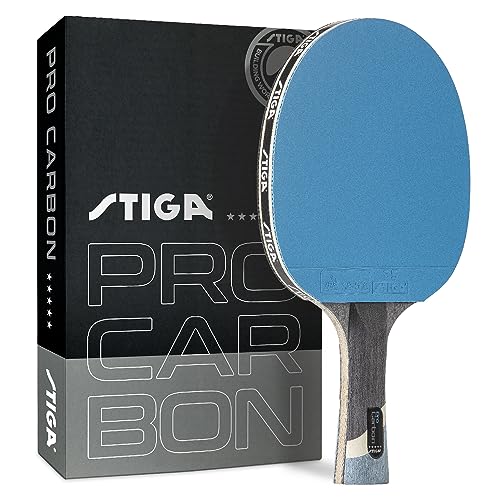
STIGA Pro Carbon Performance-Level Ping Pong Paddle
A seven-ply carbon blade with 2 mm sponge both sides at a price that does not assume you play in a league - the default upgrade from a boxed set.
Blade
7-ply with carbon layers (published)
Sponge
2 mm (published)
Handle
Flared
Approval
ITTF-approved rubber (published)
Pros
A seven-ply blade with carbon stiffening is a genuinely different object from a boxed-set paddle - the ball leaves the face faster for the same swing, which is the thing people notice first
2 mm sponge on both faces is at the practical top of what the 4.0 mm ITTF sandwich limit allows, so you are not buying a paddle you will want to re-rubber in a season
STIGA is a Swedish table tennis maker rather than a general sporting-goods brand, and it keeps this model in production year after year - the paddle you buy is the paddle in the reviews
Flared handle, which is the shape most players settle on because it stops the racket sliding out of the hand on a fast loop
Cons
The fast, stiff combination is unforgiving while you are still learning - mis-hits fly off the end of the table instead of dropping into the net, and that is more discouraging than it sounds
No case is included at this price, and an uncased rubber picks up dust and loses friction faster
The listing publishes no blade weight, so you cannot know how head-heavy it will feel before it arrives
It is a single paddle: a table that two people play on needs two, which puts the real spend above several of the sets lower down this page
Best for: One paddle you will not outgrow in a year.
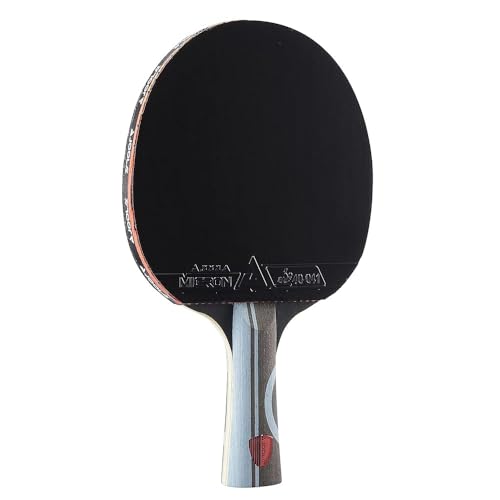
Five plies rather than seven means a thinner, more flexible blade, which holds the ball on the face slightly longer - the measurable mechanism behind the word 'control'
One of very few paddles at this price that publishes an actual weight (270 g), so you can compare it against another paddle instead of guessing
The carbon layer adds stiffness without the extra plies, which is why it does not feel as slow as an all-wood five-ply
JOOLA is a table tennis specialist and the official supplier to several national-level events, and its consumer paddles use rubbers from that same catalog
Cons
Slower than the STIGA Pro Carbon by design - if you already drive the ball hard, you will feel the paddle holding you back inside a week
The listing does not publish a sponge thickness figure, which is the single most useful number on a paddle spec sheet
Light blue face: legal under the post-2021 color rule, but worth knowing if you expected the traditional red
No case, and this is a paddle whose carbon layer makes the blade worth protecting
Best for: A first real paddle, where keeping the ball on the table matters most.
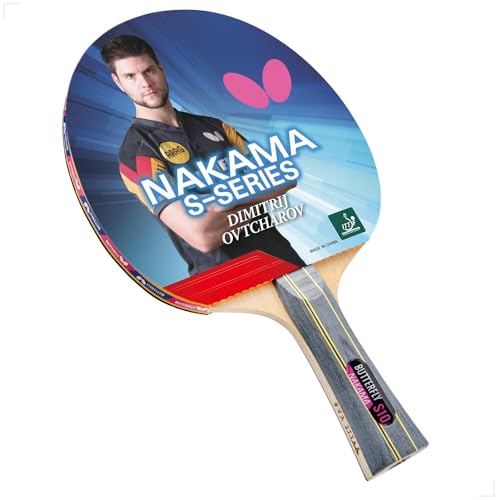
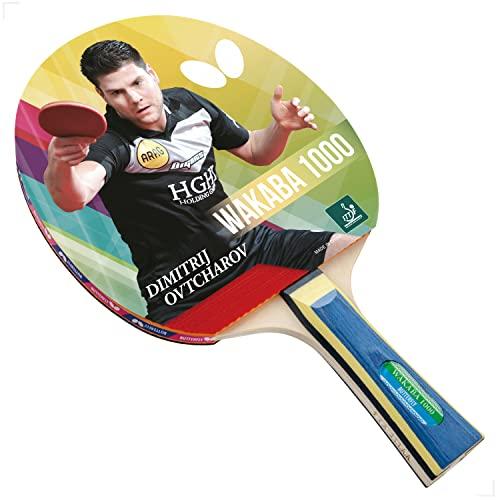
Butterfly's entry Nakama with its own Wakaba rubber and a thick sponge layer - the cheapest way onto this maker's ladder.
Blade
Wood (ply count not published on listing)
Rubber
Butterfly Wakaba, thick sponge layer (published)
Approval
ITTF-approved (published)
Included
2 balls
Pros
Butterfly is the most recognized name in the sport and the Nakama line is its own graded series - S-10 at the bottom, S-1 at the top - so there is a defined upgrade path rather than a dead end
The rubber is a named Butterfly rubber (Wakaba) rather than an unbranded sheet, which means the sheet on this paddle is the sheet Butterfly sells separately
ITTF-approved, so it is legal for sanctioned play out of the box
Two balls included, which sounds trivial until you realize a 3-star ball costs a meaningful fraction of a cheap paddle
Cons
The listing does not publish a ply count, a blade weight or a sponge thickness in millimeters - 'thick sponge layer' is as specific as it gets, and that is less information than the STIGA or JOOLA give you
This is the bottom of the Nakama range: the S-1 above it costs roughly four times as much, so the badge here buys pedigree rather than performance
No case included
A beginner will not detect what this paddle does better than the PRO-SPIN below it, which costs noticeably less
Best for: Buying into a real table tennis range without a three-figure spend.
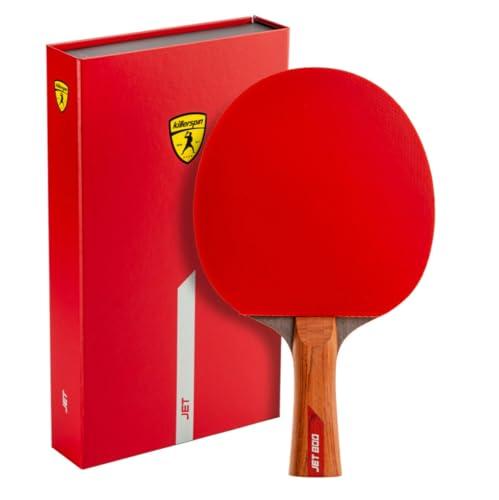
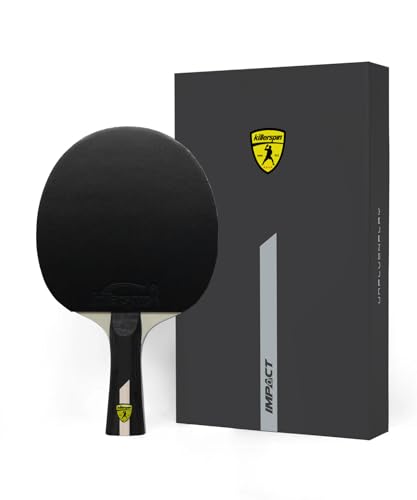
Competition-grade construction with Killerspin's own Nitrx rubber - the most paddle on this page, and the least forgiving.
Grade
Professional / competition (published)
Rubber
Killerspin Nitrx (published)
Handle
Flared
Faces
Red / black
Pros
The closest thing here to a custom build bought pre-assembled: a named competition blade with a named competition rubber on both faces
Killerspin's Jet series has been in production for well over a decade, so the model is a known quantity rather than a seasonal listing
Built for an offensive game - if your problem is that your current paddle cannot keep up with your swing, this is the pick that solves it
Red and black faces, the classic legal pairing, with no ambiguity about tournament eligibility
Cons
Costs roughly six times the JOOLA Family set of four, and a beginner will play worse with it, not better - speed without a stroke to put behind it just means more balls off the end
The listing does not publish a sponge thickness or a ply count, which for a paddle at this price is a genuine gap
The fast Nitrx rubber is the part that wears, and replacing a competition rubber on both faces costs a real fraction of the paddle
Single paddle, no case at this listing - and this is the one paddle on the page that most needs a case
Best for: A player who already loops and wants the fastest legal setup here.
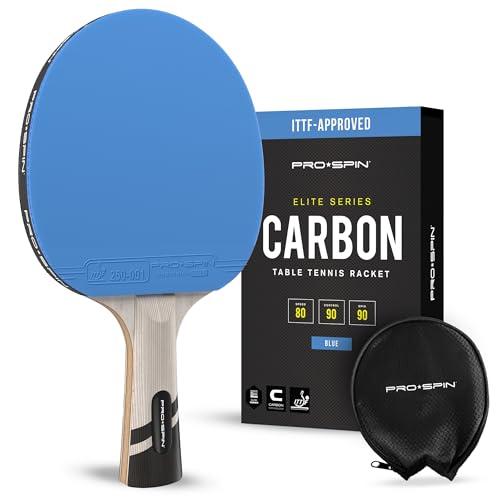
A 7-ply carbon blade with 2.0 mm sponge and ITTF-approved rubber for well under half the STIGA - the spec sheet is the argument.
Blade
7-ply with carbon fiber (published)
Sponge
2.0 mm (published)
Approval
ITTF-approved (published)
Faces
Blue / black
Pros
Publishes the two numbers that matter - 7-ply carbon blade, 2.0 mm sponge - and they are the same numbers as paddles costing twice as much
ITTF-approved rubber at this price is unusual, and it is the clearest signal that the sheet is a real rubber rather than a hard sheet with a sponge-shaped print
The cheapest pick here that we would call a genuine upgrade from a boxed-set paddle rather than a lateral move
Blue face rather than red, which the post-2021 color rule permits, and which makes the two faces easy to tell apart at a glance
Cons
PRO-SPIN is an Amazon-native brand rather than a table tennis maker, so there is no upgrade ladder above this paddle and no separately-sold replacement rubber
Several near-identical PRO-SPIN listings exist at different prices and pack sizes - check you are buying the single paddle and not a set, or the reverse
The listing does not publish a blade weight or a handle shape
Owner reports on these Amazon-native paddles are less consistent than on STIGA or Butterfly, which is what you would expect from a brand with no decades-long production history
Best for: The most paddle per dollar, if you only need one.
STIGA Performance 4-Player Ping Pong Paddle Set (USATT-approved)
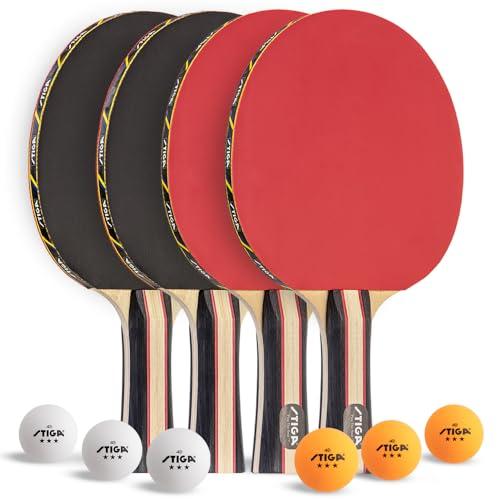
Four USATT-approved rackets with 3-star balls from a real table tennis maker - the set to buy when the table is the family's, not yours.
Quantity
4 rackets (2- or 4-player option)
Blade
5-ply with flared handle (published)
Approval
USATT-approved (published)
Included
3-star balls
Pros
USATT approval on a four-paddle set is rare and means all four are legal rackets rather than novelty bats
Five-ply blades with flared handles - the forgiving, controllable combination, which is the right choice for four players of mixed ability
3-star balls included: the top consumer ball grade, and a real cost saving against buying them separately
Four matching paddles removes the argument about who got the good one, which is the actual failure mode of a mixed paddle drawer
Cons
This listing is sold in both 2-player and 4-player configurations at different prices - read the option you are selecting carefully, because the cheaper variant is two paddles
No sponge thickness is published for any of the four, so you cannot compare them against the single paddles above on the most useful number
A set of four means the money is spread four ways: no individual paddle here plays like the STIGA Pro Carbon
No case for the paddles themselves - the balls come boxed, the rackets do not
Best for: A table that four people play on, where the paddles should match.
$26.9937% offPrice as of November 24, 2026·#addisclosure
JOOLA Family Premium Ping Pong Paddle Set (4 paddles, 10 balls, case)
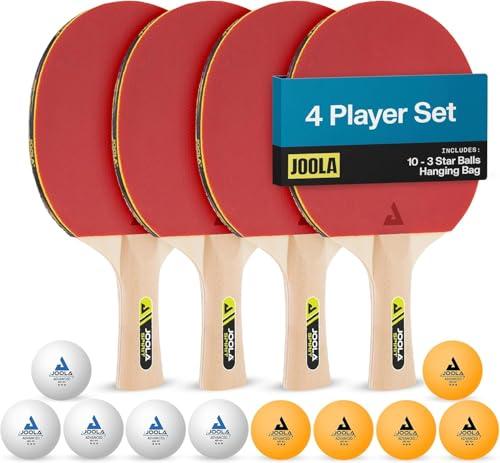
Four paddles, ten 3-star balls and a case for less than one performance racket - the cheapest honest way to make a table playable.
Quantity
4 rackets
Included
10 3-star balls, storage case
Brand
JOOLA
Use
Recreational / competitive (per listing)
Pros
Four paddles, ten balls and a storage case for less than the price of a single mid-range racket - nothing else here comes close on cost per playable seat
A case is included, which is the accessory that actually extends rubber life, and the one most single paddles at any price omit
Ten 3-star balls is a genuinely useful number: balls get stepped on, and a table with two balls left is a table nobody uses
JOOLA is a table tennis maker rather than a general toy brand, so even the family-grade rubber is a table tennis rubber
Cons
No sponge thickness, ply count or approval is published for these paddles, and at this price you should assume thin sponge over a basic blade
A competent player will outgrow all four inside a few weeks - this is equipment for a table, not for a player
Spin is where cheap rubber fails first: these will block and drive adequately and will not hold a heavy topspin
No upgrade path - when one wears out you replace the paddle, not the rubber
Best for: Kitting out a table for the whole house on the smallest sensible budget.
Butterfly's cheapest ITTF-approved racket - the badge and the legality, without the Nakama price.
Rubber
Butterfly Wakaba (published)
Approval
ITTF-approved (published)
Models
3 variants on listing
Brand
Butterfly
Pros
ITTF-approved from the sport's best-known maker at a price that undercuts the Nakama S-10 - if approval is a gate for you, this is the cheapest way through it
Uses the same named Wakaba rubber as the Nakama S-10 above, so the contact surface is not a downgrade from the pricier paddle
Butterfly keeps this model in production across years, which means replacement and resale are both straightforward
Three variants on one listing gives some choice of speed and spin bias without leaving the model
Cons
Three models on a single listing is a real trap - the variant you receive depends on the option selected, and the page does not make the differences obvious
No published ply count, blade weight or sponge thickness anywhere on the listing
The blade below the Wakaba rubber is the cheapest Butterfly sells, and that is where the saving against the Nakama comes from
No case, no balls
Best for: League-legal play at the lowest price from a sport brand.
$39.9525% offPrice as of November 24, 2026·#addisclosure
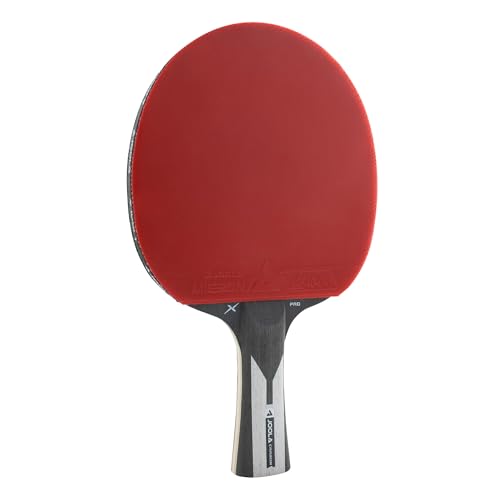
JOOLA Carbon X Pro Ping Pong Paddle (ITTF-approved)
An ITTF-approved JOOLA with an ergonomic handle and vibration damping - the pick chosen for how it feels to hold, not how fast it is.
Handle
Ergonomic grip (published)
Approval
ITTF-approved (published)
Feature
Pro Friction surface treatment (published)
Brand
JOOLA
Pros
The handle is the differentiator and it is a real one - an hour of continuous play is where a badly-shaped grip announces itself, and this is the pick that addresses it
ITTF-approved at a price below the Infinity Edge, so legality is not the trade-off for the comfort
JOOLA's Carbon series sits in a defined range, so moving up to the Infinity Z later is a straightforward step
Vibration control genuinely matters on a stiff carbon blade, where a mis-hit otherwise rings through the handle
Cons
'Pro Friction technology' and 'vibration control' are the maker's own marketing terms with no published figures behind them, and we have not tested either claim
No published sponge thickness or ply count
An ergonomic handle is a personal fit, not an upgrade - if a standard flared handle suits your hand, this pick's main advantage does nothing for you
Carbon in the name here does not mean the same construction as the STIGA Pro Carbon's published seven-ply carbon sandwich
Best for: Long sessions, or a hand that finds a plain flared handle uncomfortable.
Skip this
The budget traps that look cheap and cost you twice. We'd skip these.
Any paddle with two black faces
One face must be black and the other clearly distinguishable from black and from the ball - a rule in force since 1986, precisely so an opponent can see which rubber is coming. A matching-black pair is not a legal racket for sanctioned play, whatever the listing says.
Paddles sold purely on a printed speed / spin / control score
Those numbers are set by each manufacturer for its own range and are not comparable between brands. A 95 from one maker and a 95 from another are two unrelated claims. Published sponge thickness and ply count are comparable; the scores are not.
A 'carbon fiber' paddle with no published ply count
The rules cap any carbon or glass fiber layer at 7.5% of blade thickness or 0.35 mm, whichever is smaller. On a legal paddle the carbon is a thin stiffener inside a wooden blade. A listing that leads with carbon and will not say how many plies are around it is selling the word, not the construction.
A boxed set with a net, four paddles and a 'pro' label under $15
At that price the rubber is a hard thin sheet with little or no sponge, which is why the ball comes off dead regardless of how well it is struck. If the budget is genuinely that tight, the JOOLA Family set is the floor at which paddles start behaving like paddles.
Replacement rubber, if you own a pre-assembled paddle
Re-rubbering is the custom route: a bare blade, a chosen sheet per face, and glue. Sticking a performance sheet onto a boxed-set blade spends real money on the half of the paddle that was not the problem.
Our verdict
Buy the STIGA Pro Carbon if you want one paddle that will still be the right paddle in two years. Buy the JOOLA Family set of four if the table belongs to the house rather than to you, and the STIGA Performance set if you want four paddles that are also legal rackets. Buy the PRO-SPIN if you want the published 7-ply carbon and 2.0 mm sponge spec for the least money, the JOOLA Infinity Edge if control matters more than speed, and the Killerspin Jet 800 only if you already have a stroke that a slower paddle is holding back.
What a paddle can and cannot fix
A better paddle produces more spin for the same stroke, and that is the whole of what it does. It does not improve your timing, your footwork or your serve. The order of things that limit a home game is: the table, then the ball, then the player, then the paddle - and the paddle is genuinely last. A warped tabletop with a sagging net makes every paddle on this page play the same, which is why our small ping pong table roundup and the outdoor table roundup are the better first purchases if the table is the weak link.
The ball is the cheapest real upgrade and the one people skip. A 3-star ball is the top consumer grade, and the difference between it and a bag of unmarked balls is visible in how consistently the ball bounces off the same spot. Several picks here include 3-star balls for exactly that reason. One caution: the star rating is not standardized between manufacturers, so three stars from an unknown brand is a claim rather than a grade.
Where paddles fit in a game room
Paddles are the one piece of game-room equipment that disappears. A pool table keeps its cues in a wall rack, a dartboard keeps its darts in the cabinet, and ping pong paddles end up under a sofa cushion. Buy the number of paddles the table needs, in one set, and give them somewhere to live - a drawer, a hook, or the case that comes with the JOOLA and Killerspin picks here.
If the table is a conversion top on a pool table or a dining table, the storage problem is worse, because the whole setup gets packed away between uses and the paddles are the smallest part of it. The combo-table picks in our pool and ping pong combo table roundup and the multi-game table roundup all have this problem, and a single zipped case solves it better than a drawer does. For everything else a game room needs to be usable rather than just furnished, our game room games roundup covers the rest.
How much should a first paddle cost?
There are three sensible price points on this page and nothing worth buying between them. At the bottom, a four-paddle set makes a table playable for everyone in the house. In the middle, a single paddle with a published multi-ply carbon blade and 2 mm sponge is the point at which the equipment stops being the limiting factor for a recreational player - that is where the STIGA Pro Carbon and the PRO-SPIN sit, at very different prices for a similar published spec. At the top, a competition racket is a purchase for a player who has a stroke to put behind it.
What is not worth paying for is a mid-priced paddle that publishes nothing. If a listing will not give a ply count, a sponge thickness or an approval status, the money is going into the box art. Our how we pick page sets out the published-spec rule we apply here and on every roundup on this site.
The other consumable in the room
Table tennis rubber and dart tips fail the same way: quietly, from the surface in, while the object still looks fine. A rubber that has lost its friction produces less spin for the same stroke, and a bent plastic dart tip throws off-line while feeling normal in the hand. If an electronic dartboard is the other thing in the room, our best soft tip darts roundup counts the spare tips on every set — because that, not the barrel, is what decides when you next spend money.
Frequently asked questions
What is the best ping pong paddle for most people?+
A single paddle with a published multi-ply blade, a carbon stiffening layer and around 2 mm of sponge on each face - the STIGA Pro Carbon is our pick, and the PRO-SPIN publishes the same 7-ply carbon and 2.0 mm sponge spec for less. If the table is shared by a household, a matched four-paddle set is the better purchase than one good paddle and three mismatched ones.
Does an expensive ping pong paddle actually make you better?+
It produces more spin for the same stroke, and that is all. It does not improve timing, footwork or serve. A faster, stiffer paddle in the hands of a beginner usually makes the score worse, because mis-hits that used to land in the net now fly off the end of the table. The honest order of what limits a home game is the table, then the ball, then the player, then the paddle.
What does 'ITTF approved' mean on a ping pong paddle?+
It means the rubber is on the governing body's authorized list and the racket is legal for sanctioned competition. For league or tournament play it is a requirement. For a basement table it is useful mainly as evidence that the rubber is a real table tennis rubber rather than a hard sheet, and nothing more than that.
How thick should the sponge on a ping pong paddle be?+
The rules cap sandwich rubber at 4.0 mm total including the topsheet, and performance paddles typically publish 2 mm of sponge. Thinner sponge gives more control; thicker sponge gives more speed and less margin for error. A paddle that publishes no sponge figure at all is usually a thin hard sheet over little or no foam, which is the dead feel people complain about in boxed sets.
Why does a ping pong paddle have one red side and one black side?+
So your opponent can see which rubber you are about to use. Until a 1986 rule change both faces could be black, which let players hide the difference. Today one side must be black and the other must be clearly distinguishable from black and from the ball - and since 2021 that second color can be blue, green, pink or violet as well as red, which is why several paddles here ship with a blue or green face.
Is a carbon fiber ping pong paddle better than a wooden one?+
It is stiffer, which returns more of your swing speed to the ball. It is not a carbon bat: the rules require at least 85% of blade thickness to be natural wood and cap any fiber layer at 7.5% of thickness or 0.35 mm, whichever is smaller. So carbon means a thin stiffening sheet inside a wooden blade, and whether that suits you depends on whether you want more speed or more dwell time on the face.
How long does ping pong paddle rubber last?+
Rubber is kept until it wears out or is damaged, and no listing publishes a lifespan - it depends entirely on how often you play and how the paddle is stored. What is known is that the surface needs regular cleaning with water and soap or a commercial cleaner to hold the friction that produces spin, and that a paddle kept in a case holds that surface longer than one left face-down on a table.
Should I buy a paddle set or a single paddle?+
Buy the number the table needs. A table used by four people wants four matched paddles, because the real failure is a drawer with one good paddle and three strangers in it and an argument about who gets which. A table one person practices on wants one good paddle. Buying one performance racket for a family table is the most common mistake on this page.
Are the speed, spin and control numbers on the packaging comparable between brands?+
No. Each manufacturer sets those scales for its own range, and there is no cross-brand standard behind them. A 95 from one maker tells you nothing about a 95 from another. Compare published sponge thickness, blade ply count and approval status instead - those are the figures that mean the same thing on every listing.
Prices and availability shown here come from Amazon's live data and change often; we re-verify them regularly. Bar Bumper is an Amazon Associate and earns a commission on qualifying purchases at no extra cost to you. Read our full disclosure.