Cheap battle ropes: what to buy, what length, and the part everyone forgets to order
This is one of the few bits of gym equipment where cheap and expensive are the same product. A rope is a rope — the only decisions are thickness, length, and what you tie it to.
Updated October 2026 · By Stephen V.
Buy a 1.5-inch by 30-foot poly dacron rope with a sleeve and an anchor included, and stop thinking about it — the Perantlb 1.5 in x 30 ft is that rope. If you would rather buy from a seller with the simplest returns, the Amazon Basics 1.5 in x 30 ft is the same specification minus the anchor. If you have a garage long enough to use it, the 40-foot version is heavier and gives the wave somewhere to travel. And if your rope does not come with an anchor, add the POWER GUIDANCE anchor strap kit, because the rope is useless until it is tied to something.
Battle ropes are the rare case where the budget version is not a compromise. There is no motor, no bearing, no electronics and no frame — it is twisted poly dacron with a sleeve over it and heat-shrunk ends. A $35 rope and a $200 rope of the same diameter and length are doing identical work. What you are actually buying at the higher price is a brand name, a nicer sleeve, and occasionally a steel anchor plate. That makes this one of the highest-value purchases a budget home gym can make.
What matters instead is matching the rope to your space and your body. Diameter sets the grip and the difficulty: 1.5 inch is the standard and the right answer for essentially everyone buying their first rope; 2 inch is a specialist grip-destroying tool that costs three times as much. Length sets the weight and the space you need: a 30-foot rope anchored in the middle gives you two 15-foot halves, so you need roughly 15 to 20 feet of clear floor. The sleeve decides whether the rope survives being dragged across concrete. And the anchor is the part people forget, then improvise badly.
We have not lab-tested ropes. Every figure below is the manufacturer's or the listing's published specification, labelled as such — and in this category the published specs genuinely are most of the story, because there is so little else to a rope.
The short answer
In a hurry? These are the picks we'd buy. Prices are live; tap a card below for the full reasoning.
$69.9920% offPrice as of October 6, 2026·#addisclosure
Quick picks
#
Product
Best for
Score
Price
1
Best overall
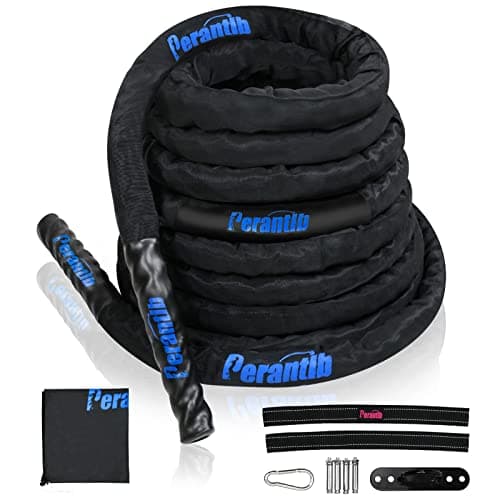
Perantlb Poly Dacron Battle Rope with Sleeve & Anchor (1.5 in x 30 ft)
A 1.5-inch by 30-foot poly dacron rope with a protective sleeve and an anchor strap kit included, which makes it a complete setup rather than a rope you then have to solve a problem with.
almost everyone: standard diameter, standard length, and the anchor is in the box
$45.9920% offPrice as of October 6, 2026·#addisclosure
2
Best known quantity
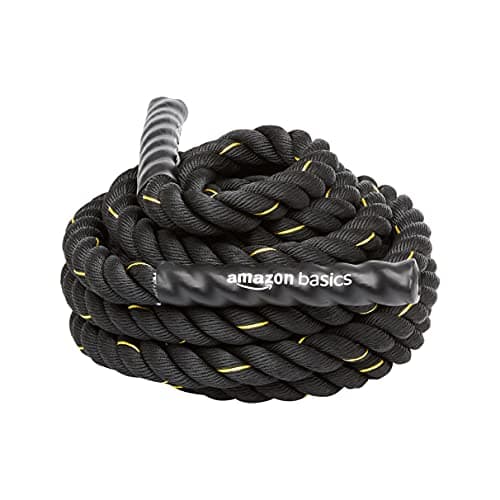
Amazon Basics Battle Rope (1.5 in x 30 ft)
The same 1.5-inch by 30-foot poly dacron specification with a waterproof sleeve and heat-shrink end caps, from the one seller whose returns process is never a question.
a buyer who wants the simplest possible purchase and already has somewhere to tie it
Perantlb Poly Dacron Battle Rope with Sleeve & Anchor (1.5 in x 40 ft)
The same rope with ten more feet of it: heavier in the hands, longer travel for the wave, and the version to buy if 30 feet has already stopped being hard.
a garage, driveway or yard with 20-plus feet of clear space and a desire for harder work
$45.9920% offPrice as of October 6, 2026·#addisclosure
Perantlb Poly Dacron Battle Rope with Sleeve & Anchor (1.5 in x 30 ft)
A 1.5-inch by 30-foot poly dacron rope with a protective sleeve and an anchor strap kit included, which makes it a complete setup rather than a rope you then have to solve a problem with.
Diameter
1.5 in
Length
30 ft
Material
100% poly dacron (listing)
Sleeve
Protective sleeve (listing)
Anchor
Strap kit included (listing)
Space needed
About 15-20 ft clear
Pros
The anchor strap kit is included, which is the difference between training on day one and ordering a second thing. Sold separately an anchor costs roughly a third of what this rope costs
1.5 inch by 30 ft is the correct default: heavy enough to be genuinely hard, thin enough to grip properly, short enough to fit in a two-car garage or a driveway
The protective sleeve is the single spec that decides how long a rope lasts. Bare poly dacron dragged over concrete abrades; a sleeved rope mostly does not
Also sold in 40 ft and 50 ft at the same specification, so if you later want more rope you are not relearning a product
100% poly dacron rather than a nylon blend, which is what you want: it does not soak up water, it does not stiffen in the cold, and it frays slowly
Cons
Perantlb is a marketplace brand with no independent testing behind it. The specification is standard and the price is low, but there is no warranty department worth the name
The rope weight is not published, which is the one figure serious buyers want — for a given diameter and length it is fairly predictable, but it is not stated
The included anchor is a nylon strap, not a steel plate. It is entirely adequate wrapped around a post or a rack upright; it is not a permanent wall mount
Like every sleeved rope, the sleeve can creep toward the handle end after a lot of heavy waves and occasionally needs working back
30 ft anchored in the middle still needs 15 to 20 ft of clear floor to use properly. In a small room you will be doing shortened waves against a wall
Best for: almost everyone: standard diameter, standard length, and the anchor is in the box.
The same 1.5-inch by 30-foot poly dacron specification with a waterproof sleeve and heat-shrink end caps, from the one seller whose returns process is never a question.
Diameter
1.5 in
Length
30 ft
Material
3-strand poly dacron (listing)
Sleeve
Waterproof sleeve (listing)
Ends
Heat-shrink caps (listing)
Anchor
Not included
Pros
A waterproof sleeve and heat-shrink end caps are both stated on the listing, and both are exactly the details that make a rope last — fraying ends are the usual way a cheap rope dies
Amazon Basics means a predictable returns experience, which on a bulky 30-foot item that has to go back in a box is worth more than it sounds
Three-strand twisted poly dacron construction, the standard for this category, with no nylon blend to stiffen up in a cold garage
Often the cheapest sleeved rope on the market at this specification, which makes it the honest floor price for a rope worth owning
A high-visibility tracking line is woven in, which sounds like marketing but does help you see whether both sides of the rope are moving symmetrically
Cons
No anchor included. Budget for one, or plan to wrap it around a rack upright or a sturdy post — this is the one reason it is not our overall pick
At typical prices it costs about the same as a rope that does include an anchor, which makes the value proposition worse rather than better once you add the missing part
Thirty feet of 1.5-inch rope is not heavy in absolute terms, and no rope weight is published for this listing. Strong users sometimes find a 30 ft rope less punishing than they expected — the fix for that is more length, not more diameter
No brand story, no customer service beyond the marketplace, and no replacement sleeve available if you wear one out
Same space requirement as any 30 ft rope: 15 to 20 ft of clear floor, and ideally somewhere you do not mind the rope slapping
Best for: a buyer who wants the simplest possible purchase and already has somewhere to tie it.
$69.9920% offPrice as of October 6, 2026·#addisclosure
Perantlb Poly Dacron Battle Rope with Sleeve & Anchor (1.5 in x 40 ft)
The same rope with ten more feet of it: heavier in the hands, longer travel for the wave, and the version to buy if 30 feet has already stopped being hard.
Diameter
1.5 in
Length
40 ft
Material
100% poly dacron (listing)
Sleeve
Protective sleeve (listing)
Anchor
Strap kit included (listing)
Space needed
About 20-25 ft clear
Pros
More rope is more weight, and weight is how a battle rope gets harder. This is the cheapest way to make the same workout considerably more difficult
A longer rope gives the wave further to travel, which makes alternating waves feel smoother and sustained sets feel less choppy
Still includes the anchor strap kit, so it is a complete setup like the 30 ft version
Useful for two people: a 40 ft rope anchored in the middle gives two genuinely usable 20 ft halves for partner or circuit work
Costs meaningfully less than a 2-inch rope while being harder than a 30 ft 1.5-inch rope, which is better value than going thicker
Cons
It needs the space. 20 to 25 ft of clear floor is a full garage bay or outdoors — in a spare bedroom this is simply the wrong purchase
Heavier to coil, carry and store. A 40 ft rope is a real armful and it does not hang neatly on a small hook
Harder than most beginners want. If you have never done rope work, the 30 ft version will already have you breathing hard inside twenty seconds
Same marketplace-brand caveat as the 30 ft: no independent testing, no meaningful warranty, and no published rope weight
Stock on the longer lengths moves in and out more than the 30 ft, so it is worth checking availability rather than assuming
Best for: a garage, driveway or yard with 20-plus feet of clear space and a desire for harder work.
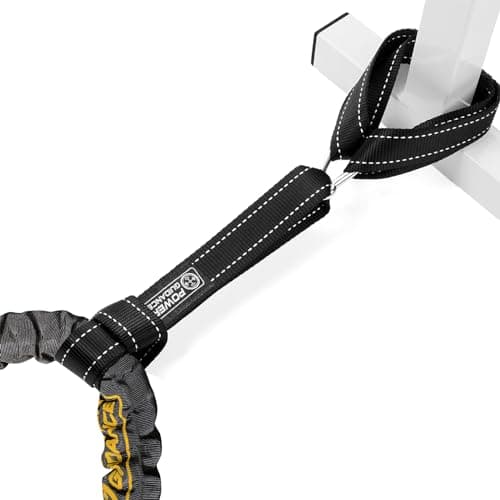
A strap kit that wraps a post, tree or rack upright and gives the rope a proper pivot, for roughly a tenth of the cost of the rope it protects.
Type
Strap and loop kit
Fits rope
1.5 in and 2 in (listing)
Anchors to
Post, tree, rack upright
Install
Wrap, no drilling
Portable
Yes
Capacity
Not published
Pros
Lets the rope pivot at the anchor point instead of grinding against whatever you looped it around, which is what actually destroys cheap ropes
No drilling, no bolts, nothing permanent. It wraps a rack upright, a fence post, a tree or a structural column and comes off in seconds
Fits both 1.5-inch and 2-inch ropes per the listing, so it carries over if you upgrade
Costs about a tenth of what the rope costs, which makes it the cheapest piece of insurance in the gym
Portable in a way that a wall-mounted bracket is not — it goes to a park or a driveway with the rope
Cons
No published capacity figure, which in fairness is true of almost every strap in this category. Inspect the stitching before each session
You still need something solid to wrap it around. In an empty garage with nothing structural at floor level, you need a wall bracket instead and that means drilling
Wrapping it around a painted rack upright will mark the paint over time — not structural, but worth knowing
Redundant if your rope already came with an anchor strap, which two of our three rope picks do
A strap is not a steel wall plate. If you want a permanent, always-ready anchor at a fixed height, this is the cheap answer rather than the right one
Best for: anyone whose rope did not include an anchor, or who is currently using a radiator.
Skip this
The budget traps that look cheap and cost you twice. We'd skip these.
2-inch ropes as a first purchase
A 2-inch rope costs roughly three times a 1.5-inch rope of the same length and the extra difficulty is almost entirely in your grip, not your conditioning. Most people cannot hold onto one long enough to get a cardiovascular effect. Buy 1.5 inch, and if it stops being hard, buy more length rather than more diameter.
Cordless or 'anchorless' battle rope trainers
The short weighted handles sold as cordless battle ropes remove the rope, which is the entire piece of equipment. What makes rope work hard is moving the mass of 30 feet of poly dacron; a pair of weighted grips moves your arms and nothing else. If space is the problem, a shorter real rope solves it better.
Unsleeved rope if you train on concrete
A bare poly dacron rope dragged across a concrete garage floor or a driveway abrades from the outside in, and the fraying starts in the first month. Sleeved ropes cost the same or less than bare ones at this end of the market, so there is no reason to buy bare unless you are training exclusively on grass or rubber.
Anchoring to furniture, a radiator or a door handle
People do all three and all three end badly. A battle rope puts a repeated snatching load on the anchor point in a direction furniture is not braced for. Use a structural post, a loaded rack upright, a tree, or a properly bolted wall bracket. A strap kit costs about ten dollars and is cheaper than a wall repair.
How to choose (and what to skip)
1.5 inch, not 2 inch
This is the only diameter decision that matters and the answer is 1.5 inch for virtually every home gym. It is the standard thickness, it is what almost every workout you will find online assumes, and it is grippable for the thirty to sixty seconds a work interval lasts. A 2-inch rope is a grip-strength specialty tool that costs three times as much and will have you dropping the rope before your heart rate gets anywhere interesting.
Length is really a question about your floor
A rope anchored in the middle gives you two halves. 30 ft means two 15 ft halves and about 15 to 20 ft of clear floor; 40 ft means two 20 ft halves and 20 to 25 ft. Measure the space before you choose, because a long rope in a short room means you train with slack in it, which is both less effective and harder on the sleeve. If in doubt, 30 ft is the safe choice and it is still properly hard.
The sleeve is the durability spec
A sleeve is a woven cover over the rope, and it is what takes the abrasion instead of the rope itself. On concrete, a driveway or asphalt it roughly decides the lifespan of the product. Sleeved ropes are not more expensive than bare ones in this price bracket, so there is no trade to make: buy sleeved. The only people who should consider a bare rope are training exclusively on grass or rubber mats.
Work out your anchor before you order the rope
The rope cannot be used until it is attached to something. A loaded power rack upright, a structural post, a fence post or a tree all work with a cheap strap kit. If you have none of those, you need a bolted wall or ceiling bracket, which means finding studs or a joist. Decide this first, because it occasionally changes which rope to buy: two of our picks include a strap and one does not.
Check whether an anchor is in the box
This is the most common cause of disappointment in the category. Listings for near-identical ropes differ on whether a strap is included, and a rope that arrives without one is just a heavy coil. Where everything else is equal, the rope that includes the anchor is the better buy by the cost of an anchor, which is why our top pick is the one it is.
What a rope will and will not do for you
It is a conditioning tool, not a strength tool. It raises your heart rate fast, loads the shoulders and grip without loading the spine or the knees, and packs a hard interval into a very small amount of time. It will not build maximal strength, and it is not a substitute for a barbell or for steady cardio. Buy it as the cheapest way to get a genuinely hard interval into a garage gym.
Why cheap works here and does not work elsewhere
Most of this site is about where cheap equipment breaks down — thin upright gauge on a budget power rack, undersized motors on a cheap treadmill, sloppy welds on a bench. Battle ropes are the exception that proves the rule. There is nothing in a rope to cheapen: no motor to undersize, no bearing to skimp on, no frame to under-gauge. A twisted poly dacron rope at 1.5 inch and 30 feet performs identically whether the label on it is a marketplace brand or a premium one.
That is why there is no premium pick on this page and no 'step up to' recommendation. The only genuine upgrades available are more length, a thicker diameter you probably do not want, or a steel wall anchor. Everything else you would be paying for is the name. For a budget gym it is a rare clean win: buy at the bottom of the market without the usual compromise, the same way cheap resistance bands and a cheap ab roller work out.
How much space you actually need
The rule of thumb that matters: anchor in the middle and you need a bit more than half the rope's length in clear floor, plus room to stand and move. A 30-foot rope therefore wants about 15 to 20 feet; a 40-foot rope wants 20 to 25. You can train with less by letting the rope run with slack, but slack kills the wave and drags the sleeve across the ground on every rep, which is how a rope wears out early.
Outdoors solves the space problem entirely and is where a lot of rope work happens — a driveway, a yard, a fence post. Grass is kindest to the rope, asphalt is harshest. If you are training in a garage and the floor is bare concrete, a few rubber tiles or a mat under the working section of rope will extend its life noticeably and cut the noise, which matters if the gym shares a wall with a bedroom. Our guide on reducing home gym noise covers the rest of that problem.
Where a rope fits in a budget gym
A battle rope is a conditioning purchase, and it competes with cardio machines rather than with weights. For roughly the price of a single month of a gym membership it gives you intervals that are genuinely hard, impose almost no impact on knees or hips, and take up no floor space when coiled in a corner. Compared with the machines on our cheap cardio machines page it is dramatically cheaper and takes a fraction of the room — and dramatically less convenient, because it needs an anchor and clear floor rather than a plug socket.
The sensible way to think about it: a rope covers short, hard, low-impact intervals. A walking pad covers long, easy, daily volume. Those are the two ends of the cardio problem in a home gym and they cost very little together. The cheapest machine alternative is a budget mini stepper, which needs no anchor and almost no floor but tops out on resistance in a way a rope never does. The thing a rope does not do is steady-state work — nobody does forty minutes of waves — so if your goal is a daily 45-minute session, buy the machine. If your goal is to be properly out of breath in ten minutes in a garage, the rope is the cheaper and better answer, and it pairs well with the explosive work on our cheap medicine ball and plyo box pages.
Making a cheap rope last
Three habits, and they are the whole maintenance story. Anchor it properly so the rope pivots at the anchor rather than sawing against a sharp edge — this is most of it. Keep the working section off abrasive ground where you can, which usually means a mat, grass or a rubber-floored bay. Check the ends, because the heat-shrink caps are the first thing to go and a frayed end unravels fast once it starts; a wrap of electrical tape buys you a long time.
Done right, a sleeved poly dacron rope is the kind of purchase you make once. There is nothing in it to break, nothing to service, and no electronics to fail — which puts it in the same small category as a kettlebell or a cast iron plate: equipment that is effectively permanent. That is a useful thing to own when you are building a gym on a budget and most of what is on offer is not.
Frequently asked questions
Are cheap battle ropes any good?+
Yes, and this is one of the few categories where that is simply true rather than qualified. A rope has no motor, no bearings and no frame, so a cheap 1.5-inch poly dacron rope with a sleeve does the same job as an expensive one of the same size. Spend the difference on an anchor, or on more length. The one thing to avoid is an unsleeved rope if you train on concrete.
What size battle rope should I buy for a home gym?+
1.5 inch diameter by 30 ft for almost everyone. That gives two 15-foot halves when anchored in the middle and needs roughly 15 to 20 ft of clear floor. Go to 40 ft only if you have 20 to 25 ft of space and want the extra weight. Skip 2-inch ropes unless your specific goal is grip strength — they cost about three times as much and most people drop them before the conditioning effect arrives.
How much space do you need for battle ropes?+
A bit more than half the rope's length, because the rope is anchored in the middle and doubled back. For a 30 ft rope that is about 15 to 20 ft of clear floor, plus room to stand and move your arms. Less space than that and you train with slack in the rope, which both reduces the effect and drags the sleeve on the ground every rep. A driveway or a garage bay is ideal.
What do you anchor a battle rope to?+
Something structural: a loaded power rack upright, a steel post, a fence post, a tree, or a wall or floor bracket bolted into studs or masonry. Use a strap kit so the rope pivots at the anchor instead of grinding on an edge. Do not use furniture, a radiator, a door handle or a water pipe — the load is a repeated snatching pull in a direction none of those is braced for.
Do battle ropes come with an anchor?+
Some do and some do not, and it is the most common cause of disappointment in this category. Our top pick and the 40 ft version both include a strap kit per their listings; the Amazon Basics rope does not. Where two ropes are otherwise identical, the one including the anchor is better value by the price of an anchor — which is roughly a tenth of the rope's cost.
Are battle ropes good cardio?+
They are very good at short, hard intervals with almost no impact on joints, which makes them useful if running hurts your knees. They are not useful for steady-state work, because nobody sustains rope waves for forty minutes. The CDC's adult activity guidance asks for 150 minutes of moderate activity or 75 of vigorous per week; rope intervals count toward the vigorous side, but you will want something else for the volume — see our cheap cardio machines page.
Battle rope or a cardio machine for a small budget?+
A rope costs a fraction of any machine, stores in a corner, and needs no power. A machine is far more convenient, works in any floor space and supports long easy sessions. If you have 15 to 20 ft of clear floor and an anchor, the rope is the cheaper and harder workout. If you do not, or if you want daily low-effort volume, buy a walking pad instead.
How long do battle ropes last?+
A sleeved poly dacron rope used on a mat, grass or rubber flooring and anchored with a strap should last for years — there is nothing in it to wear out mechanically. The failure modes are abrasion from concrete or asphalt and fraying at the ends once the heat-shrink caps split. Both are slow, both are visible, and taping a split end early stops it spreading.
Prices and availability shown here come from Amazon's live data and change often; we re-verify them regularly. Bar Bumper is an Amazon Associate and earns a commission on qualifying purchases at no extra cost to you. Read our full disclosure.