Cheap resistance bands: the best few dollars in the whole gym
For warm-ups, accessories, and travel, resistance bands are the best value in a home gym. Tube-with-handles for full-body, fabric loops for lower-body — here's the split.
Updated July 2026 · By Stephen V.
Dollar for dollar, resistance bands are the best value in a home gym. A full set costs less than a couple of plates and does jobs nothing else does as cheaply: warming up shoulders and hips before you lift, adding accessory volume for arms and glutes, and packing an entire workout into a bag when you travel. No band replaces a barbell, but almost every budget gym is better for having a set in a drawer.
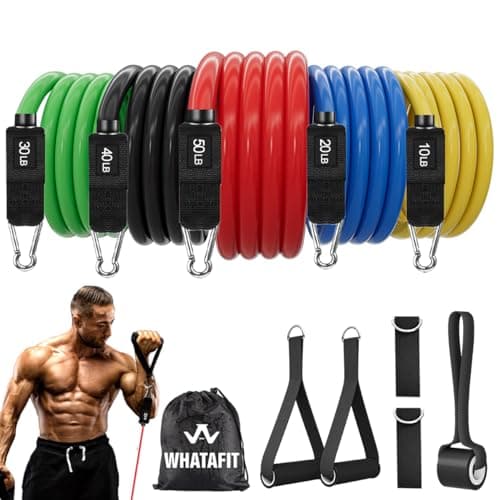
There are really two useful kinds. Tube bands with handles anchor to a door and cover full-body pressing, pulling, and curling — the closest a band gets to a cable machine. Fabric loop bands sit around the thighs for glute and lower-body work without slipping or rolling. Most people benefit from one of each. Here are the two we'd buy, and the marketing claim to ignore.
The short answer
In a hurry? These are the picks we'd buy. Prices are live; tap a card below for the full reasoning.
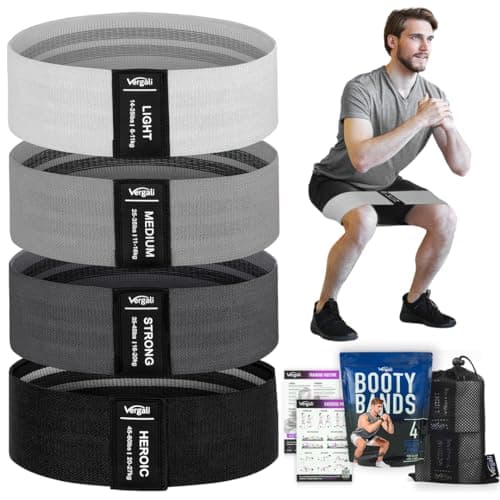
The pick for lower-body work — fabric loops that grip the thighs and won't roll or snap.
Type
Fabric loop bands
Set
4 resistance levels
Surface
Non-slip fabric
Best for
Glutes, hips, warm-ups
Pros
Fabric grips the thighs instead of rolling or pinching
Four levels cover warm-up to burnout
No latex to snap under a hard stretch
Cons
Loop shape limits them to lower-body work
Not for pressing or full-body movements
Fixed loop size suits a range of legs, not all
Best for: glutes and hip work.
Skip this
The budget traps that look cheap and cost you twice. We'd skip these.
Thin latex loop bands with no handles for pressing work
The cheap thin latex loops are fine for warm-ups, but people try to press and row with them and there's nothing to hold — you end up gripping bare rubber that digs into your hands and can snap back. For pressing and pulling you want tube bands with handles and an anchor; save the thin loops for mobility and glute activation.
Bands sold on wildly inflated 'resistance lbs' claims
A band's resistance changes with how far you stretch it, so a single big '150 lbs!' number on the pack is marketing, not a spec you can trust. Buy on band count, build quality, and what's in the set (handles, anchor, straps) rather than a headline pound figure — the stated pounds are a rough guide at best.
How to choose (and what to skip)
Match the band type to the job
Tube bands with handles are for full-body work — presses, rows, curls, and anything you'd anchor to a door. Fabric loop bands are for lower-body and glute work where you want grip around the thighs. They're cheap enough that owning one of each is the sensible move rather than forcing one to do both.
Ignore the headline 'lbs' number
Resistance rises the further you stretch a band, so the big pound figure on the package is approximate at best. Use it only to order bands light-to-heavy within one set. Judge sets on band count, material, and the handles and anchors included, not on a single dramatic number.
Fabric over thin latex for anything hard
For real working sets — hip thrusts, lateral walks, banded squats — fabric loops grip the skin and won't roll up or pinch like thin latex loops. Keep thin latex bands for warm-ups and mobility, where their light, smooth resistance is exactly what you want.
The set is only as good as its accessories
For tube bands, the door anchor, handles, and ankle straps are what make the set actually useful — they're the difference between a full-body toolkit and a drawer of loose rubber. Check the anchor is sturdy and the clips feel solid, since those are the first parts to wear out.
Frequently asked questions
Are cheap resistance bands worth it?+
For warm-ups, accessory work, and travel, they're the best value in a home gym — a full set costs less than a couple of plates. They won't replace a barbell for building maximal strength, but for prehab, added volume, and a packable travel workout, few purchases do more per dollar.
Tube bands with handles or fabric loop bands?+
Tube bands with handles are for full-body work — anchor them to a door for presses, rows, and curls, and pack them for travel. Fabric loop bands are for lower-body and glute work, sitting around the thighs without slipping. They do different jobs, and they're cheap enough that most people should just own one of each.
What do the resistance 'lbs' on bands actually mean?+
It's an approximate figure, not a hard spec. A band's resistance increases the more you stretch it, so any single pound number is a rough average rather than a fixed weight like a dumbbell. Use the numbers to order bands from light to heavy within a set, and don't compare a headline 'lbs' claim across brands too literally.
Do resistance bands wear out?+
Yes, they're a consumable. Latex and rubber degrade with UV light, heat, and heavy use, and clips and handles loosen over time. Store them out of direct sun, check for nicks or thinning before loading them hard, and replace any band that's showing cracks — a snapping band under tension is exactly what you want to avoid.
Prices and availability shown here come from Amazon's live data and change often; we re-verify them regularly. Bar Bumper is an Amazon Associate and earns a commission on qualifying purchases at no extra cost to you. Read our full disclosure.