When the floor has to stay a floor. Folding racks and wall-mount cable stations turn 18 inches of wall into a full gym — if you get the anchoring right.
Updated August 2026 · By Stephen V.
Most budget home-gym advice quietly assumes you have a spare room. Plenty of people don't — they have a garage that still has to hold a car, a basement that's also the laundry, or a spare bedroom that's also an office. For those rooms, the constraint isn't money at all. It's permanent floor space, and the answer is to hang the gym on the wall.
Wall-mounted gear trades one thing for another. You give up portability and you take on an installation job that has to be done properly. In return, you get a rack that folds to four inches deep, a cable station that occupies no floor at all, and a room that goes back to being a room in about fifteen seconds. Below are the four pieces we'd build a wall-mounted gym from, plus the anchoring rules that decide whether any of it is safe.
The short answer
In a hurry? These are the picks we'd buy. Prices are live; tap a card below for the full reasoning.
Abahub Wall-Mounted Multi-Grip Pull-Up Bar (440 lb)
The entry point to a wall-mounted gym: a proper multi-grip bar that's rated far beyond what a doorway bar manages.
Type
Wall-mounted pull-up bar
Capacity
440 lb (mfr rating)
Grips
Multi-grip
Footprint
Wall only
Pros
Solid enough for weighted pull-ups and kipping, unlike doorway bars
Cheap enough to be a first purchase rather than a project
Doubles as an anchor point for bands and a suspension trainer
Cons
Permanent — leaves fixings in the wall
Needs enough clearance above and behind for your head and knees
Pulling only; no pressing station
Best for: one wall, one purchase, real training.
Skip this
The budget traps that look cheap and cost you twice. We'd skip these.
Mounting anything load-bearing into drywall alone
Drywall anchors are rated for pictures and shelves, not for a person swinging under a bar or a rack absorbing a racked barbell. Every piece here has to land in studs, in solid masonry, or in properly specified structural blocking. If you can't confirm what's behind the surface, buy free-standing gear instead — this is the one corner in a budget gym that has no safe shortcut.
Wall-mounted gear in a rental you can't modify
These systems leave a grid of substantial holes and, on masonry, permanent anchors. If your lease doesn't allow that, a free-standing squat rack or power tower is the right answer even though it eats floor space. Making the hole first and asking later is an expensive way to find out.
Assuming the fixings in the box are the right ones
Kits are supplied with generic hardware that assumes a timber-framed wall. If yours is brick, block, or concrete, you need the appropriate anchors for that material, sized to the manufacturer's spec. Budget for the correct fixings as a separate line item — they're cheap, and they're the part holding you up.
How to choose (and what to skip)
Find out what your wall is made of first
This decides everything. A timber-stud wall needs the rack's mounting holes to line up with studs at 16 or 24 inch centers, which constrains where it can go. Solid brick, block or poured concrete gives you freedom of position but needs masonry anchors. A stud finder costs almost nothing and answers the question in five minutes.
Measure fold-out depth, not stowed depth
The marketing number is how flat it folds. The number that decides whether you can still park is how far it projects when it's out, plus the room you need to walk around a loaded bar. Chalk the fold-out footprint on the floor before you drill, and stand in it.
Check what's on the other side of the wall
You're putting substantial fixings deep into a structure, so know what's behind: plumbing, cabling, and, on a party wall, a neighbor. Repeated impact through a shared wall transmits noise far more effectively than through the air, which is one more reason to prefer an external or internal load-bearing wall.
Height matters as much as width
Wall racks need to be tall enough to press overhead inside them, and pull-up bars need clearance above the bar for your head and behind it for your knees. In garages, the door track is the usual obstruction. Measure to the lowest thing in the swing, not to the ceiling.
Don't skip the floor because you saved space on the wall
A folding rack still puts a loaded barbell over a concrete slab. Rubber where the weight lands is exactly as necessary as it is with a free-standing rack — see our flooring picks for what works over concrete.
What a wall-mounted gym actually gives you
The pitch is simple: a folding rack occupies roughly four to six inches of depth when stowed, against the roughly four by four feet a power cage occupies permanently. In a single-car garage that is the difference between a gym and a car. In a spare bedroom it's the difference between a gym and a room with a gym in it.
The less obvious benefit is stability. A free-standing budget rack resists tipping using its own weight and base width, which is why we're so insistent about frame weight in the power rack roundup. A wall-mounted rack is bolted to the building, so tipping isn't a failure mode at all. Properly installed, it's a stiffer, safer frame than a free-standing rack costing the same.
The cost is permanence and skill. You're making a structural attachment, and the quality of that attachment is the entire safety margin. There is no version of this where you improvise the fixings.
Stud walls vs masonry: what you're allowed to do
Timber stud walls
The load has to go into the studs themselves, using long lag bolts or structural screws, with the correct washers. That constrains position, because the rack's mounting holes must align with studs at 16 or 24 inch centers — which is why most folding racks are designed at exactly those spacings. Where holes and studs don't line up, the fix is a horizontal timber ledger bolted across several studs, with the rack mounted to that. Never into the drywall between studs, and never into a single stud where the manufacturer specifies two.
Brick, block and concrete
Solid masonry is the better substrate and gives you free choice of position. Use the anchor type specified for the material and the load — not generic plastic plugs. Hollow blocks need a different anchor from solid brick, and old, soft or perished mortar is not a fixing point: drill into the masonry unit, not the joint. If the wall's condition is genuinely uncertain, that's the moment to get a builder's opinion rather than a forum's.
How to lay out a whole gym on one wall
A working wall-mounted setup usually stacks three zones on one run of wall:
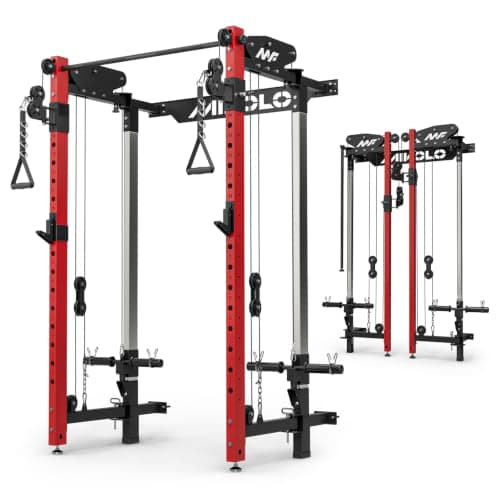
The rack zone — the folding rack, centered where you have the most fold-out room and the best floor underneath. This is the anchor of the whole layout, so place it first.
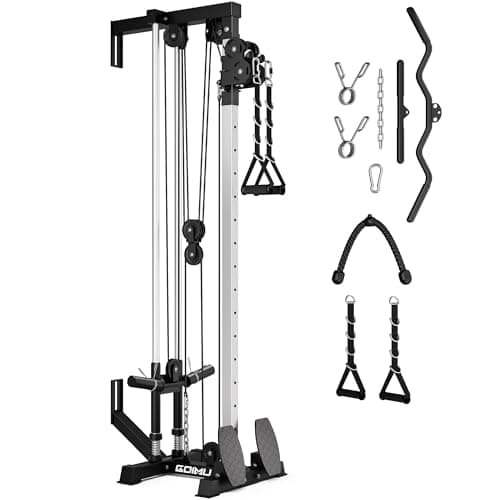
The pull zone, above — a pull-up bar or the cable station's high pulley, mounted high enough to hang freely but not so high you can't reach it.
The storage zone, beside — plate pegs, band hooks and a small shelf. Storage on the wall is what stops the floor filling back up with the gear you just saved space on.
The mistake people make is mounting everything at a comfortable standing height, then finding the rack fold-out overlaps the cable station's working area. Chalk it all out on the wall and floor first, walk through a squat, a press and a row in the chalk, and only then drill.
The garage-specific problems
Garages are the most common home for this gear and have three quirks worth planning around. The garage door track usually runs across the ceiling and limits both mounting height and where a bar can travel — measure to the track, not the ceiling. Exterior garage walls are often single-skin block or, in some builds, non-structural sheathing over a frame; the strong wall is usually the one shared with the house. And temperature swings drive condensation, which is what rusts a barbell to a garage wall, covered in our rust prevention guide.
One more practical note: check the fold-out position against where the car actually stops, with the doors open. Plenty of installations clear the parked car and not the passenger door.
What a wall-mounted gym can't do
It can't move with you, which matters if you rent or expect to. It can't be resold with a house the way a free-standing rack can be sold to the next lifter. It doesn't suit a wall you can't drill. And it doesn't remove the need for floor protection, plates, a bar or a bench — it saves space, not money. If your constraint is budget rather than square feet, a cheap free-standing cage is still the better buy; see the under-$500 build for what that looks like.
Where it wins, though, it wins completely. A room that can hold a full barbell gym for an hour a day and a car for the other twenty-three is not a compromise. It's the only version of that room that works at all.
Frequently asked questions
Are wall-mounted squat racks safe?+
Properly installed, they are stiffer and safer than a comparable free-standing budget rack, because they're bolted to the building and cannot tip. The entire safety margin, though, sits in the installation: fixings into studs, solid masonry or specified structural blocking, using the hardware the manufacturer requires. Mounted into drywall or into a wall you haven't identified, they are not safe at any price.
Can you put a wall-mounted rack in a rented apartment or garage?+
Usually not without permission. These systems leave a grid of substantial holes and, in masonry, permanent anchors, which most leases prohibit. If you rent, a free-standing squat rack or power tower is the honest answer even though it uses floor space permanently.
How much space does a folding wall rack need?+
Stowed, roughly four to six inches of depth. In use, plan for the fold-out depth stated by the manufacturer plus enough room to walk around a loaded barbell and to load plates on both ends. Chalk the fold-out footprint on the floor before drilling — the stowed number is the one on the box, and the fold-out number is the one that decides whether it fits.
Do I need a stud wall or will masonry work?+
Both work with the right hardware. Timber studs need long structural screws or lag bolts into the studs themselves, which constrains position to 16 or 24 inch centers. Solid brick, block or concrete gives you free positioning but needs the correct masonry anchors for that material. Drill into the masonry unit rather than the mortar joint.
Is a wall-mounted cable station as good as a free-standing one?+
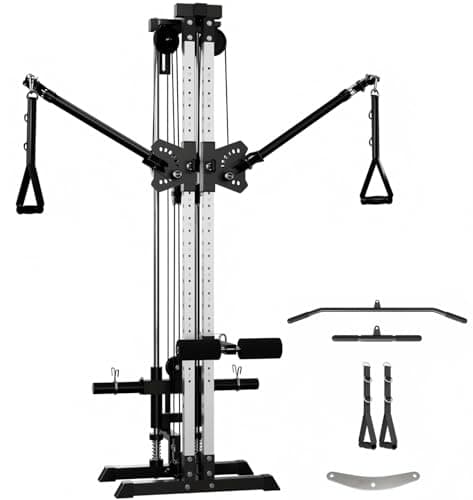
For most home training, close. You get the same pulldowns, rows, pushdowns and crossovers on no floor space at all, and plate-loading means it expands with the plates you own. What you give up is cable travel and the convenience of a selectorized stack, plus the requirement for a structurally sound wall to mount to.
Prices and availability shown here come from Amazon's live data and change often; we re-verify them regularly. Bar Bumper is an Amazon Associate and earns a commission on qualifying purchases at no extra cost to you. Read our full disclosure.