Home gym storage ideas that cost less than the floor they free up
A small gym does not feel small because of the equipment. It feels small because everything is on the floor. Storage is the cheapest square footage you will ever buy.
Updated August 2026 · By Stephen V.
There is a moment in every home gym where the equipment stops being a collection and starts being an obstacle course. Plates against one wall, dumbbells wherever they were last used, bands draped over the rack, a foam roller under the bench. The room has not shrunk; the floor has just been colonized.
Storage is the cheapest way to make a gym feel twice the size, and it is almost always cheaper than the equipment it holds. The principle is simple: everything gets a home, and as much as possible that home is on a wall rather than on the floor. Here is how to do that room by room, with the cheap options that actually work.
The short answer
In a hurry? These are the picks we'd buy. Prices are live; tap a card below for the full reasoning.
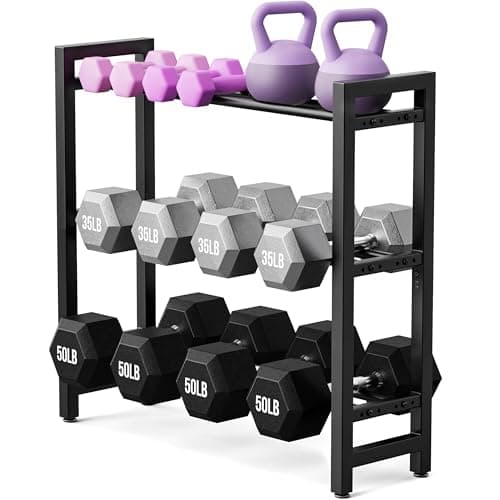
Three tiers against a wall replaces a scattered row of dumbbells across the middle of the room.
Holds
Fixed dumbbells
Tiers
3
Capacity
390 lb (mfr rating)
Footprint
Wall-hugging
Pros
Very cheap for the amount of clutter removed
Keeps pairs together and in weight order
Sits flat against a wall
Cons
Sized for hex dumbbells, not bulky adjustable sets
Light frame shifts if you drop weights onto it
Bottom tier means bending to floor level
Best for: fixed dumbbell sets.
The principle: vertical beats horizontal, always
Almost everything in a home gym is stored flat on the floor by default and can be stored vertically instead. Plates go on posts. Bars stand in a corner or hang on two hooks. Mats roll and stand on end. Bands hang from a peg. Every item you move from horizontal to vertical returns floor space at roughly ten times the storage footprint it takes.
Walls are the resource most home gyms leave completely unused. In a garage, the wall above waist height is usually empty from one end to the other, and it will hold everything except the plates.
Plates: the biggest single win
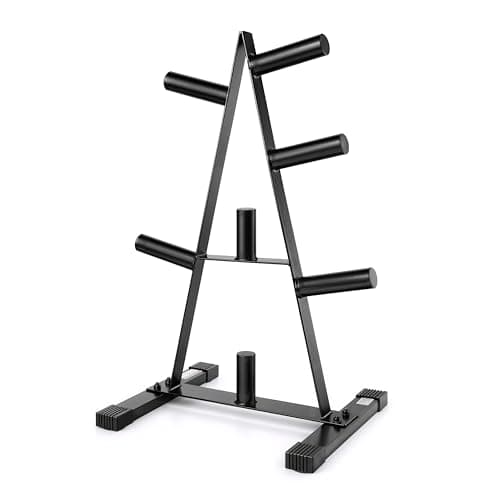
Plates are heavy, numerous, and the worst thing to store flat because getting to the one you want means moving the ones you do not. A plate tree fixes all of it and costs less than one 45. If your set is rubber rather than cast iron, get the bumper-specific tree with longer posts. Our weight plate storage roundup covers the options by plate type.
Wall-mounted plate pegs are the alternative if you have solid walls and want zero floor footprint. They hold a couple of plates each, they need to go into structure rather than plasterboard, and a full set of them costs about the same as a tree. In a rented space, the tree is the safer choice.
Bars, and why they should not live on the floor
A barbell on a concrete floor gets stepped on, rolled into, and picks up moisture from the slab, which is how bars rust from the underside. Two wall hooks hold a bar horizontally for almost nothing. A vertical bar holder takes about a square foot and holds several. Some plate trees include bar holders, which is the tidiest solution because it solves both problems in one purchase.
The same applies to specialty bars. A trap bar in particular is awkward — it does not lean and does not fit standard holders — so plan a corner or a pair of heavy hooks for it. Our trap bar roundup flags this as the category's main practical downside.
Small items: pegboard, hooks and a bucket
Bands, straps, ropes, collars, chalk and lifting belts are individually small and collectively the messiest part of a gym. Three cheap approaches cover almost all of it. A sheet of pegboard with hooks is the classic and costs very little for a large wall area. A row of heavy-duty screw-in hooks does the same job with no board. And a single bucket or crate for the genuinely small things means they are in one place rather than five.
The rule that makes any of them work is that the storage has to be easier than the floor. If hanging a band takes three seconds, it gets hung; if it needs unclipping something first, it ends up on the bench.
Mats, benches and awkward shapes
Foam tiles that are not permanently laid can be stacked flat against a wall behind the rack. Rolled mats stand on end in a corner. Flat benches slide under an adjustable bench or stand on end against a wall — most will stand up safely if the base is wide.
For an adjustable bench, standing it on its end against a wall is the standard move and recovers a surprising amount of floor. Check the bench is stable that way first; some are top-heavy at the back-pad end.
If the gym shares the room
A garage that a car parks in, or a spare room that is also an office, needs everything to be movable rather than merely tidy. That changes the shopping list: folding wall-mounted racks, plate trees with wheels on one end, benches that fold, and cardio that folds flat. Our wall-mounted home gym guide covers that setup properly, and small home gym on a budget covers the wider space problem.
The order to do it in
If you are starting from a messy room and a small budget: plates first, because they are the biggest single space cost. Then the bar, because it is the item most likely to be damaged on the floor. Then dumbbells, then everything small onto a wall. That order recovers the most floor for the least money at every step, and the whole sequence typically costs less than a single piece of equipment.
Frequently asked questions
What is the cheapest way to store weight plates?+
A plate tree, which usually costs less than one of the plates it holds and returns more floor space than it occupies. Wall-mounted plate pegs are the zero-footprint alternative but need solid structure to fix into and cost about the same for a full set. Storing plates flat on the floor is the most expensive option in every sense except the sticker price.
How should I store a barbell at home?+
Vertically in a bar holder, or horizontally on two wall hooks. What matters is getting it off a concrete floor, where it is stepped on, rolled into, and picks up moisture that starts rust on the underside. Some plate trees include barbell holders, which solves both storage problems in one purchase.
How do I organize a home gym in a shared garage?+
Prioritize things that move or fold: a folding wall-mounted rack, a plate tree with wheels on one end, a folding bench, and cardio that folds flat. Then get everything small onto the walls with hooks or pegboard. The goal in a shared space is not tidiness, it is being able to clear the floor in a couple of minutes.
Is pegboard strong enough for gym equipment?+
For light items, yes — bands, straps, ropes, collars, chalk and small accessories are exactly what pegboard is for, provided the board itself is fixed properly into structure. It is not for plates, bars or anything heavy. Those need dedicated racks or hooks fixed directly into studs or masonry.
Prices and availability shown here come from Amazon's live data and change often; we re-verify them regularly. Bar Bumper is an Amazon Associate and earns a commission on qualifying purchases at no extra cost to you. Read our full disclosure.