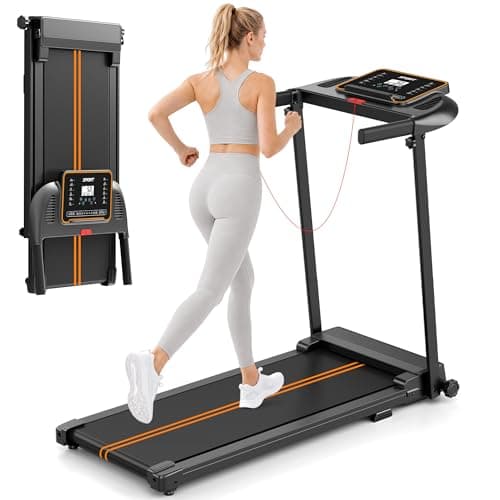
Best budget treadmill: walking pad vs folding treadmill
The budget question isn't which treadmill — it's whether you'll walk or run. Get that right and $200-$400 buys the machine you'll actually use. Get it wrong and you own a loud, huge coat rack.
Updated July 2026 · By Stephen V.
There's one decision that matters more than the brand, the display, or the app: are you buying this to walk, or to run? Cheap treadmills split cleanly along that line. A folding walking pad with a small ~1-2 HP motor is genuinely excellent for walking, hitting a step goal, and light jogging — and it slides under a bed when you're done. But ask that same small motor to carry a running stride for 30 minutes and it will run hot, bog down, and wear out fast. Regular running needs a 2.5+ HP continuous-duty motor, a longer belt, and a heavier frame, which costs more and takes up real floor space.
So we're not going to pretend one $300 machine does everything. Below are two picks — the best value for walkers and step-counters, and the best cheap machine for people who actually run — plus the marketing trap (“peak HP”) that makes weak motors look strong.
The short answer
In a hurry? These are the picks we'd buy. Prices are live; tap a card below for the full reasoning.
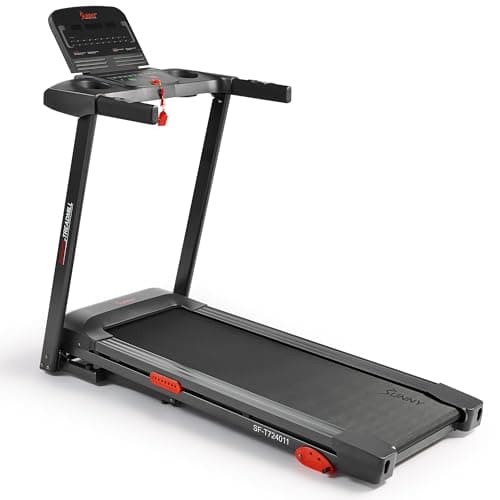
A foldable Sunny Health treadmill with a bigger motor and manual incline — the cheap machine we'd trust for actual running.
Type
Folding treadmill
Best use
Jogging, running
Incline
Manual
Brand
Sunny Health & Fitness
Pros
Bigger motor handles a running stride, not just walking
Manual incline adds real intensity for free
Folds up between sessions to reclaim floor space
Cons
Bigger and heavier than a walking pad
Louder under a running pace
Manual incline means stopping to adjust it
Best for: jogging and running programs.
Skip this
The budget traps that look cheap and cost you twice. We'd skip these.
The biggest cheap treadmill you can afford — bought to run, then never used
A large, loud budget running treadmill that lives in the spare room is the most common home-cardio regret. If you honestly walk more than you run, a walking pad you'll actually step onto beats a full treadmill you avoid. Match the machine to the habit, not the ambition.
“Peak HP” motor numbers on the box
Peak (or “max”) horsepower is a brief, best-case spike the motor can hit for a moment — not what it sustains. The number that matters for running is the continuous-duty rating (CHP), which is always lower. A “3.5 peak HP” cheap treadmill may only hold ~1.5 HP continuously, which is walking-pad territory dressed up as a runner.
How to choose (and what to skip)
Decide walk or run before anything else
This single choice sets your budget and your footprint. Walking or light jogging? A folding walking pad is cheaper, quieter, and stores away. Running for 20+ minutes at a time? Budget for a 2.5+ HP continuous-duty motor and the bigger machine that comes with it.
Continuous-duty HP, not peak HP
Ignore the big “peak HP” number on the box. Look for the continuous-duty (CHP) rating — roughly 1-2 HP is fine for walking, 2.5+ HP is what running actually needs. If a listing only quotes peak HP, assume the sustained figure is much lower.
Belt size and stride length
Walking pads use a shorter, narrower belt, which is fine at a walk but cramps a running stride. If you run, you want a longer belt so your foot lands where it should. Taller and faster runners need more belt than a walking pad gives.
Folded footprint and noise
Measure where it stores, not just where you use it. A walking pad folds under a bed; a running treadmill folds up but still needs a corner. And a cheap motor pushed to running speed is loud — a real consideration in an apartment or shared home.
Incline is free intensity
A manual incline is the cheapest way to make an easy walk or jog harder without buying a stronger motor. On a budget machine it usually means stopping to adjust it by hand, but even a couple of fixed positions add real training value.
Frequently asked questions
Can I run on a cheap walking pad?+
For short, occasional bursts, maybe — but not as a running program. Walking pads use a small motor (~1-2 HP class) and a short belt, both built for walking and light jogging. Sustained running makes a small motor run hot and wear out early. If you plan to run regularly, buy a treadmill with a 2.5+ HP continuous-duty motor instead.
What motor size do I actually need?+
For walking and step-counting, a small ~1-2 HP motor is plenty. For jogging, aim for around 2.0-2.5 HP continuous-duty. For regular running, look for 2.5+ HP continuous-duty (CHP). The key word is continuous-duty — the “peak HP” number on a cheap treadmill is a short spike, not what the motor holds mile after mile.
Is a walking pad or a folding treadmill better for a small apartment?+
For most apartments, a folding walking pad wins: it's quieter, lighter, and stores under a bed or couch. A folding running treadmill still needs floor space when folded and gets loud at running speeds. Choose the walking pad unless you specifically need to run indoors.
Why is my budget treadmill so loud?+
Two usual causes: a small motor being pushed near its limit, and a light frame that rattles at speed. Walking on a walking pad is quiet; running on a cheap machine is not. Keep it on a mat, don't exceed the speed the motor is comfortable at, and if you need to run quietly, budget up for a heavier machine.
Prices and availability shown here come from Amazon's live data and change often; we re-verify them regularly. Bar Bumper is an Amazon Associate and earns a commission on qualifying purchases at no extra cost to you. Read our full disclosure.