Recumbent vs upright exercise bike: which one belongs in your home gym
A recumbent bike is the one you will still be using in a year if your back or knees are the problem. An upright is smaller, cheaper and harder to coast on. Here is how to tell which one you are.
Updated October 2026 · By Stephen V.
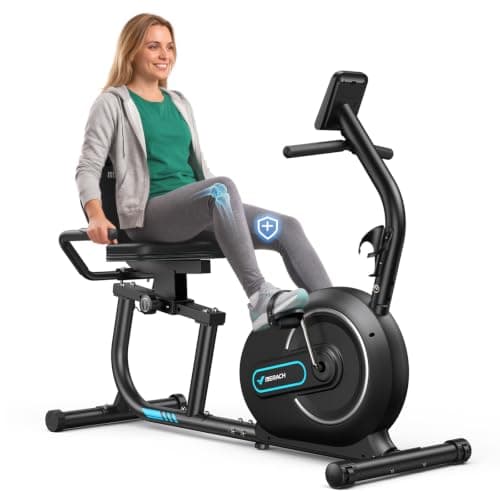
If your back, hips or knees are the reason you are shopping for a bike, buy a recumbent — the MERACH S08, with a published 300 lb user rating, a backrest and eight magnetic resistance levels, is the one we would get. If none of those is a problem and floor space or money is, buy an upright: the YOSUDA indoor cycling bike if you want to train hard, the Marcy NS-652 if the bike has to fold away between sessions. That is the whole decision, and it is a decision about your body and your room rather than about which design is superior.
The mechanical difference is simple. On a recumbent you sit in a chair with the pedals out in front of you and your back supported, so your bodyweight is carried by a seat and a backrest and almost nothing is asked of your trunk. On an upright you sit on a saddle with the pedals beneath you, so your core, hips and lower back are all doing low-level work for the whole session and your weight is on a small contact patch. Neither is impact. Both are among the gentlest cardio options there are — which is why they both appear in our low-impact cardio comparison.
What that difference produces, practically, is four trade-offs: comfort and session length (recumbents win, decisively — most people can sit on one for an hour and read, and very few can say that about a saddle), footprint (uprights win; a recumbent is a piece of furniture roughly four and a half feet long), price (uprights win at the bottom of the market), and how hard you can work (uprights win, because you can get out of the saddle and because nothing on a recumbent stops you coasting).
One thing both share at this end of the market, and it is worth knowing before the picks: magnetic resistance is now standard and it is genuinely good. All three bikes below use magnetic systems, which means nothing touches anything, there is no pad to wear out, and they are quiet enough to use at 6am in a flat. A cheap magnetic bike is one of the few budget cardio purchases that is not a compromise, which is the argument our cheap cardio machines page makes at greater length.
The short answer
In a hurry? These are the picks we'd buy. Prices are live; tap a card below for the full reasoning.
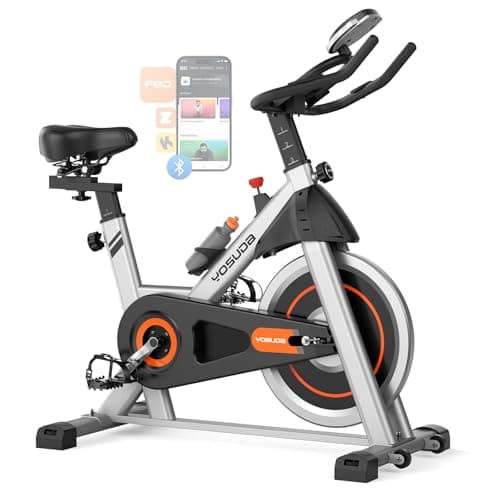
A weighted flywheel and a cycling position mean this is the only bike here you can get out of the saddle on — the one that keeps getting harder as you get fitter.
anyone with healthy joints who wants cardio they can actually push on
A published 300 lb rating, a backrest, a low step-over and eight magnetic levels in a bike that costs less than most uprights with half its capacity.
Rated capacity
300 lb (mfr)
Resistance
8 levels, magnetic (mfr)
Footprint
51.97 x 25 in (mfr)
Machine weight
57.3 lb (mfr)
User height
5 ft 3 in to 6 ft 2 in (mfr)
Back support
Adjustable seat and backrest
Pros
A published 300 lb user rating, which is the highest in this comparison and well above what most budget uprights state
The backrest is the entire point and it changes who can use a bike. If sitting upright unsupported for 30 minutes is the barrier, this removes it
A low step-over height means you sit down into it rather than swinging a leg over a frame — the single most underrated accessibility feature in home cardio
Eight numbered magnetic levels, so sessions are reproducible and the bike can get harder as you get fitter
MERACH publishes a full spec sheet including the recommended user height range and the extended leg length, which is unusually specific and genuinely useful for deciding whether you fit
Cons
It is a large object. At roughly 52 inches long it occupies a permanent strip of floor and will not fold or hide
At 57.3 lb it is heavy to reposition, even with transport wheels. Decide where it lives before you assemble it
The published user height range starts at 5 ft 3 in. Shorter riders may not reach the pedals comfortably even at the closest seat setting — check the figure against the person who will use it
A supported seat makes it very easy to coast. Without a plan or an app, a recumbent session drifts into gentle pedalling while you read, which is pleasant but is not training
No handlebars to pull on and no standing position, so there is a hard ceiling on how hard you can work
Best for: a bad back, stiff hips, limited mobility, or long easy sessions while reading.
$249.9928% offPrice as of October 6, 2026·#addisclosure
YOSUDA Indoor Cycling Bike
A weighted flywheel and a cycling position mean this is the only bike here you can get out of the saddle on — the one that keeps getting harder as you get fitter.
Type
Indoor cycling bike
Rated capacity
270-330 lb depending on model (mfr)
Flywheel
35-40 lb depending on model (mfr)
Resistance
Continuously variable
Drive
Belt — very quiet
Footprint
Compact, permanent
Pros
A heavy flywheel gives a smooth, road-like pedal stroke that light-flywheel budget uprights cannot match
You can stand up on it, which means intervals, climbs and genuinely hard efforts are all available. No recumbent can do that
Belt drive with magnetic resistance on the current models is close to silent, which makes it a realistic apartment purchase
YOSUDA is one of the few budget bike brands that publishes capacity and flywheel figures per model and sells through major retailers, so the numbers are checkable
Compact footprint for the capability — it occupies far less floor than the recumbent above
Cons
A cycling saddle is uncomfortable for the first few weeks and permanently uncomfortable for some people. This is the main reason budget uprights end up unused
Published capacity and flywheel weight vary by model — 270 lb with a 35 lb flywheel on some, 330 lb with a 40 lb flywheel on others. Read the spec on the exact listing rather than assuming
The forward-leaning position loads your wrists, lower back and neck. If any of those is already a problem, this is the wrong bike
No backrest and a high step-over, so it is a poor choice for anyone with limited mobility
Basic monitor, no built-in programmes. You bring the structure
Best for: anyone with healthy joints who wants cardio they can actually push on.
$159.9915% offPrice as of October 6, 2026·#addisclosure
Marcy NS-652 Foldable Exercise Bike
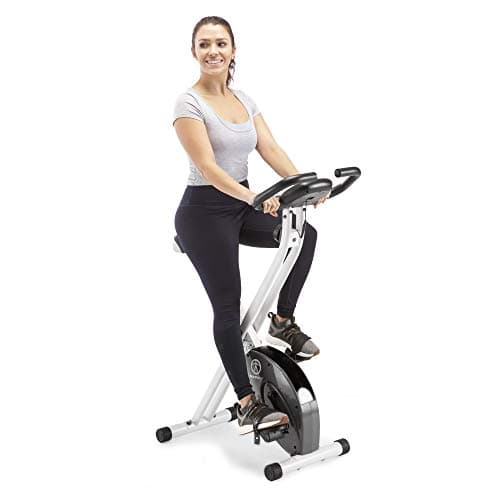
Eight magnetic levels, a published 250 lb rating and a frame that folds flat, from a brand that has been making home gym equipment for decades.
Type
Folding upright bike
Model
NS-652
Rated capacity
250 lb (mfr)
Resistance
8 levels, magnetic (mfr)
Footprint
32 x 18.25 x 42.25 in (mfr)
Inseam range
28-33 in (mfr)
Pros
It folds, which is the only reason to choose it over the bikes above — and for a lot of people it is a decisive reason
Eight numbered magnetic levels, so it is reproducible and progressive despite the price
Marcy is an established US brand with a published spec sheet, 14-gauge steel construction and parts support, rather than a marketplace name
A 32 by 18 inch footprint is small enough to use in a bedroom and then tuck behind a door
A more upright, comfortable riding position than a cycling bike, which makes it easier to read or watch something on
Cons
A 250 lb published rating is the lowest of the three, and folding frames are inherently less rigid than fixed ones
A folding bike wobbles slightly more under hard effort than a fixed frame. It is fine for steady riding and not the bike for standing sprints
The published inseam range of 28 to 33 inches is narrow. Outside it, the fit will be wrong and no amount of adjustment will fix it
No flywheel worth speaking of compared with the YOSUDA, so the pedal stroke feels lighter and less road-like
Folding is a habit. If the bike has to be unfolded before every session, that is one more small barrier between you and the session
Best for: a flat or shared room where the bike cannot live out in the open.
Skip this
The budget traps that look cheap and cost you twice. We'd skip these.
A recumbent bought for a small room
Recumbents are long. The MERACH above is nearly 52 inches, and that is typical rather than large for the type. They do not fold, they weigh enough that moving them is a decision rather than an action, and the pedals stick out at the front. If the bike has to share a bedroom or live behind a sofa, buy a folding upright and accept the saddle. A recumbent you have to move every day is a recumbent you will stop using.
An upright bought when a saddle is already a known problem
If you have tried a spin class or a bike and the saddle was the reason you stopped, do not buy another saddle in the hope that this one is different. Saddle discomfort at the budget end is close to universal for the first few weeks and permanent for a minority of people. A recumbent costs a little more floor space and solves it completely, and it is a far cheaper fix than a bike that goes unused.
Any bike with no published weight rating or resistance levels
This is the tell for a listing rather than a product. A brand that publishes a user weight rating, numbered resistance levels and real dimensions has committed to those figures and will have a support contact when something rattles. The bikes at the very bottom of this market publish a struck-through list price and a stock photo. The functional gap is smaller than you would think; the gap in what happens when a crank arm works loose is total.
How to choose (and what to skip)
Back support is the spec that decides the format
Everything else about this comparison is secondary to one question: can you sit unsupported on a saddle for the length of a session, repeatedly, for months. If the answer is yes, an upright is smaller, cheaper and harder to coast on, and you should buy one. If the answer is no — because of back pain, a disc problem, hip stiffness, balance, or simply because you have tried and hated it — then a recumbent is not a compromise, it is the correct machine. The backrest is also what makes long, easy, reading-while-pedalling sessions possible, and for a lot of people those are the sessions that actually happen.
Knees: it is about the pedal circle, not the format
Both bike types are non-impact and both are kind to knees compared with anything that involves landing. The real variable is seat position, because a seat that is too low forces a deeper knee bend at the top of each stroke and that is where cycling knee pain comes from. A recumbent makes this easier to get right because the seat slides horizontally along a rail with clear positions, and because your weight is not balancing on the saddle while you adjust it. If knees are the concern, buy the format you can set up correctly and leave set up.
Published capacity, and why it is higher on recumbents
The figures across these three picks are 300 lb for the MERACH recumbent, 270 to 330 lb for the YOSUDA depending on model, and 250 lb for the folding Marcy. Recumbents tend to publish higher ratings than folding uprights because the load is spread across a long frame and a wide seat rather than concentrated on a saddle post and a folding hinge. If you are near any of these numbers, this alone may decide it — and it is why a recumbent is often the right answer for heavier beginners, as our guide for heavier beginners covers in more detail.
Footprint: measure the length, not the floor area
An upright occupies roughly a two-foot by three-foot patch. A recumbent occupies a strip over four feet long and does not fold. The number that catches people out is not the area but the length plus the clearance needed in front of the pedals, and the fact that a recumbent reads as furniture in a room in a way an upright does not. If the bike has to live in a bedroom or a lounge, walk the footprint out with a tape measure first. Our page on how much space a home gym needs has the real figures for everything else that might share the room.
Magnetic resistance and numbered levels are non-negotiable
All three bikes here use magnetic resistance, which means a magnet moves closer to or further from a flywheel and nothing is ever in contact. There is no pad to wear, nothing to squeak, and the noise floor is low enough for early mornings in a flat. Numbered levels matter as much as the mechanism: eight defined settings let you repeat a session and make it harder next month, whereas an infinitely variable friction knob gives you a number nobody can reproduce. Treat a friction-brake bike at this price as a reason to keep shopping.
Which one you will still be using in a year
This is the only question that matters, and the honest answer is: the one that is comfortable and does not need moving. Comfort beats capability at the budget end of cardio, because the capability gap between a recumbent and an upright is far smaller than the gap between a bike you use four times a week and one you use twice a month. If the choice is genuinely balanced, pick the one you would be happy to sit on for 45 minutes with a book, and then make it harder from there.
The quick split
Bad back, disc problem, or you cannot sit unsupported. Recumbent. Not a close call.
Limited mobility or balance concerns. Recumbent — the low step-over is as important as the backrest.
Over about 250 lb. Recumbent, or check the exact YOSUDA model's published rating. The folding upright's 250 lb figure rules it out.
You want intervals and hard efforts. Indoor cycle. It is the only format you can stand up on.
The bike must fold away. Folding upright. Nothing else here does it.
Tight budget, healthy joints. Upright. It is cheaper for the same resistance system.
You will watch television while pedalling. Recumbent, and be honest that this is the plan — it is a perfectly good reason to buy one.
What a recumbent genuinely buys you
Session length, and therefore adherence. The reason recumbents dominate rehab clinics and retirement communities is not that they are easier — you can work extremely hard on one — it is that nothing about sitting in them hurts after twenty minutes. Your weight is on a padded seat with a backrest instead of a saddle, your wrists carry nothing, your neck is neutral, and the step-over is low enough that getting on and off is not an event. For anyone whose barrier to cardio is discomfort rather than motivation, that is the entire ballgame.
The second thing it buys is a published capacity rating that is usually higher than the folding alternatives, because the load is spread along a long frame. That makes recumbents a reasonable default for heavier riders, alongside a walking pad with a 300 lb rating. It is the same logic that runs through our page on home gym equipment for seniors: published numbers and comfortable positions, not features.
What an upright genuinely buys you
A ceiling. On an indoor cycle you can get out of the saddle, lean on the bars and produce far more power than any recumbent position allows, which means the bike stays challenging as you get fitter instead of becoming a gentle habit. You also get a much smaller footprint, a lower entry price, and — with a weighted flywheel — a pedal feel that is genuinely close to riding a bike. If you are healthy and your goal is fitness rather than movement, the upright is the better machine and the saddle is the price of admission.
If you want the upright position without the spin-bike saddle, the folding bikes sit in the middle: a more upright posture, a wider seat, less aggressive geometry, and a frame that disappears behind a door. Our budget exercise bike roundup ranks the whole upright field, and cheap Peloton alternatives covers the bikes people shortlist when they want the class experience without the subscription.
How a bike compares with the other cheap cardio options
Against a rower, a bike is easier to learn and easier to do badly without consequence; a rower works more muscle but punishes poor technique with a sore back. Against an elliptical, a bike is cheaper, smaller and more reproducible; an elliptical is weight-bearing, which is a point in its favour for bone health. Against a walking pad, a bike is the machine you train on and the pad is the machine you accumulate hours on. Our three-way comparison goes through all of it with the trade-offs laid out properly.
And on noise, which decides a lot of apartment purchases: magnetic bikes of either type are the quietest cardio machines you can buy. There is no impact, no motor and nothing in contact. If you share a ceiling, a bike is the safe choice — see quiet cardio for apartments for how the formats rank on that specifically.
Frequently asked questions
Is a recumbent or upright exercise bike better?+
Neither, in the abstract. A recumbent is better if your back, hips, balance or mobility limit how long you can sit on a saddle, and it usually publishes a higher weight rating. An upright is better if your joints are healthy and you want a machine you can push hard on, because you can stand up on it and it takes up far less floor. The practical tiebreaker is which one you will still use in a year, and that is usually the comfortable one.
Which is better for bad knees?+
Both are non-impact and both are good. The variable that actually matters is seat position rather than bike type: a seat set too low forces a deeper knee bend at the top of the pedal stroke, which is where cycling knee pain comes from. Recumbents make this easier to get right because the seat slides along a rail with defined positions and you are not balancing while you adjust it. If knees are the main concern, our low-impact cardio comparison goes wider than bikes.
Do you burn fewer calories on a recumbent bike?+
At the same power output, no — work is work. In practice people often do less on a recumbent, because a supported seat and a comfortable position make it very easy to coast while reading or watching something. The fix is not a different bike, it is numbered resistance levels and a plan: pick a level, hold a cadence, and write it down. All three bikes here have the resistance system needed to do that.
Is a recumbent bike good for a bad back?+
It is the standard answer for one, and for good reason: the backrest carries your weight, your trunk is not working to hold you upright, and there is no forward lean loading your lower back. That is the opposite of an indoor cycling position. It is not medical advice and a bike cannot treat a back problem — but if sitting unsupported for 30 minutes is what stops you doing cardio, a recumbent removes that barrier entirely.
How much space does a recumbent bike need?+
More than people expect. The MERACH S08 is published at about 52 inches long by 25 inches wide, which is typical for the format, and recumbents do not fold. Add clearance in front of the pedals and you are committing a strip of floor permanently. An upright occupies roughly a two-by-three-foot patch, and a folding upright like the Marcy NS-652 collapses to something you can stand behind a door.
What weight capacity do exercise bikes have?+
At this price, typically 250 to 330 lb, and it varies more by format than by price. Our three picks publish 300 lb (MERACH recumbent), 270 to 330 lb depending on model (YOSUDA upright), and 250 lb (folding Marcy). Recumbents and fixed-frame uprights generally rate higher than folding frames, because a hinge is a concentrated load path. Always read the figure on the exact model you are buying rather than the brand's best number.
Is magnetic resistance worth it on a cheap bike?+
Yes, and it is now standard enough that a friction-brake bike at this price should be treated as a reason to keep looking. Magnetic resistance has nothing in contact, so there is no pad to wear, nothing to squeak, and the bike is quiet enough for early mornings in a flat. Just as important, magnetic systems come with numbered levels, which is what makes a session repeatable and progressive.
Can you build fitness on either type?+
Yes. Both can take you a long way if you actually apply resistance and keep raising it. The ceiling differs: an upright you can stand up on allows higher peak efforts than any recumbent position, so for intervals and hard training the upright has more headroom. For steady aerobic work, long easy sessions and consistency across months, a recumbent is often the bike that produces more total training because it produces more sessions.
Prices and availability shown here come from Amazon's live data and change often; we re-verify them regularly. Bar Bumper is an Amazon Associate and earns a commission on qualifying purchases at no extra cost to you. Read our full disclosure.