Wall-mounted vs doorway pull-up bar: which one to buy, and what each costs your house
A doorway bar costs nothing but twenty dollars and a bit of trim wear. A bolted bar costs you four holes and gives you a bar you can swing, dip and hang rings from. The deciding question is whether you can drill.
Updated October 2026 · By Stephen V.
If you are allowed to drill, buy a bolted bar — the Abahub wall-mounted multi-grip bar, rated by its maker at 440 lb, is the pick for most homes. It is stronger than any doorway bar, it gives you clear space under the bar so your knees are not hitting a door frame, and it will take rings, a hanging bag or a dip belt. If you cannot drill — a rental, a shared flat, a landlord who would notice — buy a leverage-mount doorway bar, and the Sportneer no-drill bar at a published 440 lb is the one we would choose. Both are good purchases. They are just answers to different housing situations.
It is worth being precise about how a doorway bar actually holds you up, because the mechanism explains all of its limits. A leverage-mount bar does not clamp or screw into anything. It is a lever: your weight on the front of the bar pushes a padded brace against the wall above the door frame, and friction plus geometry does the rest. That works, reliably, and the published ratings on the better ones are high. What it means is that the bar is only as good as the door frame and the wall above it — and that pulling sideways, kipping, or swinging is exactly the kind of load the geometry is not designed for.
A bolted bar is the opposite trade. Four lag bolts into studs or a ceiling joist, and the bar is now part of the building. It will take dynamic load, it has nothing above your head to hit, and it does not care which way you pull. The cost is four holes you will have to fill one day, and the requirement that you find real structure to bolt into — which in a plasterboard wall means a stud finder and a willingness to be exactly right about where the studs are.
So the four things worth sorting on: published capacity, what it anchors to, clearance above and below the bar (the one nobody checks and the one that decides whether you can do a full rep), and what it does to the house. We have not load-tested these. Every capacity figure below is the manufacturer's published user rating, labelled as such.
The short answer
In a hurry? These are the picks we'd buy. Prices are live; tap a card below for the full reasoning.
$39.9915% offPrice as of October 6, 2026·#addisclosure
Quick picks
#
Product
Best for
Score
Price
1
Best overall
Abahub Wall-Mounted Multi-Grip Pull-Up Bar (440 lb)
Bolted into studs with a published 440 lb rating and multiple grips, this is the cheapest way to own a pull-up bar you can genuinely treat as permanent equipment.
a garage, basement or spare room where drilling into studs is allowed
$49.9932% offPrice as of October 6, 2026·#addisclosure
3
Best range of motion
Fitarc Joist / Ceiling-Mount Pull-Up Bar (440 lb)
Bolted into a joist with a published 440 lb rating and nothing anywhere near your head, this is the closest thing to a real gym pull-up station at a fraction of the price.
a garage or basement with exposed or findable ceiling joists
$39.9915% offPrice as of October 6, 2026·#addisclosure
4
Cheapest sensible doorway bar
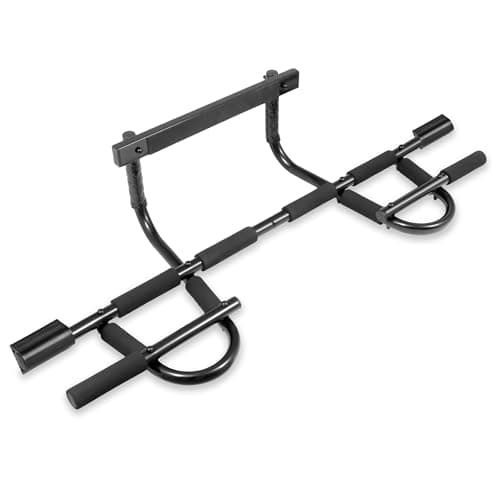
ProsourceFit Multi-Grip Doorway Pull-Up Bar
A 300 lb rating, twelve grip positions and a lifetime warranty from an established brand, at the price point where the alternative is an anonymous listing.
the lowest-risk way to find out whether you will actually do pull-ups
$40.0315% offPrice as of October 6, 2026·#addisclosure
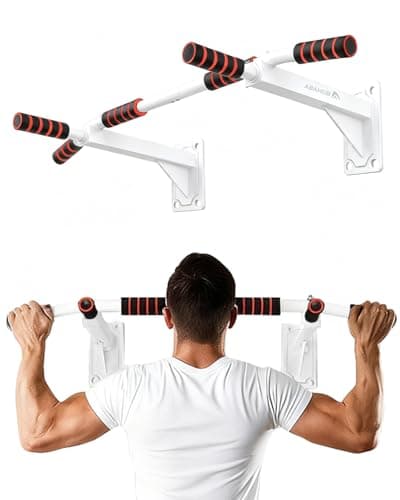
Abahub Wall-Mounted Multi-Grip Pull-Up Bar (440 lb)
Bolted into studs with a published 440 lb rating and multiple grips, this is the cheapest way to own a pull-up bar you can genuinely treat as permanent equipment.
Mount
Wall (bolted)
Capacity
440 lb (mfr rating)
Grips
Multi-grip
Install
Anchors into studs/masonry
Clearance
Stands off the wall
Takes rings
Yes
Pros
A published 440 lb user rating, which is roughly double a typical doorway bar's figure and leaves room for a weighted vest or a dip belt
The bar stands off the wall, so you have clear space in front of your chest and nothing to hit on the way up — the single biggest practical difference from a doorway bar
It will take dynamic load. Kipping, swinging, hanging gymnastic rings and hanging a bag are all on the table, which they are not on a leverage mount
Multiple grip positions in a fixed, repeatable place, so wide, narrow and neutral grips all work without re-rigging anything
Once it is up it is up. No setup before a session, no checking the brace, no drift — and that removes the last friction between you and a set of pull-ups
Cons
You have to drill, and you have to hit studs or solid masonry. A pull-up bar lagged into plasterboard alone will eventually come out of the wall with you attached to it
Permanent. Four filled holes and some paint when you move, which rules it out in most rentals
You must check clearance before you buy: enough height above the bar for your head and enough depth below it that your feet do not touch the floor at the bottom of a rep
Abahub is a marketplace brand. The 440 lb rating is its own published figure with no independent testing behind it — treat it as a manufacturer claim, which is all any bar on this page offers
Masonry needs the right anchors, and the right anchors for brick are not the ones in the box on most of these kits
Best for: a garage, basement or spare room where drilling into studs is allowed.
$49.9932% offPrice as of October 6, 2026·#addisclosure
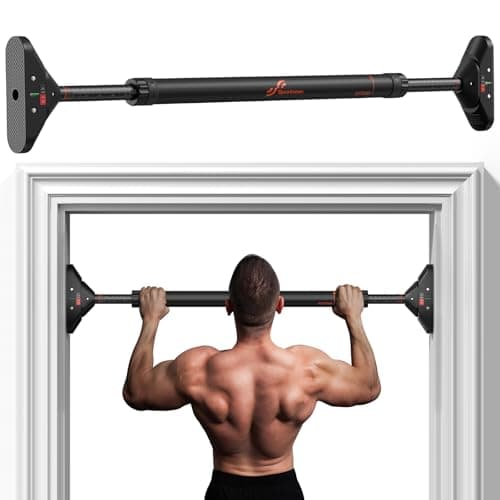
Sportneer No-Drill Doorway Pull-Up Bar (440 lb)
A published 440 lb rating on a leverage mount that needs no tools and no holes, with an adjustable width that fits most standard door openings.
Mount
Doorway, no drilling
Capacity
440 lb (mfr rating)
Width
29.5-37 in adjustable
Install
Tool-free, minutes
Leaves marks
Possible on soft trim
Removable
Yes, in seconds
Pros
A published 440 lb rating, which is unusually high for a doorway bar and the reason this is the one we would pick in the category
No holes, no tools, no landlord conversation. It goes up in minutes and comes down in seconds, which no bolted bar can say
The 29.5 to 37 inch adjustable width covers most standard interior door openings, which is where cheaper fixed-width bars fail
Portable in a real sense. It moves house with you, moves between doorways, and travels if you want it to
Costs a fraction of a bolted setup once you count the bolts, the stud finder and the paint
Cons
It needs the right doorway: within the width range, with wood trim and a solid wall above the frame. Hollow-core trim or a poorly built frame is a no
Clearance is the real limit. Your head is inches from the frame at the top of a rep and your knees have to go somewhere at the bottom — most people bend their legs for every single rep
Static pulling only. Kipping, swinging and hanging rings all load the mount in the direction its geometry does not account for
The padded braces will mark soft paint or varnish on the trim over time, which in a rental is the exact thing you were trying to avoid
Check it before every session. A leverage mount can shift, and the one you want to notice is not the one you notice halfway through a rep
Best for: a rental, a shared flat, or anywhere a hole in the wall is not an option.
$39.9915% offPrice as of October 6, 2026·#addisclosure
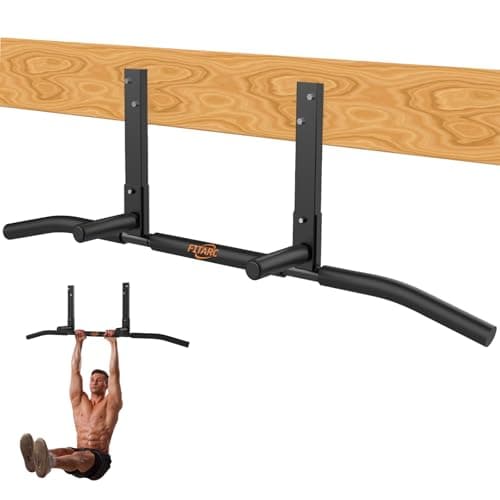
Fitarc Joist / Ceiling-Mount Pull-Up Bar (440 lb)
Bolted into a joist with a published 440 lb rating and nothing anywhere near your head, this is the closest thing to a real gym pull-up station at a fraction of the price.
Mount
Ceiling / joist (bolted)
Capacity
440 lb (mfr rating)
Install
Lag bolts into a joist
Clearance
Full range under the bar
Takes rings
Yes
Needs
A located joist and headroom
Pros
Nothing above or in front of you. A ceiling-mounted bar gives the cleanest full range of motion of any option on this page, including most power racks
A published 440 lb rating bolted into a structural joist, which is the strongest mounting point available in a typical house
Rings, straps, a bag and leg-raise work all hang from it without a second thought, which makes it the most versatile anchor point a cheap home gym can have
A garage with exposed joists is the ideal case: you can see exactly what you are bolting into, which removes the main risk of the whole category
Cons
Needs real headroom. In a room with an eight-foot ceiling a ceiling-mounted bar often leaves too little space above your head to finish a rep, so measure before you buy
You must find and hit a joist. Lag bolts into the plasterboard of a ceiling is the single most dangerous installation mistake in home gym equipment
Permanent, visible and in the ceiling. Not a rental purchase under any circumstances
Fitarc is a marketplace brand and the 440 lb figure is its own published claim. The hardware supplied is also the part worth upgrading — buy proper structural lag screws of the specified size
Fixed position. Unlike a doorway bar, you cannot move it if you later rearrange the room
Best for: a garage or basement with exposed or findable ceiling joists.
A 300 lb rating, twelve grip positions and a lifetime warranty from an established brand, at the price point where the alternative is an anonymous listing.
Mount
Doorway (leverage)
Capacity
300 lb (mfr rating)
Fits
24-36 in door frames (mfr)
Grips
12 positions (mfr)
Install
No drilling, no tools
Warranty
Limited lifetime (mfr)
Pros
The widest doorway fit on this page: a published 24 to 36 inch range, which covers narrow doors the 29.5 inch minimum bars will not
Twelve published grip positions, which at this price is a genuine amount of variety for pull-ups, chin-ups and neutral-grip work
ProsourceFit is an established brand with a published limited lifetime warranty, which is the opposite of the anonymous listings at the same price
Foam covers on the contact points are specifically there to protect door trim, and they do help
Cheap enough that if pull-ups turn out not to be your thing you have lost very little
Cons
A 300 lb published rating is the lowest here. Fine for most people's bodyweight, tight once you add a weighted vest
Same leverage-mount limits as any doorway bar: static pulling only, no swinging, no rings
Same clearance problem, worse if you are tall. Expect to bend your knees on every rep and to be close to the frame at the top
The published install limits matter — up to about 3.5 inches of molding width and 6.25 inches of wall thickness. Measure yours; thick period trim is a common reason it will not fit
Best for: the lowest-risk way to find out whether you will actually do pull-ups.
Skip this
The budget traps that look cheap and cost you twice. We'd skip these.
A telescoping bar that wedges inside the door frame
These are the ones that expand against the two sides of the opening and hold by pressure alone. They are cheaper than leverage mounts and they are the type that fails: the force goes sideways into the frame rather than down into the wall, the adjustment works loose with use, and a bar that lets go mid-rep drops you from full hang. If you cannot drill, buy a leverage mount with a published rating. Do not buy a pressure-fit tube.
A bolted bar installed into plasterboard with the supplied anchors
This is the one genuinely dangerous mistake in this category. A pull-up bar sees several times your bodyweight when you drop onto it at the bottom of a rep, and plasterboard anchors are not rated for that in any direction. You need studs, joists or masonry with the correct anchor type, located properly. If you cannot confirm what is behind the wall, buy a doorway bar instead — there is no version of this where guessing is acceptable.
Any bar bought before measuring clearance
Two measurements decide whether a bar is usable, and almost nobody takes them. Above: enough space for your chin to clear the bar without your head hitting the frame or ceiling. Below: enough depth that your feet do not reach the floor at full hang with your legs bent. Doorway bars fail the first; low-ceiling ceiling mounts fail both. Our guide to home gyms with low ceilings covers the numbers.
How to choose (and what to skip)
What each mount actually attaches to
A leverage-mount doorway bar attaches to nothing. It rests over the frame and uses your bodyweight to press a brace against the wall above the door, so its strength is really the strength of your door frame and the wall behind it. A wall-mounted bar lags into studs, typically four bolts into two studs at 16-inch centres. A ceiling bar lags into a joist. The published capacity figures — 440 lb on three of our four picks, 300 lb on the ProsourceFit — describe the bar, not the building, and the building is the part that fails. Finding real structure matters more than the number on the box.
Clearance is the spec that decides whether you can do a full rep
Measure two things before you buy anything. Above the bar you need room to bring your chin over it without your head meeting the door frame or the ceiling; doorway bars sit low in the opening, so tall users end up tilting their head back on every rep. Below the bar you need enough depth that your feet clear the floor at full hang — at a typical 80-inch door height, most people have to bend their knees, every rep, forever. A ceiling mount solves the problem under the bar and can create one above it in a room with an 8-foot ceiling. There is no right answer except the tape measure.
Static load vs dynamic load, and why it matters
This is the real divide. A bolted bar is part of the structure, so it does not care whether you pull straight down, swing, kip, hang rings from it or attach a bag — the load path is the same. A leverage mount is a geometry trick that assumes the force goes mostly downward and slightly inward. Swinging, kipping or hanging anything that moves pulls in directions the mount does not account for, which is the mechanism behind almost every doorway bar failure story. If you want gymnastic rings or any kind of dynamic work, you need to bolt something to the building. Our cheap gymnastic rings page covers what the rings themselves need.
What it does to your house, honestly
A doorway bar leaves pressure marks on soft paint or varnish over months of use, and the foam covers reduce it rather than prevent it. A wall-mounted bar leaves four filled and repainted holes. A ceiling bar leaves two to four holes in a ceiling, which is a slightly more annoying repair. None of this is serious damage; all of it is worth knowing before you commit, particularly if you are renting. If the answer is that you cannot make any holes at all, that is not a compromise — the better doorway bars publish the same 440 lb rating as the bolted ones.
Published capacity, and how much headroom to leave
Our picks publish 440 lb (Sportneer doorway, Abahub wall, Fitarc joist) and 300 lb (ProsourceFit doorway). These are manufacturer user ratings, not tested limits, and a pull-up bar sees considerably more than your static weight at the bottom of a rep when you drop into the hang. Leave real margin, and leave more if you intend to add a weighted vest or a dip belt — which is the main reason a 300 lb rating becomes limiting sooner than the number suggests.
When neither is the right answer
If you want dips, leg raises with full clearance, a place to hang a band and a bar you can treat as the centre of a gym, a bolted bar is a stepping stone and a power tower or a power rack is the destination. A tower costs more and takes floor space but needs no drilling and does dips and knee raises too, which makes it the better free-standing answer for a renter who has the space. A rack brings a pull-up bar as a side effect of buying a squat station, which is often the cheapest route to both.
Decide it in three questions
Can you drill into studs or a joist? If no, buy a leverage-mount doorway bar and stop reading. If yes, continue.
Do you have headroom above a ceiling-mounted bar? If yes, a joist mount gives the best range of motion available. If no, go on the wall.
Do you want rings, a bag, or any kind of swinging work? If yes, it has to be bolted. A doorway bar cannot do it safely at any price.
If all three answers push you towards a bolted bar but you do not own a stud finder, buy one — they cost less than the bar and they are the difference between an installation that is fine for a decade and one that comes out of the wall. The same principle runs through our guide on whether you need to bolt down a power rack: with home gym equipment, the fixing is usually the weak link rather than the steel.
Why a doorway bar is better than its reputation
There is a lot of sneering about doorway bars, and most of it is aimed at the wrong product. The pressure-fit telescoping tubes genuinely are unsafe and genuinely do fail. Leverage mounts are a different design with a different load path, and the better ones publish ratings — 440 lb on the Sportneer — that are the same as the bolted bars on this page. For straight, static pull-ups and chin-ups, which is what the overwhelming majority of people actually do, a good leverage mount is a legitimate piece of equipment that happens to cost twenty dollars and need no holes.
What it is not is a gym anchor point. The moment you want to hang rings, do kipping pull-ups, or put a heavy bag up, the mount is being asked to resist forces it was not designed around and the sensible answer is to bolt something to the building. That line — static pulling yes, anything dynamic no — is the single most useful thing to take from this page.
Why a bolted bar is worth four holes
Three reasons, in order of how much they matter day to day. First, clearance: with nothing above your head and nothing in front of your chest, a rep is a rep instead of a negotiation with a door frame. Second, versatility: rings, bands, a dip belt, a bag, hanging leg raises — a bolted bar is an anchor point and anchor points are what make a cheap home gym feel like a gym. Third, zero setup: it is always there, always ready, and never needs checking, which quietly matters more than any spec.
If you are weighing a bolted bar against a free-standing one, the deciding factor is usually floor space versus wall space. A power tower needs no drilling and adds dips and knee raises, but it occupies a permanent patch of floor and most towers publish lower ratings than a bar lagged into a stud. Our cheap pull-up bar roundup ranks the individual bars in all three mounting styles if you have already made the mounting decision.
What to do if you cannot pull up yet
Buy the bar anyway — it is the cheapest useful piece of equipment in a home gym and it is useful before you can do a single rep. Dead hangs build the grip that is usually the real limit. Negatives, where you jump to the top and lower slowly, build the strength. A band looped over the bar takes a chunk of your bodyweight off and turns the exercise into something you can actually train. Our cheap resistance bands page covers which sets include a band heavy enough to be useful for assistance.
And if the bar is going into a space that doubles as a wall-mounted gym, read wall-mounted home gym before you drill. Deciding the bar height, the rack position and the ring height in one go saves you drilling the same wall three times — which is the most common regret people report about this category.
Frequently asked questions
Is a wall-mounted or doorway pull-up bar better?+
A wall-mounted bar is better if you can drill: higher published capacity, clear space above and in front of you, and it takes rings, bands and a weighted vest without any concern. A doorway bar is better if you cannot drill, and the good leverage-mount ones publish the same 440 lb rating. The real difference is not strength, it is what the mount can be asked to do — a bolted bar handles dynamic load, a doorway bar handles straight static pulling only.
Are doorway pull-up bars safe?+
Leverage-mount doorway bars are, within their limits, and the better ones publish user ratings up to 440 lb. Their safety depends on three things: a solid door frame with a solid wall above it, a width inside the bar's published range, and using them for straight pulling rather than swinging or kipping. The ones that are genuinely unsafe are the telescoping bars that wedge inside the frame by pressure alone — avoid that design entirely.
Will a doorway pull-up bar damage my door frame?+
It will mark soft paint or varnish on the trim over time, because the padded braces press against it under your full bodyweight every rep. The foam covers reduce it rather than eliminate it. Structural damage is unlikely on a well-built frame, but the cosmetic marking is near-inevitable with regular use, which is worth knowing if the reason you chose a no-drill bar was to protect a rental deposit.
What do you bolt a wall-mounted pull-up bar into?+
Studs, a ceiling joist, or solid masonry with the correct anchors for that material — never plasterboard alone, and never the anchors that come in the box if you are going into brick. A pull-up bar sees well over your static bodyweight when you drop into the hang at the bottom of a rep. Use a stud finder, confirm the position, and use structural lag screws of the size the instructions specify.
How much clearance do I need for a pull-up bar?+
Enough above the bar to bring your chin over it without your head hitting anything, and enough below that your feet clear the floor at full hang with knees bent. Doorway bars sit low in the opening, so most people bend their legs on every rep. A ceiling-mounted bar solves that and can create the opposite problem in a room with an 8-foot ceiling — measure both gaps before you buy, in the actual spot.
Can you hang gymnastic rings from a doorway pull-up bar?+
No, and this is the clearest line in the whole comparison. Rings move, and a leverage mount relies on the load staying roughly where its geometry expects it. Swinging load in an unexpected direction is the mechanism behind doorway bar failures. Rings need a bolted bar, a joist, a rack or a beam — our cheap gymnastic rings page covers the anchoring options.
What weight capacity does a pull-up bar need?+
Comfortably above your bodyweight, with real margin, because dropping into a dead hang loads the bar with considerably more than your static weight. Our picks publish 440 lb on three bars and 300 lb on one. If you plan to train with a weighted vest or a dip belt, add that weight to your own and then leave headroom — this is where a 300 lb rating gets tight faster than the number suggests.
Is a power tower better than a pull-up bar?+
It is a different purchase. A power tower needs no drilling and also does dips and knee raises, which makes it the best free-standing option for a renter with floor space. A bolted bar is cheaper, stronger per dollar, invisible when not in use and takes no floor at all. If you already plan to buy a power rack, you get a pull-up bar with it and this decision disappears.
Prices and availability shown here come from Amazon's live data and change often; we re-verify them regularly. Bar Bumper is an Amazon Associate and earns a commission on qualifying purchases at no extra cost to you. Read our full disclosure.