Trap bar vs barbell deadlift: which bar a home gym should buy first
Both bars deadlift. They do not load you the same way, they do not cost the same, and one of them is far more forgiving when you train alone with nobody watching your back. Here is the honest split — and which to buy if you can only buy one.
Updated October 2026 · By Stephen V.
If you train alone in a garage and you are buying one bar to deadlift with, buy the trap bar — the CAP Olympic Hex / Trap Bar with combo high and low handles is the pick for almost everybody. It is the forgiving option: the handles sit beside you instead of in front of you, so the load line runs closer to your hips, the lower back works less hard for the same weight, and the lift is much harder to get badly wrong on a set where you are tired and nobody is there to tell you your back rounded. The straight bar is the better buy only if you already own one for squats and presses, or if you intend to compete in powerlifting, where the conventional deadlift is the lift that gets judged.
That is not a claim about which lift is superior. It is a claim about what each bar asks of you. The published biomechanics are consistent on the direction of the difference: against a conventional barbell deadlift at a matched load, the hex bar produces lower peak moments at the lumbar spine, hip and ankle, and a higher peak moment at the knee — the lift moves demand off the back and onto the quads. Trained lifters also tend to generate more peak force and peak power with the hex bar, and most people can pull somewhat more weight with it. Those figures come from published studies summarised in the sources at the foot of this page; we have not run force plates ourselves and we will not pretend otherwise.
The money side is simpler than people expect. A cheap trap bar and a cheap 7 ft Olympic bar live in roughly the same price band, and both take the same 2-inch Olympic plates, so whichever you buy you are not buying a second set of plates. What differs is what else the bar can do: a straight bar squats, benches, presses, rows and cleans, and a trap bar does none of those. That single fact decides the order for most people — which is why this page ranks three trap bars and then puts a straight bar at the bottom as the honest alternative rather than pretending it loses.
So the three things worth sorting on, before the picks: handle height (a high handle shortens the range of motion and lets you pull more; a low handle is closer to a real deadlift), open or closed frame (open-ended bars let you walk into the bar and do farmer carries and lunges; closed hex frames do not), and whether the handles rotate. Everything else in this category — finish, knurl depth, sleeve length — is noise at this price.
The short answer
In a hurry? These are the picks we'd buy. Prices are live; tap a card below for the full reasoning.
$119.9929% offPrice as of October 6, 2026·#addisclosure
Quick picks
#
Product
Best for
Score
Price
1
Best overall
CAP Olympic Hex / Trap Bar (combo grips)
Combo high and low handles mean one bar covers both the easier short-range pull and the closer-to-conventional long-range pull, which is exactly the flexibility a single-bar home gym needs.
the lifter who trains alone and wants the most forgiving heavy pull available
$79.9921% offPrice as of October 6, 2026·#addisclosure
2
Best if you want carries and lunges too
CAP Deluxe Open Trap Bar (dual grip)
The open-ended frame is the one genuine functional upgrade in this category: you walk into the bar instead of stepping over it, which unlocks farmer carries, lunges and split squats a closed hex cannot do.
a small gym where one bar has to cover pulls, carries and single-leg work
Sunny Health Olympic Hex Trap Bar (swivel handles)
Swivel handles let the grip rotate as the bar leaves the floor, which takes the twisting load off the wrists and makes the bar noticeably kinder on cranky elbows.
anyone whose wrists or elbows complain on fixed handles
$119.9929% offPrice as of October 6, 2026·#addisclosure
4
Buy this instead if you only get one bar ever
CAP 7ft Olympic Barbell (35 lb)
The straight bar loses the deadlift-specific argument and wins the whole-gym argument: it is the only bar here that also squats, benches, presses, rows and cleans.
the gym that needs squats, presses and rows as well as deadlifts
$79.9921% offPrice as of October 6, 2026·#addisclosure
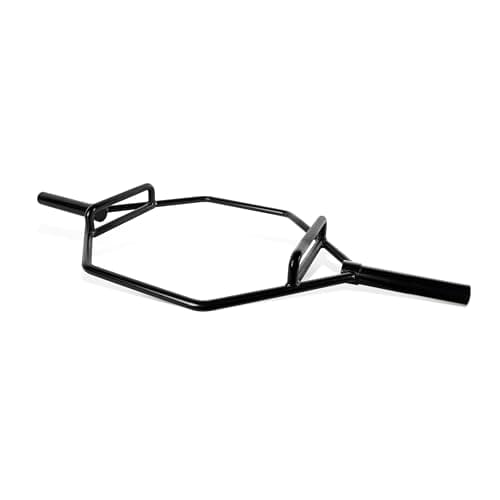
CAP Olympic Hex / Trap Bar (combo grips)
Combo high and low handles mean one bar covers both the easier short-range pull and the closer-to-conventional long-range pull, which is exactly the flexibility a single-bar home gym needs.
Frame
Closed hex
Handles
Combo (high and low)
Sleeves
2-inch Olympic
Also does
Shrugs, carries, rows
Flip to change
Yes — turn the bar over
Pros
Two handle heights in one bar. Flip it over and the high handles cut maybe two inches off the range of motion, which is the difference between a pull you can load heavy and a pull you can load heavier
The load sits beside your body rather than in front of it, which is the entire mechanical argument for the hex bar and the reason the published lumbar moments come out lower than a straight-bar pull
CAP is the most widely stocked budget plate and bar brand in the US, so spares, matching plates and replacement collars are never a hunt
Takes the same 2-inch Olympic plates as every barbell on this site, so it adds a lift without adding a second weight set
Far more forgiving to fail on. A trap bar you cannot finish gets set back down between your feet; a straight bar you cannot finish has to come down past your shins
Cons
Closed frame, so you step in and out over the bar rather than walking into it. That rules out loaded lunges and makes farmer carries awkward in a tight garage
It deadlifts, shrugs, rows and carries, and that is the list. It will not squat, bench or press, so it cannot be the only bar in a complete gym
The knurling on cheap hex bars is shallow. With chalk it is fine; with sweaty hands and no chalk your grip will give out before your hips do
Awkward to store. A hex frame does not hang on a standard bar holder and it does not stand in a corner neatly — plan a wall bracket or floor space for it
Best for: the lifter who trains alone and wants the most forgiving heavy pull available.
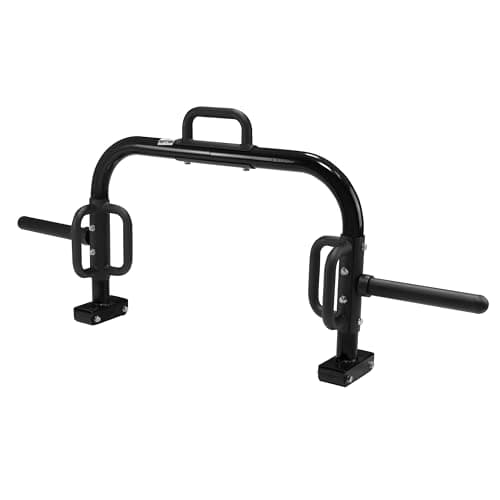
The open-ended frame is the one genuine functional upgrade in this category: you walk into the bar instead of stepping over it, which unlocks farmer carries, lunges and split squats a closed hex cannot do.
Frame
Open-ended hex
Handles
Dual grip (hex and shrug)
Sleeves
2-inch Olympic
Also does
Farmer carries, lunges, split squats
Loading
Walk-in — no stepping over
Pros
Open end means you walk into the bar. In a garage where the bar lives against a wall that is a real quality-of-life difference every single session
Farmer carries, walking lunges and split squats all become available, which is a meaningful amount of extra training for no extra equipment
Dual-grip handles cover both the deadlift position and a shrug position, so it still does the two things people buy a trap bar for
Same 2-inch Olympic sleeves and the same CAP supply chain as the pick above
Cons
An open frame is less rigid than a closed one by definition. At the loads a budget home gym actually pulls that is academic, but it is the trade you are making
The weight is not evenly balanced front-to-back when it is loaded and standing free, so it wants a wall or a rack to lean against between sets
Usually the pricier of the two CAP hex bars, and the extra money buys exercise options rather than a better deadlift
No high-handle option on most listings, so you lose the flip-it-over trick that makes the pick above so flexible
Best for: a small gym where one bar has to cover pulls, carries and single-leg work.
$119.9929% offPrice as of October 6, 2026·#addisclosure
Sunny Health Olympic Hex Trap Bar (swivel handles)
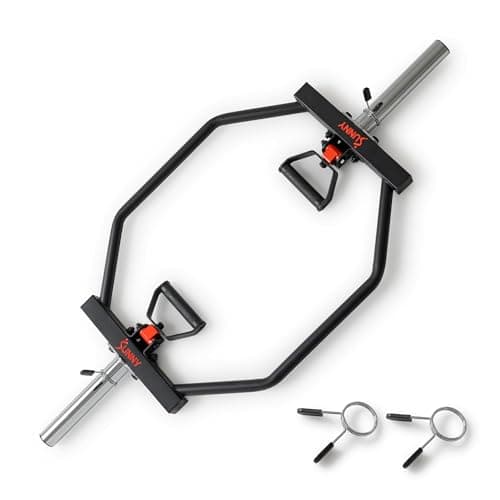
Swivel handles let the grip rotate as the bar leaves the floor, which takes the twisting load off the wrists and makes the bar noticeably kinder on cranky elbows.
Frame
Closed hex
Handles
Swivel
Sleeves
2-inch Olympic
Best for
Heavy pulls, wrist comfort
Brand
Sunny Health & Fitness
Pros
Rotating handles are the only feature on this page that addresses joint comfort rather than leverage. If your wrists hurt on a fixed hex bar, this is the fix
Sunny publishes real spec sheets and runs a US support operation, which is more than the anonymous hex bars sold at the same price
A swivel handle self-aligns as the bar breaks the floor, so your hands finish where they want to be rather than where the weld put them
Same closed-hex forgiveness on a failed rep as the top pick
Cons
Swivels are moving parts, and moving parts are the thing that eventually fails on a bar that otherwise has nothing to fail. Expect some rattle and some play over time
Closed frame, so no carries or lunges — same limitation as the top pick
Single handle height on most listings, so no flip-over range-of-motion option
The swivel mechanism adds dead weight at the handles, which slightly changes how the bar feels off the floor compared with a rigid hex
Best for: anyone whose wrists or elbows complain on fixed handles.
$79.9921% offPrice as of October 6, 2026·#addisclosure
CAP 7ft Olympic Barbell (35 lb)
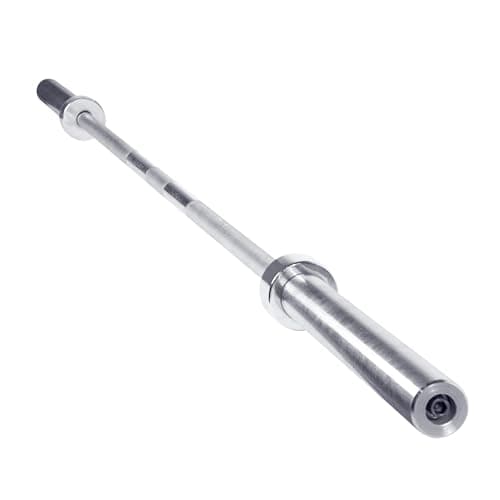
The straight bar loses the deadlift-specific argument and wins the whole-gym argument: it is the only bar here that also squats, benches, presses, rows and cleans.
Type
7 ft Olympic barbell
Bar weight
35 lb (per listing)
Sleeves
2-inch Olympic
Finish
Chrome
Also does
Squat, bench, press, row, clean
Pros
One bar, every barbell lift. No trap bar can make that claim, and in a gym with a budget this is usually the decisive fact
The conventional deadlift is the lift that gets judged in powerlifting, so if you intend to compete you have to train it on a straight bar anyway
Published studies put higher hamstring and spinal erector activation on the conventional pull than the hex-bar pull — if posterior-chain work is the goal, the straight bar trains it more directly
Racks, benches, J-hooks and bar holders are all designed around a 7 ft straight bar. Nothing in a home gym is designed around a hex frame
Cons
The bar starts in front of your shins, which is what produces the higher published lumbar and hip moments. Train it alone, tired, with no spotter, and form is more likely to go
A cheap 35 lb bar at this price has a lower published or implied capacity than a real power bar, a modest whip and sleeves that will develop play. It is a starter bar, not a lifetime bar
Chrome over a soft core is a corrosion risk in an unheated garage — see our garage gym rust guide, because a rusted bar in a damp space is the single most common cheap-equipment regret
Needs a rack or stands to be fully useful. A trap bar needs nothing but floor
Best for: the gym that needs squats, presses and rows as well as deadlifts.
Skip this
The budget traps that look cheap and cost you twice. We'd skip these.
A trap bar as your FIRST bar, if you do not own a straight bar yet
This is the mistake we see most often in this category. The trap bar is the better deadlift tool and the worse gym tool, and a home gym with only a trap bar cannot squat, bench or press. If you own nothing, buy the straight bar and a set of plates first, add a rack and a bench, and then add the trap bar as the fourth or fifth purchase — at which point it is genuinely excellent.
Unbranded hex bars with a struck-through list price and no published capacity
Trap bars are welded steel frames, and a weld is the one thing on a bar you cannot inspect from a product photo. A bar that publishes no capacity figure and comes from a four-letter marketplace brand with a theatrical discount is the category's standard trap. Stick to a brand with a product page, a support contact and a stated rating, even if it costs twenty dollars more.
Paying extra for a rackable trap bar you cannot rack
Rackable hex bars — the ones with straight ends that sit in J-hooks — cost more and are genuinely useful for rack pulls and hex-bar squats. They are also useless if you do not own a power rack with wide enough uprights. Check the inside width of your rack before you pay the premium, or buy the cheaper non-rackable bar and keep the difference.
How to choose (and what to skip)
What the published research actually says
The direction of the finding is consistent across the studies summarised in our sources: compared with a conventional barbell deadlift at the same load, the hexagonal bar lowers peak moments at the lumbar spine, hip and ankle and raises the peak moment at the knee. Trained lifters generate higher peak force and peak power with the hex bar, and in one often-cited comparison the average one-rep max was higher with the hex bar than with the straight bar. Muscle activation splits the way the geometry predicts: more quadriceps with the hex bar, more hamstring and spinal erector with the conventional pull. None of that makes either bar better. It means the hex bar is a more knee-dominant, lower-back-sparing pull, and the straight bar is a more hip-dominant, back-intensive one.
High handles vs low handles is the spec that changes your numbers
Most cheap trap bars have two handle heights and you choose by flipping the bar over. High handles raise your starting position by roughly a couple of inches, which shortens the range of motion and lets you pull more weight for the same effort. Low handles put you closer to a conventional start position and are the harder, more honest pull. Neither is wrong. What matters is that you pick one and stay with it for a training block, because switching handle heights mid-programme makes your logbook meaningless. If you are buying one bar, buy one with both.
Open frame or closed frame decides what else the bar does
A closed hex frame surrounds you: you step in, you pull, you step out. An open-ended bar is a U shape you walk into, which means it also does farmer carries, walking lunges and split squats without a second piece of equipment. The closed frame is marginally more rigid; the open frame is meaningfully more useful. In a small garage where every item has to justify its floor space, we would take the open bar, and in a gym that already has dumbbells for carries we would take the closed one.
Price, plates and the thing that actually costs money
Both bar types take 2-inch Olympic plates, so adding a trap bar to a gym that already has a barbell costs you the bar and nothing else. That is the quiet reason the trap bar is such a good third or fourth purchase: the expensive part of a deadlift setup is the plates, and you already own them. If you are starting from zero, the plates will cost more than either bar, which is worth knowing before you agonise over the bar choice. Our plate-buying page covers what cast iron actually costs per pound.
What neither bar fixes
A trap bar does not make deadlifting safe, and nothing in the published literature says it does. It redistributes load. If your lower back hurts when you pull, a hex bar may let you keep training while you sort the cause out, but the cause still needs sorting. The same goes for grip: both bars will out-grip you before they out-strength you, which is why chalk, and eventually straps, matter more at this price point than any feature on either bar.
Deadlifting alone, which is how most of this site's readers train
This is the part the gym-based comparisons leave out. In a commercial gym a failed deadlift is embarrassing; in a garage at 6am it is a bar you have to control by yourself. A closed-frame trap bar is the most forgiving heavy lift in a solo home gym, because a rep you cannot finish simply goes back down inside the frame between your feet. That is a real safety argument, not a marketing one, and it is why the trap bar sits at the top of this page even though the straight bar is the more useful piece of equipment overall.
The short version, by situation
You own nothing yet. Buy the straight bar and plates. Build the gym, then add a trap bar later. Our budget barbell roundup and cheap weight plates page cover that order.
You own a bar, a rack and plates. The trap bar is one of the best-value additions left to make. It adds a genuinely different pull for the price of the bar alone.
Your lower back is the limiting factor. Start with the trap bar and the high handles. It is the lowest-back-demand way to load a heavy hinge that we know of.
You want to compete in powerlifting. Straight bar, conventional pull, no debate — that is the lift that gets judged.
You train alone and push close to failure. Closed-frame trap bar. The failed-rep story is simply better.
You have almost no floor space. Neither. Adjustable dumbbells deadlift well enough at the loads a small room supports, and they do fifty other things.
Why the trap bar lets most people lift more
It is geometry, not magic. In a conventional deadlift the bar has to clear your shins, so it starts in front of the middle of your foot and the weight sits forward of your hips. Every inch forward is a longer lever arm for your lower back to hold against. In a hex-bar pull the handles sit level with your hips, roughly over the middle of your foot, which shortens that lever. The same muscles do the work; they just do it at a mechanical advantage. Add the couple of inches of range of motion that high handles remove and you get the published result — more weight moved, more peak power, less demand on the lumbar spine.
The honest flip side is that a lift you can load more is not automatically a lift that builds more. The hex bar shifts work towards the quads, which means it trains the hamstrings and spinal erectors less than a conventional pull does at the same weight. If the whole point of your deadlift is posterior-chain strength, the straight bar remains the more direct tool, and our guide to how much weight you actually need is a better starting point than chasing a bigger number on an easier bar.
What a cheap trap bar gives up
Three things, consistently. Knurl. Budget hex bars have shallow, polite knurling that will not hold a sweaty hand under load, which makes chalk effectively mandatory. Sleeve length. Short sleeves limit how many plates fit, which only matters once you are pulling well into the triple digits — but it does eventually matter. Published capacity. Most cheap hex bars publish nothing, which is the reason we only recommend ones from brands with a real product page behind them. Our cheap trap bar roundup goes through the individual listings in more detail and is the page to read if you have already decided which bar type you want.
What it does not give up is the thing you are buying. A $150 hex bar and a $400 hex bar hold plates at the same handle height with the same geometry. This is one of the categories where budget equipment genuinely does the job, which is not true of, say, a cheap treadmill.
Where specialty bars fit after this one
The trap bar is usually the first specialty bar a home gym buys, and it is the right first choice because it adds a lift rather than a variation. After it, the two that earn their place soonest are the safety squat bar, which lets you squat heavy without holding a bar on your back, and the EZ curl bar, which is the cheapest joint-comfort upgrade in the gym. All three take the same plates, so each one is a bar-only purchase.
If you are weighing the trap bar against a belt rather than against another bar: a belt is far cheaper, and for most people pulling moderate weights it changes more about how a heavy set feels. Our page on whether you need a lifting belt covers what the pressure research actually supports.
Frequently asked questions
Is the trap bar deadlift as good as the barbell deadlift?+
For building strength and muscle in a home gym, yes — it is simply a different distribution of the same work. The published comparisons put lower peak moments at the lumbar spine and hip with the hex bar, a higher peak moment at the knee, more quadriceps activation, and less hamstring and spinal erector activation. Lifters also tend to produce more peak force and power with it. The straight bar is better if posterior-chain strength is specifically the goal, or if you compete in a sport that judges the conventional deadlift.
Can you lift more with a trap bar?+
Usually, yes. Two things stack up in your favour: the handles sit beside your hips rather than in front of your shins, which shortens the lever your lower back has to hold against, and high handles remove roughly two inches of range of motion. In one widely cited comparison the average one-rep max was higher with the hex bar than with the conventional bar. Treat the two lifts as separate exercises with separate logbooks rather than converting between them.
Is a trap bar better for your back?+
It places less peak demand on the lumbar spine at the same load, which is what the published joint-moment data shows, and that is a meaningful difference if your lower back is what limits your pulling. It is not a back-pain treatment and it does not make a heavy pull risk-free. If deadlifting hurts, the useful order is: fix the cause, keep training with the more forgiving tool in the meantime, and keep the loads honest.
Should I buy a trap bar or a barbell first?+
A barbell, unless you already own one. A straight bar squats, benches, presses, rows and cleans; a trap bar deadlifts, shrugs, rows and carries. A home gym built around only a trap bar cannot train the upper body properly. Once you own a bar, plates, a rack and a bench, the trap bar becomes one of the best-value additions available, because it adds a whole lift for the cost of the bar alone.
Do trap bars use the same plates as a barbell?+
Yes, as long as both are Olympic. Every bar on this page takes 2-inch Olympic plates, so adding a trap bar to an existing barbell setup costs you nothing extra in weight. If you are on a 1-inch standard set, check our Olympic vs standard barbell guide first — that incompatibility catches people out and it is the more expensive mistake.
What is the difference between an open and a closed trap bar?+
A closed hex frame is a complete loop you step into; an open-ended bar is a U shape you walk into from one side. The open design also does farmer carries, walking lunges and split squats, which the closed frame cannot. The closed frame is slightly more rigid and slightly cheaper, and it has the better failed-rep behaviour because the bar comes down inside the frame between your feet.
Are high or low trap bar handles better?+
High handles shorten the range of motion by a couple of inches, so you can load more weight for the same effort — useful for building confidence and for heavy work. Low handles put you nearer a conventional start and are the harder pull. Most cheap trap bars give you both: flip the bar over. Pick one per training block so your numbers stay comparable.
Do I need a rack for a trap bar?+
No, and that is one of its advantages. A trap bar deadlift starts and finishes on the floor, so the bar plus plates is the whole setup — no rack, no stands, no spotter. A straight bar, by contrast, needs a rack or stands to reach most of its exercises. If floor space is what you have and rack money is what you do not, that difference matters.
Prices and availability shown here come from Amazon's live data and change often; we re-verify them regularly. Bar Bumper is an Amazon Associate and earns a commission on qualifying purchases at no extra cost to you. Read our full disclosure.