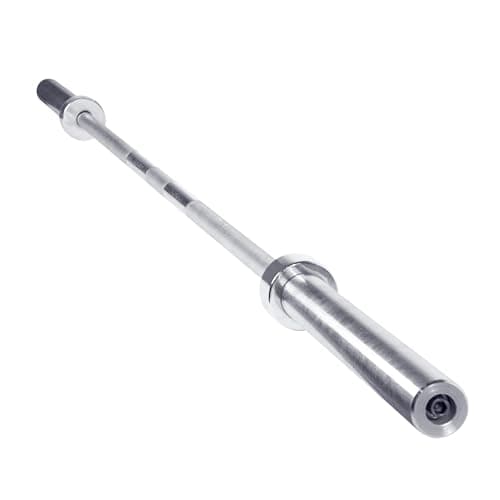
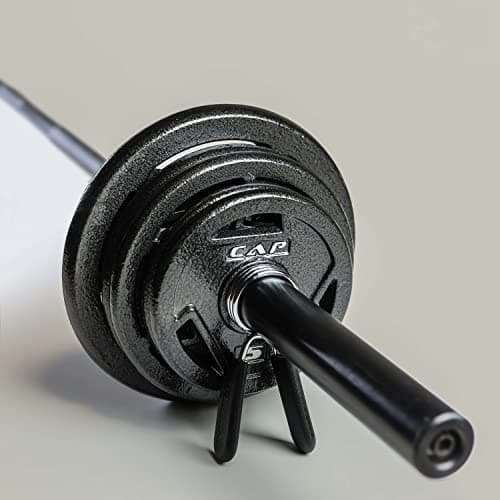
An Olympic barbell has 2-inch diameter sleeves that rotate on bushings or bearings, a shaft usually around 28-32 mm, and a typical weight of 35-45 lb for a 7 ft bar. It's the format used in every commercial gym, every competition, and by essentially every plate manufacturer.
A standard barbell has 1-inch sleeves that are usually part of a single continuous shaft — so the whole bar is one diameter end to end, with collars to hold the plates on. It's lighter, cheaper, and was the home-gym default decades ago. It still exists mainly because it's cheap to make and because a lot of old plate sets are out there.
Visually, the giveaway in a listing photo is the step: an Olympic bar has an obvious shoulder where the thin shaft meets the fat sleeve. A standard bar is a straight tube.
Why the plate ecosystem decides it
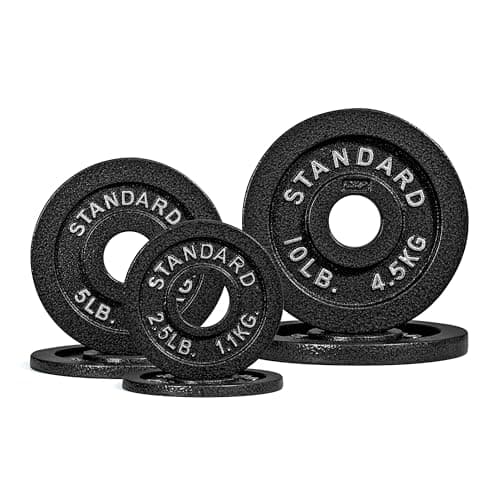
Here's the part that isn't obvious when you're comparing two bars. Over the life of a home gym, the bar is a small fraction of what you spend on the barbell side — the plates are the rest of it, and they keep accumulating. Our weight plate roundup covers the cast-iron and bumper options, and nearly all of them are 2-inch.
Which means the sleeve size doesn't lock in a $40 decision, it locks in every plate purchase you make afterwards. In the Olympic standard you have cast iron, grip plates, bumpers, competition plates, fractional plates, and a healthy second-hand market at every weight. In the 1-inch standard you have a much thinner selection, almost no bumper options, and prices that are frequently higher per pound because volumes are low.
It also decides accessories. Landmine attachments, plate-loaded cable stations, plate storage pegs on racks, weight-plate collars, deadlift jacks — nearly all of them are built around the 2-inch sleeve. Choosing standard quietly makes half the aftermarket unavailable.
Weight, capacity and what actually breaks
Two practical differences that matter more than they sound.
First, the bar weight. If you press a 45 lb Olympic bar, your logbook starts at 45 lb. If you press a 20 lb standard bar, it starts at 20. That's fine — a lighter starting point is genuinely useful for beginners and for anyone rehabbing a shoulder — but you need to know the number, and cheap standard bars frequently don't publish it. Weighing the bar on a bathroom scale before your first session is a reasonable move either way.
Second, capacity. A thin 1-inch tube spanning the width of a rack under a few hundred pounds develops real bending stress, and cheap standard bars do take a permanent set — they come out of the rack slightly banana-shaped and stay that way. A budget Olympic bar has substantially more material where it matters. If your five-year plan includes deadlifting more than a couple of hundred pounds, that's not a hypothetical concern.
The two cases where standard is genuinely right
We're not going to pretend it's never the answer. Two situations:
- You already own a pile of 1-inch plates. Inherited a set, or picked up plates for nothing locally. Buying a matching bar to use free plates is straightforward arithmetic, and it beats buying an Olympic bar plus a full plate set. Just make it a conscious decision, and know you're accepting the ceiling.
- You need light and short, not heavy. A lighter bar in a very small room, for pressing and accessory work at modest weights, with no plans to squat or deadlift heavy. Some standard bars are 5-6 ft, which fits rooms a 7 ft Olympic bar simply doesn't.
Outside those two, we'd take the Olympic bar every time — including on the tightest budgets, because the money you save on a standard bar comes back out of your pocket at the plate stage.
What about the odd sizes you'll see listed?
Two more numbers appear in listings and confuse people. The shaft diameter (usually 28-32 mm on Olympic bars) is where you grip — thinner shafts are easier to hold and whip more; thicker ones are stiffer. It's a preference, not a compatibility issue. And bar length comes in 4 ft, 5 ft, 6 ft and 7 ft in the Olympic standard: a 7 ft bar is required if you want to use it in a full-size rack, because the shorter bars don't span standard J-hook spacing.
So if you're buying an Olympic bar for a power rack, buy the 7 ft. The shorter Olympic bars are useful for dumbbell-style work and very small rooms, not for racked lifts.
Our recommendation
Buy a 7 ft Olympic bar with rotating sleeves and let every plate you ever buy fit it. If you're starting from zero, the bar-and-plates bundle above is the cheapest way to get a working barbell setup in one purchase; if you already have plates, buy the bar alone. Only choose standard if you've inherited 1-inch plates or you specifically need a shorter, lighter bar — and in both cases, know that you're choosing a smaller world of gear to shop in.
Once the bar is sorted, the next question is how much weight to buy, which we cover in how much weight do you need, and what kind of plates to buy it in, which is cast iron vs bumper plates.
Prices and availability shown here come from Amazon's live data and change often; we re-verify them regularly. Bar Bumper is an Amazon Associate and earns a commission on qualifying purchases at no extra cost to you. Read our full disclosure.