Cheap lat pulldown setups: add cables to the rack you already own
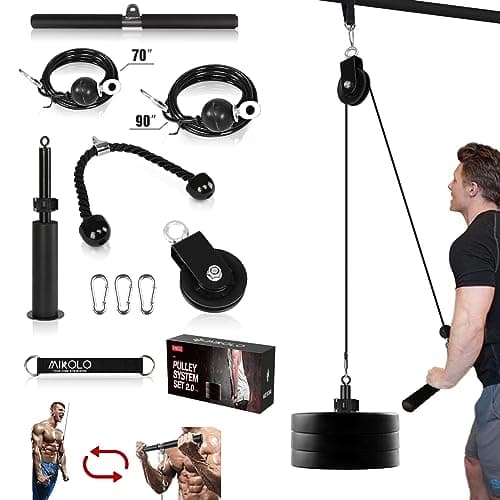
If you have a rack, you do not need a cable tower to get lat pulldowns. A pulley kit costs a fraction of one and uses the plates already on your floor.
Updated August 2026 · By Stephen V.
Lat pulldowns are the most-missed movement in a home gym. Pull-ups cover the same muscles, but they only come in one weight — yours — and if you cannot yet do a set of eight, there is no obvious way to train toward them at home. A cable is the answer, and buying a whole cable tower to get one is the expensive way to solve it.
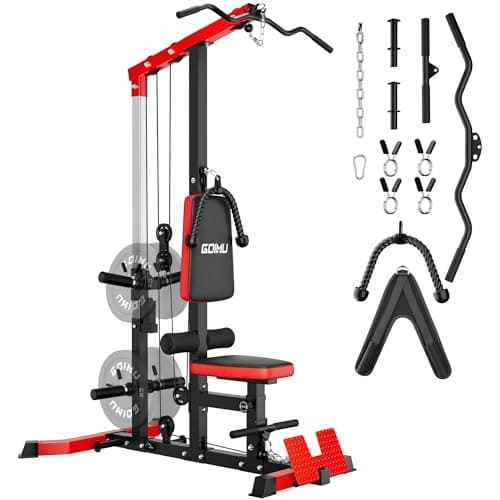
If you already own a power rack or a squat rack, a pulley kit bolts to it, hangs off a loading pin you load with the plates already on your floor, and gives you pulldowns, rows, tricep pushdowns and face pulls for a fraction of a machine. If you do not own a rack, a standalone tower is still the answer. Here is the honest split, with what fits and what does not.
The short answer
In a hurry? These are the picks we'd buy. Prices are live; tap a card below for the full reasoning.
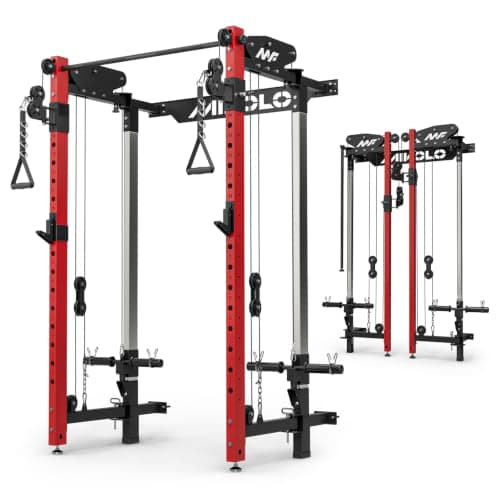
A folding wall-mounted rack with cable and lat capability built in — the answer when the machine cannot live in the middle of the room.
Type
Folding wall-mounted rack with cables
Storage
Folds flat to the wall
Cables
Crossover and lat pulldown
Needs
Solid wall with studs
Pros
Folds flat, so a garage stays a garage between sessions
Combines rack and cable functions in one wall footprint
Solves the lat problem and the rack problem together
Cons
Needs a genuinely solid wall and careful stud mounting
Most expensive route of the three
Installation is a real job, not an afternoon assembly
Best for: garages that need the floor back.
Skip this
The budget traps that look cheap and cost you twice. We'd skip these.
Buying a pulley kit without checking your rack's anchor points
Bolt-on kits need somewhere to attach: a top crossmember, a spare hole pattern, or a beam above the rack. Plenty of budget racks have round tubing, no spare holes, or a top bar the kit's brackets will not clamp to. Photograph your rack's top section and compare it against the kit's mounting method before you order.
Heavy pulldowns with no way to hold yourself down
Once the load approaches your bodyweight, a pulldown simply lifts you out of position. A tower with thigh pads solves that. With a bolt-on kit you have to improvise: kneel, wedge under a bench, or accept a lighter working weight. That is the real functional difference between the two formats, and it is worth knowing before you buy the cheaper one.
How to choose (and what to skip)
Start with what you already own
If there is a rack in your garage, the pulley kit is almost always the right answer: it is a fraction of the price, uses your existing plates, and adds no floor footprint. If there is no rack, you are comparing a standalone tower against buying a rack plus a kit — and the rack-plus-kit route usually wins on total training value.
Check the anchor before anything else
Kits mount in different ways: some clamp to a top crossmember, some bolt through existing holes, some hang from a beam. Match the mounting method to your specific rack, including tube shape and hole spacing. This is the single most common reason a pulley kit ends up returned.
Cable length decides what you can do
A longer cable gives you more range and lets the same kit serve both a high pulley and a low pulley. A short cable limits you to one position. Where a kit offers a choice, the longer option is generally the more useful one, provided your ceiling has the height for it.
Plate-loaded versus weight stack
Everything in this price band is plate-loaded, which is good news in a gym that already has plates: the machine is cheaper, and adding weight costs nothing. Stack machines are quicker to change between sets but cost far more. In a budget garage gym, plate-loaded is the right compromise.
Think about the low pulley too
The same cable that gives you pulldowns gives you seated rows, face pulls, tricep pushdowns and cable curls if it can be anchored low as well as high. That doubles the value of the purchase, so favor setups that can do both over ones locked to a single high position.
Why the lat pulldown is worth solving
A home gym built around a bar, plates and a bench is strong on pressing and pulling from the floor and weak on vertical pulling. Pull-ups fill that gap if you can do them. If you cannot yet — and plenty of people cannot — there is no scalable substitute without a cable, which is why this gap tends to persist for years in otherwise well-equipped garages.
A cable also gives you the things a barbell cannot: constant tension, easy unilateral work, and light isolation movements for shoulders and arms that do not need a whole new bar. Our budget cable machine roundup covers the full standalone-tower category, and cable machine versus bands covers the cheapest possible version of this problem.
The bands alternative, honestly
A heavy resistance band looped over a rack gives you a pulldown for about ten dollars. It is a legitimate answer for beginners and for anyone whose main goal is to build up to pull-ups. What it is not is a substitute for constant tension: the band is easiest exactly where the movement is hardest, at the top. As a bridge it works well; as a long-term solution it plateaus. Our cheap resistance bands roundup covers the band route.
Setting up so you actually use it
The practical problem with bolt-on pulley kits is friction of use: if the kit has to be rigged and unrigged each session, it gets skipped. Leave it rigged if you can. If the rack is also your squat station and the cable is in the way, run the cable to one side rather than the front, and use a carabiner so the handle comes off in one movement.
For holding yourself down on heavy pulldowns without thigh pads, kneeling is the simplest fix and works better than most improvised alternatives. If you find yourself needing more than that regularly, you have outgrown the kit and the standalone tower is the honest upgrade.
Frequently asked questions
Can I add a lat pulldown to any power rack?+
Not to any rack, no. The kit has to be able to attach to your specific frame, which depends on tube shape, hole spacing and whether there is a usable top crossmember. Check the mounting method against photographs of your own rack before you order — a mismatch here is the most common reason these kits get returned.
Is a lat pulldown attachment as good as a real machine?+
For the movement itself, close. For heavy loading, no, because a bolt-on kit has no seat or thigh pads to hold you down, so beyond roughly your own bodyweight you simply get lifted. Kneeling helps. If your pulldowns are getting genuinely heavy, that is when a standalone tower earns its price.
What can I do with a pulley kit besides pulldowns?+
Anchored high: pulldowns, straight-arm pulldowns, tricep pushdowns, face pulls. Anchored low: seated rows, cable curls, upright rows, lateral raises. That range is most of the reason a cheap pulley kit is such good value in a barbell-based gym.
Are resistance bands a good substitute for a lat pulldown?+
As a bridge, yes — a heavy band over a rack gives you a scalable vertical pull for very little money, and it is a sensible way to build toward pull-ups. As a permanent answer, it has a real limitation: band tension is lowest where the movement is hardest, so the loading profile never matches a cable.
Prices and availability shown here come from Amazon's live data and change often; we re-verify them regularly. Bar Bumper is an Amazon Associate and earns a commission on qualifying purchases at no extra cost to you. Read our full disclosure.