The honest answer is that one weight will never cover both a shoulder press and a row — which is why the useful question is not “how heavy” but “how much range”. Here is the range to buy, and what it costs.
Updated October 2026 · By Stephen V.
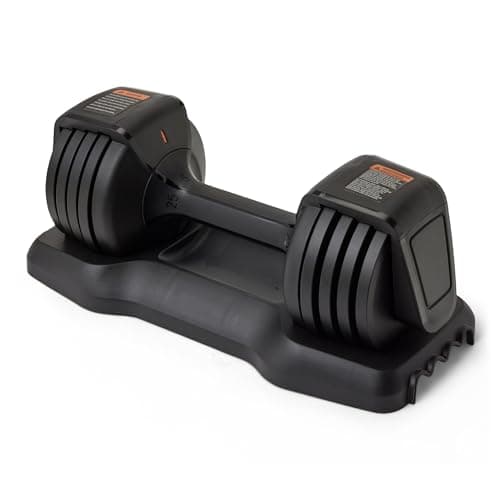
Buy a range, not a weight: for most beginners the useful span is roughly 5 to 25 lb per hand, and the cheapest way to own it is a pair of Amazon Basics 25 lb adjustable dumbbells — one for each hand. That span covers lateral raises at the bottom and rows at the top, which is the whole problem with the question as usually asked. Your shoulders will press maybe a third of what your back can row, so a single fixed pair is either too light for half your exercises or too heavy for the other half. Pick the span first and the format second.
The reason “what weight should I start with” has no single answer is that the limiting muscle changes with every movement. A small muscle working at a long lever — the side delt in a lateral raise, the rear delt in a reverse fly — is working hard at 5 to 10 lb. A big muscle working at a short lever — your back in a single-arm row, your legs in a goblet squat — wants 20 to 40 lb before it notices. Those are not different fitness levels; they are different exercises, and they are both you on the same day.
So the practical test is not a number from a chart, it is a rule: a starting weight should let you do about 8 to 12 clean repetitions, with the last two genuinely hard, and no change in technique. If you can do 20, it is too light. If form breaks at rep six, it is too heavy. Applied per exercise, that rule picks your weights far better than any bodyweight-based formula, and it is why the equipment recommendation below is about coverage rather than about a single pair.
Three ways to own that range, and the trade is always the same — cost per pound against convenience. One adjustable pair covers the whole span cheaply but needs adjusting between exercises. A light fixed set covers it instantly but costs more and takes floor space. One or two fixed pairs cover part of it for very little money and leave gaps. The picks below are one of each, so you can choose on what matters to you rather than on which is “best”.
The short answer
In a hurry? These are the picks we'd buy. Prices are live; tap a card below for the full reasoning.
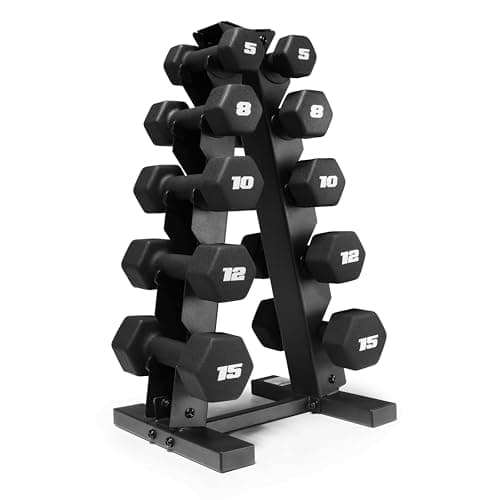
CAP 100 lb Neoprene Hex Dumbbell Set (with A-frame rack)
A 100 lb set of light neoprene pairs with its own rack: every weight in the beginner range available instantly, with nothing to adjust and nothing to fail.
a household where more than one person trains, or anyone who hates fiddling
$129.9915% offPrice as of October 6, 2026·#addisclosure
CAP 100 lb Neoprene Hex Dumbbell Set (with A-frame rack)
A 100 lb set of light neoprene pairs with its own rack: every weight in the beginner range available instantly, with nothing to adjust and nothing to fail.
Type
Neoprene hex set + rack
Set weight
100 lb total (per listing)
Storage
Vertical A-frame rack
Coating
Neoprene
Covers
Several pairs across the light range
Pros
Every weight is available instantly, which is what makes supersets, drop sets and circuit work actually work
The rack is the reason this gets used rather than stacked in a corner — weights at waist height get picked up, weights on the floor do not
Neoprene is soft, grippy and warm to hold, which is a genuine improvement over cold knurled steel for most people's hands
Fixed weights are honest: 10 lb is 10 lb every session, so progress is trackable in a way an adjustable selector's markings are not
Nothing mechanical to wear out. A fixed dumbbell is iron in a jacket and it will outlast every adjustable pair on this site
Cons
Several times the cost of a single adjustable pair for a similar usable range
Needs about a square foot of permanent floor and is heavy to move once assembled
Fixed jumps. If one pair is easy and the next is hard, there is nothing in between and no way to make one
The light range is the whole set, so you will outgrow the top of it on rows and squats while still using the bottom for raises
Set composition varies between listings — the total weight figure is the only number stated consistently, so check which pairs are included
Best for: a household where more than one person trains, or anyone who hates fiddling.
$46.9921% offPrice as of October 6, 2026·#addisclosure
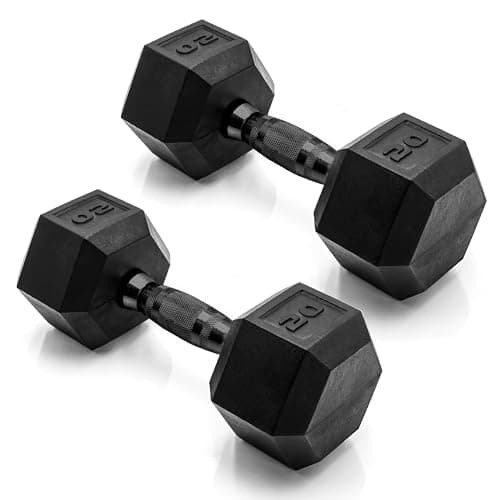
CAP 20 lb Rubber Hex Dumbbells (pair)
A 20 lb rubber hex pair is the weight most beginners need and most starter sets do not go up to — the cheapest way to extend a range you already have.
Type
Fixed rubber hex pair
Weight
20 lb pair (this listing)
Adjust
None — fixed weight
Finish
Rubber-coated hex heads
Best use
Rows, presses, goblet squats
Pros
20 lb per hand is the weight that unlocks single-arm rows, goblet squats and heavier presses, and it is where most cheap starter sets stop
Cheapest format per pound of any dumbbell, as long as you only need one or two pairs
Hex heads do not roll, so they stay where you put them and they are stable enough to do push-ups or renegade rows on
Indestructible. This is a pair you will still own in twenty years, which no mechanism can claim
Cons
One weight, forever. Building a full range out of fixed pairs costs far more than any adjustable pair
20 lb is too heavy for lateral raises and rear delt work for most beginners, so it cannot be your only pair
Needs somewhere to live. Loose fixed pairs on a floor are how a spare room becomes an obstacle course
Budget rubber coating can smell noticeably for the first couple of weeks in a closed room
Best for: filling the one gap in a range you already own.
How to choose (and what to skip)
Starting weights by exercise, not by bodyweight
This is the part the charts get wrong. For a beginner with no training history, sensible starting points per hand look roughly like this: 5 to 10 lb for lateral raises, front raises and rear delt work; 10 to 15 lb for bicep curls, tricep extensions and overhead presses; 15 to 25 lb for single-arm rows, bench presses and chest work; 20 to 35 lb for goblet squats, lunges and Romanian deadlifts, where you are loading legs and hips. Those bands overlap enormously, which is exactly why a range beats a weight. Use them as a starting guess, then apply the repetition test and adjust.
The 8-to-12 rule, and how to use it honestly
A weight is right when you can complete 8 to 12 clean repetitions with the last two genuinely hard and no change in technique. Too light looks like 20 reps and no fatigue. Too heavy looks like form breaking at rep six: the weight swinging, the back arching on a press, the torso twisting on a row. Apply it per exercise, write the result down, and expect the numbers to move quickly in the first two months. A beginner's strength improves faster than at any later point, which is the strongest argument for buying range rather than a single pair.
How much weight you actually need before you spend more
Less than the internet suggests. A span of 5 to 25 lb per hand covers every upper-body movement for a beginner's first few months and all accessory work for much longer than that. The first thing to outgrow it is lower body: once you can goblet squat with 35 lb for sets of twelve, dumbbells are limited by how much weight you can get into position rather than by your legs. That is the point to read our page on how much weight you actually need, not before.
Adjustable or fixed: decide on how you train, not on cost
Adjustable dumbbells win on cost per pound of range and on space, and they cost you a few seconds between exercises. Fixed pairs win on instant changes, on durability and on the fact that nothing can break, and they cost you money and floor. The deciding question is whether you train in straight sets with rest between them, where adjusting is a non-issue, or in circuits and supersets, where it is genuinely annoying. Our adjustable vs fixed comparison works through the whole trade, and whether cheap adjustable dumbbells are worth it answers the reliability question.
Do not buy a full fixed set as your first purchase
It is the most expensive way to start and the one most likely to leave you with weights you never use. A complete fixed range from 5 to 50 lb is several hundred dollars, a rack to hold it, and a permanent corner of a room, and a beginner cannot yet know which half of it they will actually need. Start with the range, train for three months, and buy the specific pair you keep reaching for. That is also the cheapest route to a set over time, because you only buy what gets used.
The second-hand angle, which is better than new here
Fixed dumbbells are one of the best used buys in all of fitness: they are iron, there is nothing to fail, and they routinely sell for a fraction of retail because they are heavy and awkward to post. Adjustable dumbbells are one of the worst, because the selector mechanism is the part that wears and you cannot properly inspect it. If you want the convenience of fixed pairs and are put off by the price, buy them used. Our guide to buying used home gym equipment covers what to check.
The answer in one table
Lateral raises, front raises, rear delt flyes: 5-10 lb per hand. Small muscle, long lever — this is genuinely hard work at a weight that looks trivial.
Curls, tricep extensions, overhead press: 10-15 lb per hand to start.
Goblet squats, lunges, Romanian deadlifts: 20-35 lb, and rising fast. Legs are where dumbbells run out first.
So: buy 5-25 lb per hand and expect to extend the top end within a few months rather than the bottom.
Why one pair is never the answer
Because the gap between your strongest and weakest dumbbell exercise is roughly four to one, even on day one. If you buy a 20 lb pair because it feels right for rows, your lateral raises will be done with a weight you cannot control and your shoulders will take the strain instead of your delts. If you buy a 10 lb pair because it feels right for raises, your rows will be a warm-up forever. People resolve this by buying one pair and then quietly stopping the exercises it does not suit, which is how a perfectly good purchase turns into half a programme.
A range solves it for less money than two fixed pairs cost. That is the entire case for adjustable dumbbells as a first purchase, and it is a stronger case for beginners than for anyone else — precisely because a beginner does not yet know which weights they will live at. Our cheap adjustable dumbbells roundup ranks the options above the entry-level pick on this page.
How fast you will outgrow your starting weight
Faster than you expect on the big movements and slower than you expect on the small ones. Novice strength gains are the largest they will ever be, and most of the early improvement is your nervous system learning the movement rather than new muscle, which is why the first six weeks can feel dramatic. In practice: expect to add weight to rows, presses and squats every week or two at first, and expect lateral raises to sit at the same 8 or 10 lb for months. Both are normal. Neither means you bought the wrong thing.
When the top of your range stops being enough, the decision is whether to extend dumbbells or add a barbell. Dumbbells get expensive per pound as they get heavy; a barbell and plates are the cheapest weight money can buy. Our barbell vs dumbbells comparison is the page for that decision, and it turns almost entirely on whether you have space for a rack.
What to do about the gaps
Three cheap tricks cover most of what a limited range cannot. Slow the movement down: a three-second lowering phase makes a light weight substantially harder without any new equipment. Change the leverage: an incline press, a single-leg squat or a pause at the hardest point raises the demand at the same weight. Add reps, then add a set. None of these replaces heavier weights forever, but all of them buy you several more months out of the dumbbells you already own, which is worth knowing before you spend again.
And if you are weighing dumbbells against kettlebells for a first purchase, the short version is that dumbbells are better for pressing and progressive strength work while kettlebells are better for swings, carries and conditioning in a very small space. Our kettlebell vs dumbbell comparison sets out where each wins, and what size kettlebell to start with is the equivalent of this page for bells.
Frequently asked questions
What weight dumbbells should a beginner start with?+
A range rather than a weight: roughly 5 to 25 lb per hand covers everything a beginner does. Within that, expect about 5 to 10 lb for lateral raises and rear delt work, 10 to 15 lb for curls and overhead presses, and 15 to 25 lb for rows and chest presses. The gap between your strongest and weakest dumbbell exercise is around four to one on day one, which is why no single pair works.
Is 20 lb dumbbells enough for a beginner?+
For rows, goblet squats and chest presses, yes — 20 lb per hand is a sensible starting point for all three. For lateral raises, front raises and rear delt flyes it is far too heavy for most beginners, and using it there means your shoulders and traps take over from the muscles you are trying to work. If a 20 lb pair is all you buy, expect to skip or substitute the small-muscle exercises.
How do I know if a dumbbell is too heavy?+
Technique tells you before fatigue does. Too heavy looks like the weight swinging rather than lifting, your back arching on a press, your torso twisting on a row, or form breaking before rep eight. The target is 8 to 12 clean repetitions with the last two genuinely hard and nothing changing in how you move. If you can do 20 comfortably, go up; if form goes at six, go down.
Should I buy adjustable dumbbells or a set of fixed ones?+
Adjustable if you are starting out, because they cover the whole beginner range for less money and almost no space, and you cannot yet know which fixed weights you would actually use. Fixed pairs are better once you know your numbers, train in circuits or supersets where adjusting is annoying, or want equipment with nothing mechanical to fail. Our adjustable vs fixed guide covers the full comparison.
How often should I increase the weight?+
When you can complete the top of your rep range with good form on every set — which, early on, can be every week or two on the bigger movements. Small-muscle exercises like lateral raises progress much more slowly and may sit at the same weight for months. Both patterns are normal. Add reps first, then weight, and write down what you did so the decision is based on your logbook rather than your memory.
Do I need a bench as well?+
Not immediately. Floor presses, standing presses, rows braced on a chair and every leg movement all work without one. A bench becomes worth buying when you want incline work and a proper chest press, and it is usually the second or third purchase rather than the first. Our budget weight bench roundup covers what to look for when you get there.
What dumbbell weight should a woman start with?+
The same way as anyone else: by exercise, using the repetition test. The exercise matters far more than the person — a beginner of any sex will typically find 5 to 10 lb genuinely hard for lateral raises and 15 to 25 lb appropriate for rows. Starting weights vary with training history and bodyweight, not with a chart, and the 8-to-12 rule finds your number in about two sets.
Prices and availability shown here come from Amazon's live data and change often; we re-verify them regularly. Bar Bumper is an Amazon Associate and earns a commission on qualifying purchases at no extra cost to you. Read our full disclosure.