Kettlebell vs dumbbell: which one belongs in a budget gym first?
They look interchangeable and they aren't. The offset handle changes what the tool is good at — and for a first purchase, that difference decides it.
Updated August 2026 · By Stephen V.
If you can only buy one, buy adjustable dumbbells. Not because kettlebells are worse — they're excellent — but because a pair of dumbbells covers more of a normal training program, and adjustability solves the problem that makes kettlebells expensive: you need several of them.
That said, the two tools are genuinely different, and the reason is geometry rather than marketing. A dumbbell's mass sits in line with your hand. A kettlebell's mass hangs below and behind it, on an offset handle. That single design difference is why one is better at pressing and rowing and the other is better at swinging, carrying and everything that involves the weight moving fast. Below is the honest breakdown, plus what we'd buy in each.
The short answer
In a hurry? These are the picks we'd buy. Prices are live; tap a card below for the full reasoning.
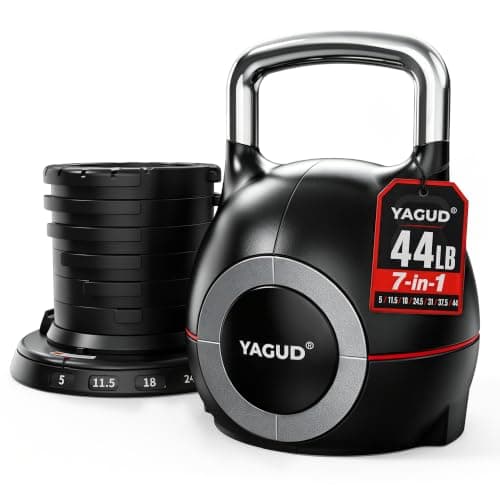
Solves the kettlebell's real budget problem — the need to own the same tool in several weights.
Type
Adjustable kettlebell
Range
5-44 lb, 7 levels
Best at
Learning the lifts, progressing cheaply
Footprint
One bell
Pros
Replaces most of a starter kettlebell collection
Lets you go lighter for technique and heavier for swings
One object to store rather than four
Cons
Adjustment mechanism is a wear point under ballistic load
Bulkier shape than a solid cast bell of the same weight
Not something to drop repeatedly
Best for: progressing without a wall of iron.
Skip this
The budget traps that look cheap and cost you twice. We'd skip these.
Vinyl-coated kettlebells for swinging
The colored vinyl shells split at the seam, and the handle finish underneath is usually rough enough to tear a hand on high-rep swings. They're fine as light bells for goblet squats and rehab work. For real ballistic training, bare cast iron with a smooth handle is both cheaper per pound and more pleasant to use.
Buying a heavy kettlebell as your first one
Swings and cleans are technique lifts, and a bell that's too heavy teaches you to muscle them with your back instead of your hips. A moderate bell you can control through a clean rep is worth more than a heavy one you can only heave.
Buying kettlebells to replace a barbell
They don't. Kettlebells top out at weights a barbell reaches easily, and the loading is awkward for heavy squats and presses. Bells are excellent conditioning and accessory tools that pair with a bar — not a substitute for one.
How to choose (and what to skip)
Buy for the movements you actually do
Look honestly at your program. If it's mostly presses, rows, squats and curls — the shape of almost every beginner and intermediate plan — dumbbells cover it and kettlebells don't. If it's swings, carries, conditioning circuits and single-arm work, the bell earns its place immediately.
Adjustability matters more for bells than you'd think
A dumbbell owner buys one adjustable pair. A kettlebell owner traditionally buys three or four separate bells, because you swing a heavier one than you press. That's the hidden cost of the format, and it's why an adjustable kettlebell is a more interesting option on a budget than an adjustable dumbbell purist would expect.
Check the handle, not the weight
On a kettlebell the handle is the whole product. Look for a smooth, unpainted or lightly powder-coated grip with no casting seam, and a window wide enough for two hands. A rough seam will shred your palms on a set of twenty swings, and no amount of chalk fixes it.
Space favors the bell, capability favors the pair
A single kettlebell is the smallest genuinely useful piece of gym equipment there is — it lives under a desk. A pair of adjustable dumbbells needs a cubic foot and a flat spot. In the very smallest rooms that difference is real.
Both are excellent second-hand
Cast iron doesn't wear out, so used bells and fixed dumbbells are among the best bargains in home fitness. Adjustable mechanisms are the exception — check those work before buying used. More on this in our used equipment guide.
What the offset handle actually changes
On a dumbbell, the load sits either side of your hand, centered on your grip. That's ideal for pressing and rowing, because the weight goes exactly where you put your hand and stays there. It's why every heavy dumbbell movement — bench press, shoulder press, row — is a dumbbell movement.
On a kettlebell, the mass hangs below and behind the handle. That creates a lever arm, which does two things. It makes the weight harder to control statically, so your grip and shoulder work more at the same load. And it makes the bell want to swing around the handle, which is exactly what you want for ballistic movements: the swing, the clean, the snatch, the Turkish get-up. Those movements aren't just possible with a bell — they only really work with one.
It also changes where the weight rests in the rack position. A kettlebell sits on the back of your forearm during a clean or press, which is comfortable and stable once you've learned it. A dumbbell in the same position has nowhere to rest. That's why kettlebell complexes flow and dumbbell complexes stop between movements.
What each one is genuinely better at
Dumbbells win at
Pressing — flat, incline, overhead. In-line loading means you can press substantially more.
Rowing — a braced single-arm row is a dumbbell's home ground.
Bilateral loading — two dumbbells, one in each hand, for squats, lunges and RDLs.
Progressive overload — adjustable pairs let you add small increments; kettlebells jump in large steps.
Being beginner-friendly — almost nothing to learn before you can train productively.
Kettlebells win at
Hip hinge power — the swing is the best-value conditioning exercise most home gyms never program.
Loaded carries — a suitcase or rack carry is trivially easy to set up with one bell.
Conditioning circuits — one tool, one weight, a whole session, no changing plates.
Grip and shoulder stability — the offset load taxes both far more per pound.
Occupying almost no space — a bell lives in a corner and needs no rack.
The budget angle nobody mentions
Per pound, kettlebells are usually more expensive than plain iron plates but comparable to fixed dumbbells. That's not the issue. The issue is how many you need. You swing a considerably heavier bell than you press, and you press a heavier one than you use for a get-up. So a functional kettlebell setup is typically three or four bells across a range, which is three or four purchases and a corner of the room.
A pair of adjustable dumbbells solves that problem by design. One purchase, a whole range, one storage spot. That's the real reason we put dumbbells first for a budget home gym, and it's arithmetic rather than preference. Our adjustable dumbbell roundup and kettlebell roundup cover the picks in each.
The adjustable kettlebell is the interesting middle. It's the only way to own a kettlebell range for one purchase, and it makes the format viable on a budget in a way that buying four bells doesn't. The trade-off is a mechanism, and a mechanism is the one thing a solid cast bell doesn't have — which matters more than usual here, because bells get swung and occasionally dropped.
The order we'd buy them in
One pair of adjustable dumbbells. The widest coverage per dollar, and the base of a first-year program. See our beginner buying order.
A bench. Doubles what the dumbbells can do before you add another tool.
One moderate cast-iron kettlebell. Adds swings, carries and conditioning — a genuinely different stimulus for very little money.
A heavier bell, or a barbell. Depending on whether your training is heading toward conditioning or toward strength.
If your goals are specifically conditioning and fat loss rather than building maximal strength, flip the first and third items. A single bell and a program of swings, cleans and carries is a legitimately complete conditioning gym for less than the price of a month of most memberships.
One thing to know before you start swinging
The kettlebell swing is a hip hinge, not a squat and not a front raise. The bell is thrown forward by your hips snapping through, and your arms just hold on — the height it reaches is a consequence, not the goal. Nearly every kettlebell injury we've read about in owner reviews traces to someone lifting the bell with their arms and lower back instead of hinging.
That's worth knowing before you buy because it changes what to buy: a moderate bell you can hinge properly beats a heavy one you have to muscle. It's also the reason a kettlebell has a slightly steeper on-ramp than dumbbells, which for a complete beginner is a genuine point in the dumbbell's favor.
Our verdict
Buy adjustable dumbbells first — more of your program runs on them, and adjustability makes them cheaper over time. Add one cast-iron kettlebell as soon as you can, because swings and carries are a training stimulus dumbbells genuinely can't replicate and a single bell is inexpensive. If you know your training is conditioning-led rather than strength-led, buy the bell first and don't feel you've compromised. Both tools are cheap, both last forever in cast iron, and most well-equipped home gyms end up with both.
Frequently asked questions
Should I buy kettlebells or dumbbells first?+
Dumbbells, for most people. A pair of adjustable dumbbells covers pressing, rowing, squatting and every accessory movement, and one purchase gives you a whole weight range. Kettlebells are excellent but you typically need three or four of them to cover swings, presses and get-ups, which is a much larger outlay for a narrower set of movements.
Can a kettlebell replace dumbbells?+
For conditioning, carries and hinge work, yes and then some. For heavy pressing, rowing and bilateral loading, no — the offset handle makes the weight harder to control in line, so you'll press meaningfully less with a bell than a dumbbell of the same weight. Most home gyms use them for different jobs rather than substituting one for the other.
What weight kettlebell should a beginner buy?+
A moderate one you can hinge cleanly through a full set of swings, rather than the heaviest you can lift once. The swing is a technique lift driven by the hips, and a bell that's too heavy teaches you to pull with your arms and lower back. It's better to start controlled and buy heavier later than to start heavy and learn the movement wrong.
Are adjustable kettlebells any good?+
They solve the format's real budget problem — needing several bells to cover swings, presses and technique work — and for a home gym that's a genuine advantage. The trade-off is a mechanism in a tool that gets swung and occasionally dropped, which a solid cast bell doesn't have. Treat one as a range-covering tool, not something to drop repeatedly.
Is a kettlebell swing better than a dumbbell swing?+
Yes, and it's the clearest example of the geometry mattering. The offset handle lets the bell swing around your grip and sit naturally in the arc your hips create. A dumbbell held vertically works, but the shape fights the movement and the grip is more awkward at speed. If swings are a real part of your training, buy the bell.
Prices and availability shown here come from Amazon's live data and change often; we re-verify them regularly. Bar Bumper is an Amazon Associate and earns a commission on qualifying purchases at no extra cost to you. Read our full disclosure.