Most people buy one bell that is too light to swing and too heavy to press. The fix is understanding that a kettlebell is really two tools — and deciding which one you are buying first.
Updated October 2026 · By Stephen V.
If you are buying one bell and swings are the point, start heavier than you think: a 30 lb cast iron bell like the CAP 30 lb kettlebell is the right first purchase for most adult men, and 18 to 26 lb for most adult women. If you are buying one bell for presses, cleans and getting the technique right, go roughly one size lighter. The reason the usual advice fails is that a kettlebell is two different pieces of equipment depending on the exercise — a hip-driven ballistic tool that needs real load, and a pressing tool that does not.
The swing is the key to the whole question. It is a hinge driven by your hips and hamstrings, which are among the strongest muscles you have, and the bell is moving fast rather than being pressed slowly. A bell light enough to feel comfortable in your hands on day one is usually far too light to teach your hips anything, so the swing becomes an arm exercise and the whole point is lost. People then conclude kettlebells are not for them, when in fact they bought the wrong size.
Overhead work is the opposite problem. A strict one-arm press is limited by your shoulder, which is small and at a mechanical disadvantage. The same 30 lb bell that is a reasonable starting swing weight is a genuinely challenging press for a beginner, and often an impossible one. Turkish get-ups, windmills and overhead carries are lighter still at first, because the limit is control rather than strength.
So the three things that actually decide your purchase: which exercises you are buying the bell for, whether you want one bell or a span (the jumps between standard bell sizes are large, which is why a set or an adjustable bell is worth considering), and handle width and finish, because a handle too narrow for two hands rules out two-handed swings and a rough casting will shred your hands. Everything else in this category is marketing.
The short answer
In a hurry? These are the picks we'd buy. Prices are live; tap a card below for the full reasoning.
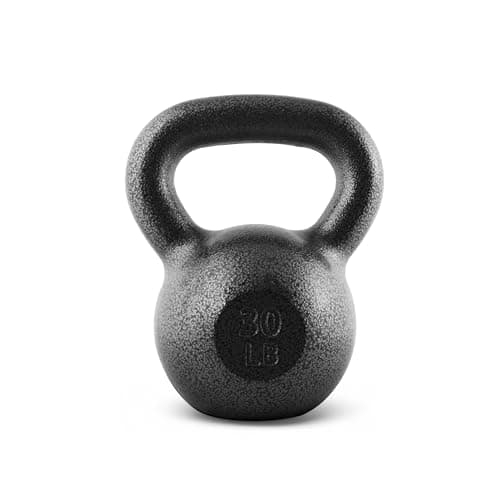
A one-piece cast iron 30 lb bell is the standard answer for a first kettlebell: heavy enough that swings teach your hips something, cheap enough to be a low-risk purchase.
A published 5 to 44 lb range across seven levels is the only format here that solves the real problem — one bell that is both light enough to press and heavy enough to swing.
owning both a light press weight and a heavy swing weight in a single object
$72.9922% offPrice as of October 6, 2026·#addisclosure
CAP Cast Iron Kettlebell (30 lb)
A one-piece cast iron 30 lb bell is the standard answer for a first kettlebell: heavy enough that swings teach your hips something, cheap enough to be a low-risk purchase.
Type
Cast iron kettlebell
Weight
30 lb (per listing)
Use
Swings, carries, conditioning
Build
One-piece cast handle
Handle
Wide enough for two hands
Pros
30 lb is the weight at which a two-handed swing starts being a hip exercise rather than an arm exercise, which is the entire reason to own a kettlebell
A one-piece casting has no seam, no weld and nothing to come apart. For a weight you are going to accelerate, that matters more than any finish
The handle is wide enough for two hands, which a surprising number of cheap bells get wrong and which rules out the main exercise if they do
CAP is the most widely stocked budget iron brand in the US, so the same bell in heavier sizes will be available when you need one
Cheap enough that if kettlebell training turns out not to suit you, the loss is small — and the bell still works as a carry and a goblet squat weight
Cons
30 lb is too heavy for a strict single-arm press for most beginners, and far too heavy for Turkish get-ups to start with. One bell cannot do both jobs
Painted cast iron chips, and the bare casting underneath will rust in a damp garage. See our rust guide — a wipe of oil is the whole maintenance regime
Budget castings can have a rougher handle finish than a premium bell, which you will feel on high-rep swings. A file and some sandpaper fix it permanently
One weight, and the next standard size up is a large jump. Progression means buying another bell rather than adjusting this one
No colour coding or weight marking on some listings, which is a minor annoyance if you later own several
Best for: a first bell bought mainly for two-handed swings.
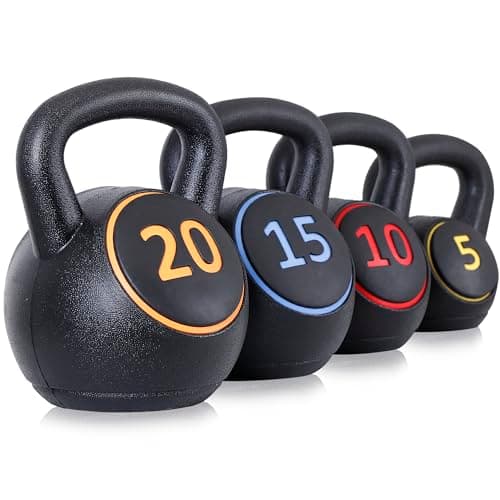
Four bells from 5 to 20 lb cover presses, get-ups and technique work at a price where a single heavy cast iron bell would be the alternative.
Type
HDPE-shelled cement set
Includes
5 / 10 / 15 / 20 lb (per listing)
Coating
HDPE over cement fill
Total
50 lb (per listing)
Best for
Presses, get-ups, technique
Pros
Four weights means the light bells for get-ups and the heavier ones for presses are all available, which is the realistic way to learn the movements
Small jumps between sizes, which is exactly what standard cast iron bells do not offer — the gaps there are large enough to stall progress
An HDPE shell will not scratch a floor or chip paint, which makes it the better choice indoors on a wooden floor
Cheapest route to a usable span of kettlebell weights by a clear margin
The 5 and 10 lb bells make this a genuinely useful set for anyone starting from a low base, which cast iron at 30 lb is not
Cons
The top weight of 20 lb is too light for a productive two-handed swing for most adults. This set covers the technique half of kettlebell training, not the ballistic half
A cement fill inside a plastic shell is a different object from a solid casting: it is bulkier for its weight and the shell is what you are trusting
Shell damage is terminal in a way a chipped casting is not. Treat these as indoor weights and do not drop them on concrete
The larger shells feel oversized in the hand relative to their weight, which changes the feel of a clean or a snatch
Four bells need somewhere to live, and a floor-level row of them is a stubbed-toe hazard
Best for: learning the movements properly, where you need light bells for technique and heavier ones for swings.
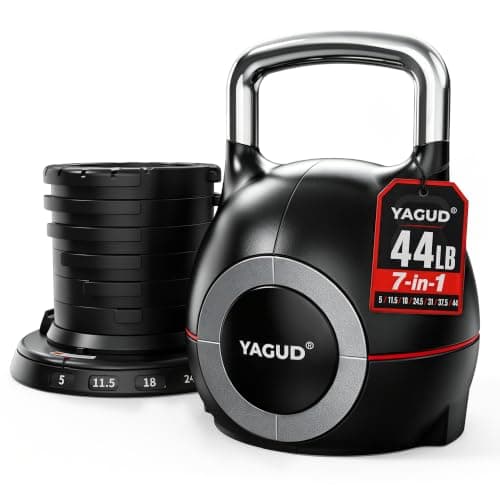
A published 5 to 44 lb range across seven levels is the only format here that solves the real problem — one bell that is both light enough to press and heavy enough to swing.
Type
Adjustable kettlebell
Range
5-44 lb, 7 levels (per listing)
Adjust
Quick-change
Footprint
One bell
Covers
Get-ups through heavy swings
Pros
A 5 to 44 lb span in one object covers the entire problem this page is about: light enough for get-ups, heavy enough for real swings
Seven levels means small increments, so progression does not require buying another bell at a large jump
One bell's worth of floor space for what would otherwise be four or five separate bells
44 lb at the top is a genuinely useful swing weight, not a token maximum — it is heavier than the top of most cheap sets by more than double
Cons
An adjustable bell is a mechanism holding plates together, and you are about to accelerate it with one hand. Check the locking mechanism every single time before a ballistic set
The centre of mass shifts as you change the weight, so the bell does not feel the same at every setting the way a casting does
Bulkier and more angular than a cast bell at the same weight, which is noticeable in the rack position against your forearm
The most expensive pick on this page, and the mechanism is the part that will eventually wear
Not the bell to buy if you only ever intend to do two-handed swings — a solid 30 lb casting is cheaper and better at that one job
Best for: owning both a light press weight and a heavy swing weight in a single object.
How to choose (and what to skip)
Starting weights, by exercise
For two-handed swings, which is what most people buy a kettlebell for: roughly 26 to 35 lb for an untrained adult man and 18 to 26 lb for an untrained adult woman. For strict single-arm overhead presses: around 18 to 26 lb for men and 10 to 18 lb for women. For Turkish get-ups and windmills, where control rather than strength is the limit: start as light as 10 to 18 lb regardless, and do not be proud about it. Goblet squats sit between the swing and press figures. These are starting guesses to be tested, not prescriptions — the repetition and technique test decides.
Why going too light on swings is the common mistake
A swing is a hip hinge performed fast, and your hips and hamstrings are far stronger than your arms. With a bell that is too light, nothing forces the hinge: you can simply lift the bell with your shoulders, the movement becomes a front raise, and the hip drive that makes the exercise worth doing never shows up. A heavier bell makes the correct movement the only movement that works, which is unusual and useful. The caveat is the obvious one: a heavier bell with a bad hinge is a back injury, so learn the hinge pattern with a lighter weight or no weight first, then load it.
How many bells you actually need
One, if you are honest about which half of kettlebell training you are buying. Two is the point at which a kettlebell programme stops being constrained, because one covers ballistics and the other covers presses and get-ups. Beyond that the returns drop off quickly for home training. The complication is that standard cast iron bells come in large jumps, so progression means buying the next size rather than adding a little — which is the argument for a set with small increments or for an adjustable bell, both on this page.
Cast iron, coated, or adjustable
Solid cast iron is the standard and the best feel: one piece, nothing to fail, and it is what the technique is built around. Coated and shelled bells (vinyl, HDPE over cement) are gentler on floors and usually cheaper, but they are bulkier for their weight and the shell is the part you are trusting. Adjustable bells solve the range problem in one object, at the cost of a mechanism you are accelerating one-handed, which is why checking the lock before every ballistic set is not optional. For a first bell bought for swings, we would take the casting every time.
Handle width and finish are the only other specs worth checking
A handle has to be wide enough to fit two hands comfortably, or two-handed swings — the main exercise — are off the table. It also has to be smooth enough not to tear your hands on high-rep sets, and budget castings sometimes are not. That is a fixable problem: a few minutes with a file and sandpaper on the handle, then a wipe of oil, permanently improves a cheap bell. Finally, check the handle is not so thick that your grip gives out before anything else does, which is common on heavier cheap bells.
Where kettlebells fit against dumbbells
They overlap more than enthusiasts of either admit. A kettlebell is better for swings, cleans, snatches, carries and anything ballistic, because the mass hangs below the handle and that offset is what makes the exercises work. A dumbbell is better for pressing, rowing, curling and progressive strength work, because the load is balanced and the jumps are smaller. If you are buying your first weight and you want general strength, buy dumbbells. If you want conditioning and hip power in a very small space, buy a bell. Our kettlebell vs dumbbell page covers it properly.
The answer in one list
Two-handed swings: 26-35 lb for most untrained men, 18-26 lb for most untrained women. Heavier than instinct suggests, and deliberately so.
Goblet squats: similar to your swing weight, or slightly lighter to start.
Strict one-arm press: 18-26 lb for men, 10-18 lb for women — roughly one size down from the swing bell.
Turkish get-ups and windmills: 10-18 lb for anyone starting out. Control is the limit, not strength.
Carries: as heavy as you can hold with good posture. This is the one exercise where heavier is almost always better.
One bell or two?
If the budget allows two, buy a heavy one for swings and carries and a lighter one for presses and get-ups. That pair covers essentially all of kettlebell training and nothing is compromised. If the budget allows one, decide what you are actually going to do with it: a 30 lb bell is the right single purchase for someone who will swing, squat and carry, and it will be too heavy to press for a while, which is fine. A 20 lb bell is the right single purchase for someone who wants to learn get-ups and presses, and will be too light to swing productively, which is also fine as long as you know it.
The third option is the one most people do not consider: an adjustable bell covers both ends in one object. The trade is a mechanism instead of a casting, and with a weight you swing one-handed that is a real consideration rather than a theoretical one. Check the lock every time and it is a good solution to a genuine problem.
Learn the hinge before you load it
A swing is a hip hinge, not a squat and not a lift with the arms. The bell travels because your hips snap, your arms are ropes, and the bell floats to roughly chest height before gravity brings it back down. Done correctly it is one of the best conditioning exercises there is. Done as a stiff-legged arm raise with a rounded back it is a reliable way to hurt yourself, and a heavier bell makes that worse rather than better. So: learn the hinge with no weight, then a light weight, then load it properly — and when it is loaded properly, the heavier bell is the safer one, because it forces the pattern.
If you are training alone with nobody to check your technique, film a set on your phone from the side. It is the cheapest coaching available and it reliably shows you what you cannot feel. The same applies to every lift in a garage — our guide to lifting alone safely covers the wider version of the problem.
What a kettlebell is genuinely good at
Conditioning in almost no space, hip power, grip, and carries. A single bell and ten feet of floor is a complete conditioning setup, which no barbell can claim and very few machines can. It is also quiet, it stores in a corner, and it does not need a rack, a bench or a spotter — which makes it one of the best pieces of equipment for a flat or a shared room. Where it is weak is progressive strength: the jumps between bells are large, the pressing loads are small, and nothing about a kettlebell lets you add five pounds to a squat.
That is why most complete home gyms end up with bells as a complement rather than a foundation. If you are building from scratch, our budget home gym build puts weights and a bar first and a bell later, and the essentials checklist is the shorter version of that order.
Frequently asked questions
What size kettlebell should a beginner start with?+
For two-handed swings, roughly 26 to 35 lb for an untrained adult man and 18 to 26 lb for an untrained adult woman — heavier than most people expect. For presses and Turkish get-ups, about one size lighter, or lighter still for get-ups where control is the limit. A 30 lb cast iron bell is the standard single first purchase if swings are the main reason you are buying.
Is a 35 lb kettlebell too heavy to start with?+
For two-handed swings, no, for most adult men — it is a reasonable first bell and the weight will make the hip hinge happen rather than letting you lift with your arms. For single-arm presses, Turkish get-ups and overhead work it is too heavy to start, and for most women starting out it is too heavy for swings too. The exercise decides, not the bell.
Why do kettlebell swings need a heavier bell than presses?+
Because they use completely different muscles at different advantages. A swing is driven by your hips and hamstrings, which are among the strongest muscles in your body, and the bell is moving fast. A press is limited by your shoulder, which is small and working at a mechanical disadvantage. A bell light enough to press comfortably will be too light to make your hips do anything, and the swing degenerates into an arm raise.
How many kettlebells do I need?+
One works if you are clear about which exercises you are buying it for. Two — a heavy one for swings and carries, a lighter one for presses and get-ups — covers essentially all of kettlebell training with nothing compromised, and is where we would stop for home training. The complication is that standard bells come in large jumps, which is the argument for a small-increment set or an adjustable bell.
Are cheap cast iron kettlebells any good?+
Yes. A kettlebell is a shaped lump of iron with a handle, and a cheap one-piece casting does the same job as an expensive one. The two things to check are that the handle is wide enough for two hands and smooth enough not to tear your palms on high-rep sets — and a rough handle is fixable in five minutes with a file and sandpaper. Our cheap kettlebell roundup ranks the options.
Kettlebell or dumbbell for a first weight?+
A dumbbell, if general strength is the goal, because the balanced load suits pressing and rowing and the weight jumps are smaller. A kettlebell, if conditioning and hip power in a very small space is the goal — swings, cleans, snatches and carries all depend on the mass hanging below the handle. Our kettlebell vs dumbbell comparison goes through the overlap in detail.
Are adjustable kettlebells safe for swings?+
They can be, with one non-negotiable habit: check the locking mechanism before every ballistic set. You are accelerating the bell with one hand, and a mechanism that works loose during a swing is a far worse outcome than a chipped casting. For swings only, a solid one-piece casting is cheaper, better balanced and has nothing to fail. An adjustable bell earns its place when you want one object to cover both light pressing and heavy swinging.
Prices and availability shown here come from Amazon's live data and change often; we re-verify them regularly. Bar Bumper is an Amazon Associate and earns a commission on qualifying purchases at no extra cost to you. Read our full disclosure.