Manual vs electric treadmill: which should you buy?
The cheapest treadmills have no motor at all. That solves the single biggest failure point in budget cardio, and introduces a different set of trade-offs.
Updated September 2026 · By Stephen V.
The biggest problem with cheap treadmills is the motor. A small continuous-duty motor asked to carry a running adult overheats, and when it fails the machine is usually finished. That one fact is why the budget end of the treadmill market has the worst reputation in home cardio.
A manual treadmill sidesteps the problem completely by not having a motor. The belt moves because you move it. That removes the failure point, removes most of the cost, removes the power cable, and removes a lot of the weight — and in exchange it changes how the machine feels and what it can do. Whether that is a good trade depends entirely on what you want a treadmill for.
The short answer
In a hurry? These are the picks we'd buy. Prices are live; tap a card below for the full reasoning.
$119.9917% offPrice as of September 14, 2026·#addisclosure
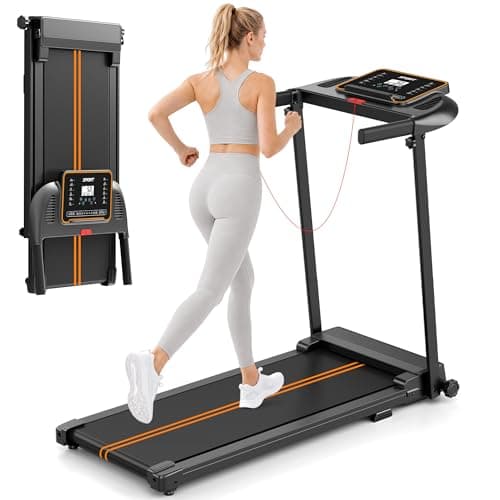
Folding Walking Pad Treadmill
The electric answer that actually works on a budget: a small motor doing the job it was sized for, with a smooth flat belt a manual cannot match.
Type
Motorized walking pad
Belt
Motor-driven, flat
Storage
Folds flat
Power
Mains required
Pros
The belt moves for you, which is much smoother and more natural than driving it yourself
Flat deck, so easy walking is genuinely easy — a manual's fixed incline is not
Folds flat and stows under furniture
Cons
Has a motor, so it has the failure point manuals do not — respect its walking-only limits
Needs a power outlet where you want to walk
No incline adjustment, so it cannot make walking harder
Best for: smooth, flat, quiet walking indoors.
Skip this
The budget traps that look cheap and cost you twice. We'd skip these.
A cheap motorized treadmill bought for running
This is what both routes on this page exist to avoid. A small motor carrying a running adult for half an hour is the classic budget cardio failure, and it does not fail gracefully. If running indoors is genuinely the goal, the honest answer is to save for real motor headroom rather than to buy either cheap option here.
Expecting a manual treadmill to feel like a gym treadmill
It will not, and the difference is not a defect. On a manual you are pushing the belt with every step, so it feels heavier and the rhythm is different. People who buy one expecting a cheap version of the gym experience are usually disappointed; people who buy one knowing it is a different machine tend to be happy with it.
Assuming the flat-belt manuals are the same thing as curved ones
The curved, slatted manual treadmills used in commercial gyms are a genuinely premium product and cost many times what these do. Budget manual treadmills are flat-belt machines with a fixed incline and a very different feel. Reviews of curved trainers tell you nothing useful about a sub-$150 manual, so do not shop across the two.
How to choose (and what to skip)
The motor is the whole question
Everything else follows from this. A motorized treadmill has a component sized for a specific load, and exceeding it is how the machine dies. A manual has no such component, which is why it is cheaper, lighter, needs no power and is far harder to break. If reliability at a low price is what you care about, that is a strong argument for manual.
Manual means you cannot make it easy
This is the trade-off people underestimate. Budget manual treadmills use a fixed incline, because the incline is part of what lets your own momentum drive the belt. That means there is no flat, easy setting — the machine is always somewhat demanding. For deliberate exercise that is fine. For casual walking while working, it is the wrong shape of machine.
Electric means a smoother, more natural walk
A driven belt moves at a constant speed underneath you, which is why it feels like walking. A manual belt accelerates and decelerates with each step, which is why it does not. If the point is to accumulate comfortable, low-attention walking time, an electric walking pad is clearly better at it, and its small motor is genuinely sized for that job.
Check capacity, not horsepower, on a manual
Manual treadmills do not publish continuous-duty horsepower because there is no motor to rate, so the specification that tells you about build quality is the stated user weight capacity, along with the frame weight if it is given. Treat a missing capacity figure the same way you would on any other machine: as a reason to ask before ordering.
Think about where it will live
Manuals need no outlet, which genuinely widens where they can go — a garage, a shed, a spare room with no convenient socket. Electric pads need mains power exactly where you want to walk, which in practice usually means near a desk. That constraint decides the purchase more often than people expect.
What a manual treadmill actually is
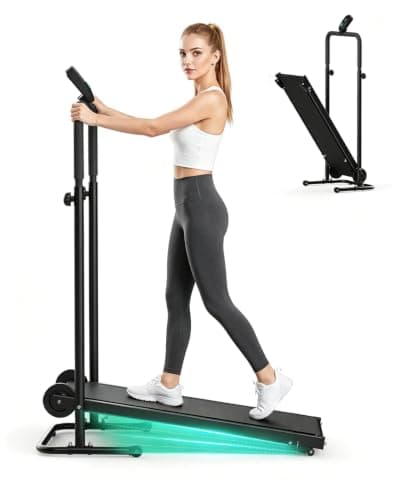
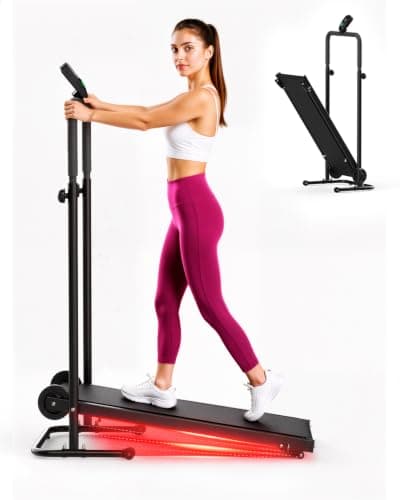
A budget manual treadmill is a flat belt on rollers with a fixed incline and no motor. Your foot pushes the belt backwards as you walk, and flywheels smooth out the motion between steps. Because the deck is tilted, gravity helps the belt return, which is what makes the whole thing work without power. That fixed incline is not a feature they chose to add — it is structural to how a manual functions.
Worth separating clearly from the curved, slatted manual treadmills you see in commercial gyms. Those are engineered products costing many times more, and they behave completely differently. Everything on this page refers to the flat-belt budget category.
Who should buy manual
Buy manual if reliability at a low price is the priority, if you have nowhere convenient to plug a machine in, or if you want walking to be genuinely effortful rather than passive. The absence of a motor removes the failure mode that gives cheap treadmills their reputation, and the price difference against any motorized machine worth owning is large.
It also suits a garage or a shed better than an electric machine does, both because of the power question and because there is less inside it to mind about temperature swings. If that is your space, our guides on heating a garage gym and preventing rust in a garage gym cover the environment side.
Who should buy electric
Buy electric — specifically a walking pad rather than a cheap full-size treadmill — if you want comfortable, low-attention walking. Desk walking is the clearest case: you want a flat belt moving at a steady speed while your attention is elsewhere, and a manual's fixed incline and variable rhythm make that genuinely unpleasant.
The important discipline with the electric route is respecting what the motor is sized for. A walking pad is excellent at walking and unreliable at running, and treating it as a running machine is how you end up back at the failure this page opened with. Is a cheap treadmill worth it covers the motor spec in more detail, and the budget treadmill roundup covers the machines themselves.
And if you want to run
Neither cheap route is the answer, and it is worth saying plainly. Running indoors needs a motorized treadmill with real continuous-duty headroom, which is a genuinely expensive purchase. The honest budget alternatives are to run outside and use a cheap machine for the days you cannot, or to pick a different cardio category entirely — cheap cardio machines that are actually worth it covers which ones survive a low price.
Frequently asked questions
Is a manual treadmill better than an electric one?+
Neither is better outright; they fail and succeed at different things. A manual has no motor to burn out, costs far less, needs no power and is harder to break. An electric one gives a smoother, flatter, more natural walk and can be genuinely easy. For reliable cheap walking with effort, manual. For comfortable low-attention walking, electric.
Are manual treadmills harder to use?+
Yes, and that is inherent rather than a flaw. You are supplying the force that moves the belt, and budget manuals have a fixed incline, so there is no flat easy setting. That makes a manual a more demanding machine at any given speed. Whether that is good or bad depends on whether you want exercise or want to accumulate comfortable walking time.
Can you run on a manual treadmill?+
On a budget flat-belt manual, not really. They are built and specified around walking, and the belt behavior under running loads is neither smooth nor stable. The curved slatted manuals used in gyms are designed for running, but they are a completely different and far more expensive product.
Do manual treadmills break less often?+
They remove the most common failure, which is the motor. That is a genuine reliability advantage and the main reason to consider one. They still have bearings, rollers and a belt that wear, and a light frame can still flex, so the honest claim is fewer catastrophic failures rather than no maintenance at all.
Which is better for walking while working?+
An electric walking pad, clearly. Desk walking needs a flat belt at a steady speed that you can ignore while your attention is on something else. A manual's fixed incline and step-by-step rhythm demand attention and effort, which is exactly wrong for that use. This is the one case where the electric route wins outright.
Prices and availability shown here come from Amazon's live data and change often; we re-verify them regularly. Bar Bumper is an Amazon Associate and earns a commission on qualifying purchases at no extra cost to you. Read our full disclosure.