Best budget air bike: what a cheap fan bike gives up, and what it doesn't
An air bike is the cheapest way to buy conditioning that never gets easier. Frame weight, drive type and fan size tell you whether the cheap ones survive it.
Updated August 2026 · By Stephen V.
The air bike is the strangest value proposition in a home gym. There is no motor, no electronics that matter, no resistance mechanism to wear out — just a fan, a crank and two handles. The fan is the resistance, and because you can never spin it faster than you can spin it, the machine cannot be outgrown. A beginner and a competitive athlete ride the same bike and both find it brutal. Almost nothing else in fitness equipment works like that.
Which is exactly why it is worth a look on a budget. On most machines, cheap means less: a smaller motor, a lighter flywheel, a shorter stride. On a fan bike, the physics that makes it hard is free. What you actually pay for as the price climbs is frame mass, drive quality, fit adjustment and a console worth reading — not more resistance. That gap is much smaller than the price gap, and it is the whole reason a cheap fan bike can be a serious purchase while a cheap treadmill usually is not.
It is also the category where being honest about the downsides matters most, because they are large. An air bike is the loudest machine you can put in a garage, it is punishing enough that plenty of people stop using it, and the cheap end of the market is full of listings that will not tell you what the frame weighs or what it is rated to hold. Below are the criteria that separate a fan bike worth owning from one that rocks across the floor, the picks that meet them, and the traps to walk past. We have not ridden any of these ourselves — we read the published specifications, compare them, and say so.
The short answer
In a hurry? These are the picks we'd buy. Prices are live; tap a card below for the full reasoning.
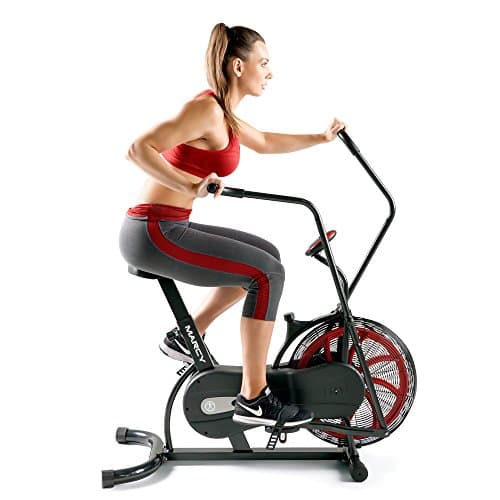
The cheapest fan bike here from a brand that publishes a real spec sheet: 14-gauge steel, a stated 250 lb rating, seven seat positions, and no pretending to be more than that.
Roughly the same money as the Marcy but far more forthcoming: a published drive train, ten seat heights with fore-aft travel, and wheels that make moving it a one-person job.
shared households and rooms where the bike has to move
The only bike here you can ride quietly: a 21-inch fan when you want the pain, plus eight levels of electromagnetic resistance for everything that is not an interval.
close neighbors, shared walls, and keeping easy days easy
The cheapest fan bike here from a brand that publishes a real spec sheet: 14-gauge steel, a stated 250 lb rating, seven seat positions, and no pretending to be more than that.
Capacity
250 lb (mfr rating)
Frame
14-gauge powder-coated steel
Seat
7 positions
Console
Time, distance, speed, calories, scan
Footprint
45 x 26.75 x 48.75 in
Pros
Marcy publishes steel gauge, capacity, footprint and a 2-year warranty — unusual disclosure at this price
An adjustable tension knob sits alongside the fan, so genuinely easy pedaling is available for warm-ups
Seven seat positions, dual-action padded handles and foot loops on the pedals — the basics are all present
Cons
250 lb is the lowest weight rating on this page, and that rating is the closest thing to a structural spec you get
Marcy does not publish the drive type or the assembled weight, so belt-versus-chain is unknown until it arrives
The console is an odometer — no interval timer, no power figure, nothing to train against
Best for: the cheapest honest way into air resistance.
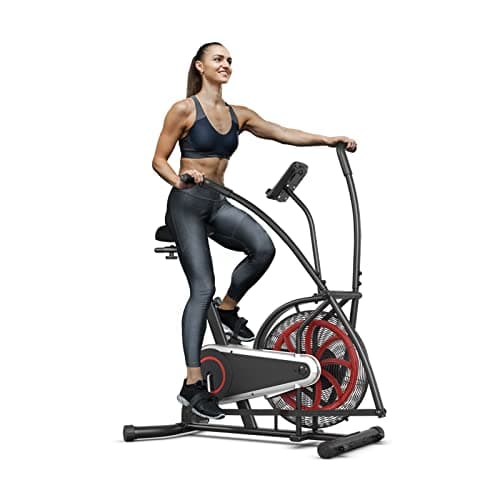
Roughly the same money as the Marcy but far more forthcoming: a published drive train, ten seat heights with fore-aft travel, and wheels that make moving it a one-person job.
Capacity
242.5 lb (mfr rating)
Drive
Two-stage belt and chain
Fan
8 blades
Seat
10 heights (33-42 in), 17-21 in fore/aft
Net weight
58 lb
Pros
Ten seat heights plus fore-aft travel is real fit adjustment, not a token seatpost
Goplus publishes the drive train, blade count, net weight and the full seat range
At 58 lb with built-in wheels, one person can reposition it without help
Cons
242.5 lb is the lowest stated capacity of the four, so heavier riders should read further down this page
58 lb is light for an air bike — expect some frame movement when a big rider stands on the pedals
The chain half of the drive adds noise on top of the fan and wants occasional oiling
Best for: shared households and rooms where the bike has to move.
$769.9916% offPrice as of September 14, 2026·#addisclosure
Eryntix Dual Resistance Air Bike (air + magnetic)
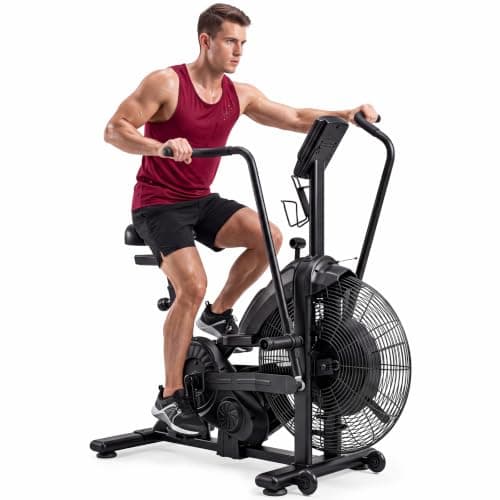
The only bike here you can ride quietly: a 21-inch fan when you want the pain, plus eight levels of electromagnetic resistance for everything that is not an interval.
Capacity
350 lb (mfr rating)
Resistance
21 in fan + 8-level magnetic
Drive
Dual belt
Seat
6 heights (34-40 in), 4 in fore/aft
Fit range
About 4 ft 8 in to 6 ft 3 in (mfr)
Pros
Magnetic mode makes steady riding genuinely quiet, which no plain fan bike can do at any price
A published 21-inch fan means the top end has somewhere to go
Dual belt drive, a 350 lb rating and the widest stated rider height range of the four
Cons
Clearly the most expensive pick here, and the gap buys a second resistance system rather than a heavier frame
In fan mode it is exactly as loud as every other air bike — the magnetic mode is the quiet part, not the bike
Two resistance systems means two things that can fail, from a brand with no long track record
Best for: close neighbors, shared walls, and keeping easy days easy.
Skip this
The budget traps that look cheap and cost you twice. We'd skip these.
Any fan bike that will not publish a weight rating
On a machine you ride standing up and sprint on, the user weight limit is the closest thing to a structural specification a listing gives you. If a seller will not state it, the frame is the thing being hidden. Treat a missing number as a low one and move on — there are enough bikes at this price that do publish it.
Buying an air bike for long, easy cardio
Fan resistance climbs steeply with speed, which makes an air bike superb for short hard efforts and genuinely unpleasant for a 45-minute steady ride. If your plan is long low-intensity sessions, a magnetic bike or a rower costs less, is far quieter, and you will actually keep using it. Buy the air bike for intervals or do not buy it at all.
Paying extra for the console
Past a clock and a distance counter, budget fan bike consoles add sport modes nobody opens and app pairing that stops being supported in a couple of years. A phone propped on the frame running a free interval timer does the same job better and never goes obsolete. Put the difference into frame weight instead.
Assuming an air bike replaces a rack
It is conditioning equipment, not strength equipment. An air bike will not build much muscle or make you meaningfully stronger, and a home gym that owns one but no bench or bar has bought the accessory before the tool. Get the strength side working first, then add the fan bike.
How to choose (and what to skip)
The fan is the resistance, so it never gets easier
An air bike works by making you push air. The power needed to overcome aerodynamic drag rises roughly with the cube of speed, so pedaling twice as fast costs far more than twice the effort. That is why nobody outgrows a fan bike, and why a cheap one is genuinely hard: the difficulty comes from physics, not from a component the manufacturer had to pay for. It also explains why the top of the price range does not buy you more resistance.
Frame weight is the specification that matters most
Almost everything you notice while riding a fan bike hard comes down to mass. A 58 lb bike moves under a heavy rider standing on the pedals; a 100 lb bike does not. When two air bikes have the same fan and the same handles, the heavier one is the better one, and assembled weight is a far more useful number than anything on the console. If the listing publishes it, read that first.
Weight rating is your proxy for build quality
Very few budget listings publish steel gauge, so the stated user weight limit is the best structural signal available. The spread on this page runs from 242.5 lb to 350 lb, and it tracks build quality closely. Buy well above your own weight rather than just above it — the rating is a static limit, and riding an air bike is anything but static.
Belt or chain is the maintenance question
A belt drive is sealed, quiet and needs nothing. A chain drive is cheaper to build, adds a mechanical clatter under the fan noise, and wants occasional oiling. Neither is a disaster, but on a machine that is already the loudest thing in the room, a belt is worth having. Some budget bikes use a two-stage system with both, which is normal, and it is still a chain for maintenance purposes.
Seat adjustment decides whether more than one person rides it
Fan bike seats need height and fore-aft travel to fit a rider properly, and fore-aft is the adjustment cheap bikes quietly leave out. If two people of different heights will share the machine, check for both, and check the manufacturer's stated rider height range. A bike only one person in the house can ride comfortably ends up as a clothes rack.
Plan for noise and floor space before you buy
Budget for a rubber mat under the bike and roughly a foot of clearance behind the fan so it can pull air. The mat protects the floor, catches sweat and takes some vibration out of the frame. And be realistic about noise: a fan bike ridden hard is loud enough to hear through a closed door, which is a fact about the category rather than a fault of any one model.
What an air bike is actually for
An air bike is a conditioning tool, not a cardio machine in the way a treadmill or a stationary bike is. Its natural use is short, hard, repeated efforts — 20 seconds on and 40 seconds off, or a 10-minute effort that ruins your afternoon — with both arms and legs working. Because the handles drive the same fan as the pedals, it is one of very few pieces of home equipment that loads the whole body at once, and that is the reason it earns the floor space it takes.
The corollary is that it is a poor machine for the thing most people buy cardio equipment for. Long steady rides on a fan bike are hot, loud and boring, and the seat is not designed to be comfortable for an hour. If you want 45 quiet minutes while watching something, an exercise bike or a rower is the honest answer — both are covered in our budget exercise bike roundup and budget rowing machine roundup.
What you give up against a commercial fan bike
The bikes you see in commercial gyms cost several times what the picks on this page do, and it is worth being precise about where that money goes, because it is not where most people assume. It does not buy more resistance — the fan is the resistance on every one of them, and yours will get just as hard. What it buys is frame mass, sealed bearings and a drive train built for a machine ridden by strangers all day, a console with proper interval programming, and a warranty written for a commercial asset.
For one household riding a few times a week, most of that is surplus. The specification that genuinely transfers is frame weight, which is why it is also the first thing to compare inside a budget. The one thing you cannot buy your way around at this price is console quality: budget interval programming is poor across the board, and the practical answer is a phone timer rather than a more expensive bike.
Noise: the part nobody warns you about
A fan bike is the loudest piece of equipment most home gyms will ever own, and unlike a barbell it is loud continuously rather than in short crashes. Noise scales with effort, so the harder the interval, the more it sounds like a leaf blower in the next room. In a detached garage this is a non-issue. In an apartment, a shared house, or a garage under a bedroom, it is the single thing most likely to make you regret the purchase — which is why air bikes appear on the avoid list in quiet cardio for apartments.
There are two honest workarounds. The first is scheduling: ride when the noise does not matter. The second is a bike with a magnetic mode alongside the fan, which lets easy and steady work happen almost silently and saves the fan for the intervals that justify it. That is the entire argument for the dual-resistance pick above, and if noise is your binding constraint it is worth the premium. If it is not, the money is better spent on frame weight.
Where an air bike fits in a budget gym
Buy it second or third, not first. A rack, a bar and plates build strength; a fan bike builds conditioning, and conditioning is the part you can also get for nothing by running outside. If the strength side of the gym is not finished yet, the money is better spent there — our budget home gym equipment guide sets out the order we would buy things in, and the under $1,000 build shows what a complete setup costs.
Once the basics are in place, an air bike earns its spot faster than almost any other machine, because it is the one piece of cardio equipment that stays hard forever and needs no maintenance to keep it that way. Put it on a rubber mat, leave clearance behind the fan, and expect to hate it in exactly the way you hoped you would.
Frequently asked questions
Are cheap air bikes any good?+
Better than cheap versions of almost anything else in a home gym, because the hard part is free. The fan supplies the resistance on an entry-level bike and on a commercial one alike, so the training stimulus is genuinely comparable. What you give up at the bottom of the market is frame mass, fit adjustment and console quality — real compromises, but none of them change how hard the machine is to ride.
What is the difference between an air bike and an assault bike?+
Nothing structural. "Assault bike" is a brand name that became a generic term; the category name is air bike or fan bike. Every machine in the category works the same way — dual-action handles and pedals driving a large fan, with air providing all of the resistance. Differences between models come down to frame weight, drive train, fan size, fit adjustment and console, not to a different mechanism.
How much do you need to spend on an air bike?+
The entry tier gets you a working fan bike with a light frame and a basic console. Roughly doubling that buys the thing that matters most: substantially more frame mass, a higher weight rating and a belt drive. Beyond that the price climbs into commercial territory, where you are paying for durability under all-day use that a home gym will never generate. For most home buyers the middle of that range is the value point. Live prices for every pick are shown above.
Are air bikes loud?+
Yes, and it is the most common regret with this purchase. Noise rises with effort, so the machine is loudest exactly when you are working hardest. A detached garage handles it fine; an apartment or a room under a bedroom generally does not. If noise is a constraint, either pick a bike with a magnetic resistance mode for the easy work or look at a magnetic bike or a rower instead.
Air bike or rowing machine for a home gym?+
A rower if you want one machine to do everything: it is quieter, gentler, works for both steady sessions and intervals, and usually folds. An air bike if you specifically want short, hard conditioning and do not care about long rides. The rower is the better single purchase for most budget home gyms; the air bike is the better second one. Our treadmill versus rower comparison covers the space side of that decision.
Do air bikes need any maintenance?+
Very little, which is a large part of their appeal. Keep the bolts tight, wipe sweat off the frame after riding, and keep the area behind the fan clear so it can pull air. A chain-driven bike wants occasional oil on the chain; a belt-driven one wants nothing at all. There is no motor, no electronics doing real work, and no friction pad to wear out.
Prices and availability shown here come from Amazon's live data and change often; we re-verify them regularly. Bar Bumper is an Amazon Associate and earns a commission on qualifying purchases at no extra cost to you. Read our full disclosure.