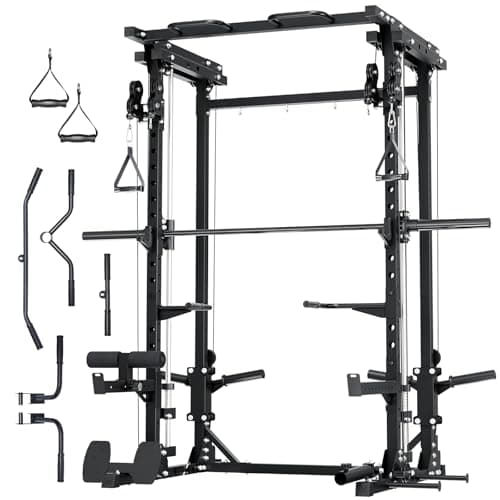
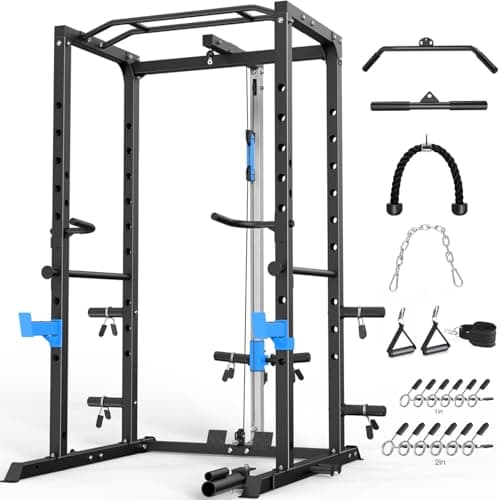
Best budget Smith machine — and the cheaper setups that beat it
A Smith machine is the safest bar in a solo gym and the most expensive way to buy safety. Here's the one worth the money, and the two frames that give you the same protection for less.
Updated August 2026 · By Stephen V.
A Smith machine solves one real problem: it lets you fail a rep alone without anything landing on you. The bar runs on fixed rails and every few inches has a hook you can rotate into — so a squat you can't stand up out of ends with a wrist flick instead of an emergency. That is genuinely valuable in a garage where nobody is going to hear you shout.
The problem is what it costs to buy that guarantee. Smith machines are heavy, complex, and long — roughly twice the steel and three times the parts of a plain power cage — so the budget end of the category is thin, and most of what's under $500 is a wobbly frame with nylon bushings that bind halfway through a rep. Below is the one budget Smith we'd actually buy, followed by the two setups we'd usually recommend instead, scored the same way, with live prices so you can see the real gap.
The short answer
In a hurry? These are the picks we'd buy. Prices are live; tap a card below for the full reasoning.
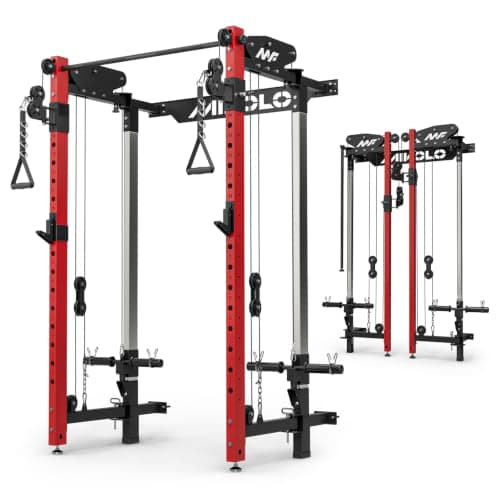
Folds to the wall between sessions and carries a cable crossover — the space answer a Smith machine can never give you.
Type
Wall-mounted folding rack
Bar path
Free (unrestricted)
Cable
Crossover + lat pulldown
Stowed depth
Folds flat to the wall
Pros
Gives the floor back when you're not training
Cable station included, so it covers pulls as well as presses
Anchored to structure, so it doesn't tip
Cons
Needs a stud or masonry wall and correct hardware — not a renter's option
Depth when folded out is fixed by the wall position
Installation is the whole safety story; get it wrong and nothing else matters
Best for: garages that need the floor back.
Skip this
The budget traps that look cheap and cost you twice. We'd skip these.
Sub-$400 free-standing Smith machines
This is the one price band in the whole category we'd tell you to walk away from. To hit that number the manufacturer thins the uprights, drops to nylon bushings instead of linear bearings, and narrows the base. The result binds and judders mid-rep, which on a guided bar is worse than a free bar because you cannot step out of the path. If the budget is under $400, buy a cage.
A Smith machine as your only bar
The rails carry the bar's balance for you, so a Smith-only lifter builds numbers that don't transfer to a free barbell — and the fixed vertical path doesn't match the natural arc of a squat or press for every body. If you buy one, buy it as an addition to free-weight work, not a replacement for it.
'Counterbalanced' claims without a stated bar weight
Smith bars range from about 6 lb to over 30 lb depending on whether the machine is counterbalanced, and almost no budget listing tells you which. That's not a scam, but it does mean your logbook numbers aren't comparable to a barbell's. Ask before you buy if the number matters to you.
How to choose (and what to skip)
Decide what you're actually buying: safety, or the guided path
If the reason you want a Smith is 'I train alone and I'm scared of getting pinned', a cage with safety arms solves that for far less money. Buy the Smith only if you specifically want the guided path itself — for high-rep machine work, for rehab-style controlled movement, or because a shoulder or back issue makes free-bar balancing genuinely uncomfortable.
Bushings vs bearings is the whole feel of the machine
The bar has to slide down two posts thousands of times. Linear bearings glide; cheap nylon bushings grab and squeak, and get worse as they wear and as the frame racks slightly out of square. It's the single biggest difference between a Smith machine that feels good and one that feels like a stuck sash window.
Only buy a combo frame
A standalone budget Smith machine takes a cage-sized footprint and can only do Smith work. A Smith-plus-rack combo gives you J-hooks and a free-bar station in the same steel, so the machine earns its floor space on days you don't want the rails. On a budget, the combo is the only version that makes sense.
Measure ceiling height before anything else
Smith frames are tall — the rails have to run past the top of a standing press — and most also carry a pull-up bar above that. Garages with a low header, a garage-door track, or a finished basement ceiling are the most common reason a Smith machine gets returned. Measure floor to the lowest obstruction, not floor to the highest point.
Budget for the plates separately
A Smith machine ships as a frame. Everything you load on it is extra, and unlike an all-in-one there's no weight stack included. Price the machine and a plate set together before you compare it to anything else, or the comparison is not honest.
What a Smith machine actually does differently
The bar is captive. It runs in two vertical (or slightly angled) rails, so it cannot move forward, backward or sideways — only up and down. Every few inches along the rail there's a hook slot, and rotating the bar drops it onto the nearest one. That's the mechanism, and everything good and bad about a Smith machine follows from it.
What you gain: you can rack a failed rep anywhere in the range of motion with a small wrist rotation, no spotter required, no setting safeties beforehand. You also remove the balance component entirely, which lets you push closer to true muscular failure on pressing movements without the bar drifting. For a solo lifter doing high-rep work, that's a real training advantage, not just a safety one.
What you lose: the stabilizer work. A free barbell asks your shoulders, hips and trunk to keep the bar in a groove; a Smith bar does that for you. Numbers on a Smith are not comparable to free-bar numbers, and strength built there transfers only partly. The fixed path is also a fixed path — if it doesn't match the arc your body wants to squat or press through, you'll feel it in your knees, back or shoulders within a few sessions.
Why budget Smith machines are so much worse than budget cages
A power cage is four posts, some crossmembers and two safety arms. There is nothing to go wrong, which is why a sub-$300 cage can be genuinely good. A Smith machine has to hold two rails perfectly parallel and perfectly plumb for the life of the machine, plus carriage assemblies, hooks, and usually a counterbalance pulley or spring.
Every one of those is a place a cheap build cuts. Rails that are a millimeter out of parallel bind under load. Nylon bushings wear oval and start to judder. A narrow base lets the whole frame flex when you unrack, which shows up as a rail that grabs at the bottom of a squat. That's why the price floor for a Smith machine we'd trust sits several times higher than the price floor for a cage — and why the honest budget answer for most people is still the cage.
The three ways to train alone safely, ranked by cost
A cage with safety arms — the cheapest reliable answer. Set the arms an inch below your bottom position and a failed rep is a non-event. The one requirement is discipline: they only work if you set them every session. See our budget power rack picks.
A folding wall rack with spotter arms — the same protection when the room can't spare a permanent footprint, at the cost of a proper wall installation.
A Smith machine — the only one that protects you without you having to think about it first, and the most expensive by a wide margin.
There's a fourth answer people forget: train the lifts that can't pin you. Dumbbell pressing, trap-bar deadlifts and leg work with adjustable dumbbells carry almost no pinning risk, because you can always drop them. A dumbbell-led program is a legitimate way to avoid the whole problem for the price of one pair of bells.
Who should buy the Smith anyway
We've argued against it twice, so here's the honest case for it. Buy the Smith machine if you tick two or more of these: you train alone and know you'll skip heavy sets without a guaranteed bail-out; you have a shoulder, wrist or lower-back issue that makes balancing a free bar the limiting factor rather than strength; you want high-rep, machine-style hypertrophy work and don't care about barbell numbers; or you're buying a combo frame that replaces a rack you'd otherwise have to buy anyway.
That last point is the one that changes the math. Compared as 'Smith machine vs cage', the Smith looks terrible on value. Compared as 'Smith-plus-rack combo vs cage plus the cable station and pull-up bar you'd add later', the gap narrows a lot — which is exactly why the only budget Smith we recommend is a combo.
Space and installation: read this before you order
Smith frames are the largest single object in most home gyms. Plan for roughly a 4 ft by 5 ft footprint plus loading room on both ends, and enough ceiling for the rails to run past a standing press with the pull-up bar above them. Then add the part people forget: you need to be able to walk around it. A machine crammed against a wall means one side of the bar can't be loaded.
Weight matters too. These frames arrive as several heavy boxes and need two people and an afternoon. If the gym is up or down a flight of stairs, check the box weights before ordering — this is the category where 'free delivery' quietly means 'curbside'. Get the floor sorted first as well; a loaded Smith concentrates a lot of weight on four small feet, which is exactly what our budget flooring guide covers.
Our verdict
For most budget home gyms, a 4-post cage with safety arms is the better purchase — it delivers the same solo protection, keeps the free bar path, and leaves several hundred dollars for the plates and bench that actually make a gym. If a guided bar is specifically what you want, buy a Smith-plus-rack combo rather than a standalone, budget for plates on top, and don't go under the price band where the bushings start to bind. Whichever way you go, check the live prices below before deciding — the gap between a Smith and a cage moves a lot on sale, and it's the gap, not the sticker, that should decide it.
Frequently asked questions
Is a budget Smith machine safe for heavy squats?+
A well-built one is, because the rail hooks let you bail at any point in the rep. The risk on a budget Smith isn't the load rating — it's binding. Thin rails and worn nylon bushings can grab mid-rep, and on a captive bar you can't step out of the path. Buy above the price floor where linear bearings and a wide base start, or buy a cage with safety arms instead.
Is a Smith machine or a power rack better for a home gym?+
For most budget home gyms, the power rack. It gives the same protection from a failed rep via safety arms, keeps the free bar path that trains stabilizers, and costs a fraction as much. A Smith machine is the better buy only if you specifically want the guided path — for high-rep work, or because an injury makes balancing the bar the limiting factor.
How much does the bar on a Smith machine weigh?+
It varies enormously — roughly 6 to 30 lb depending on whether the machine is counterbalanced and how the carriage is built. Budget listings rarely state it. That means your Smith numbers can't be compared to your barbell numbers, so log them as a separate lift rather than assuming they match.
Can you build real strength on a Smith machine?+
You can build real muscle on one, and real strength in the pattern the machine allows. What it won't build is the stabilizing strength a free barbell demands, so the numbers transfer only partly. The most sensible use of a Smith in a home gym is as an addition to free-weight training, not a replacement for it.
Do Smith machines need to be bolted down?+
Free-standing models generally don't if you stay inside the rated load and the base is wide, because the bar is captive inside the frame. Wall-mounted and folding designs absolutely do, into real structure with the specified hardware. If you can't confirm what's behind the wall surface, choose free-standing.
Prices and availability shown here come from Amazon's live data and change often; we re-verify them regularly. Bar Bumper is an Amazon Associate and earns a commission on qualifying purchases at no extra cost to you. Read our full disclosure.