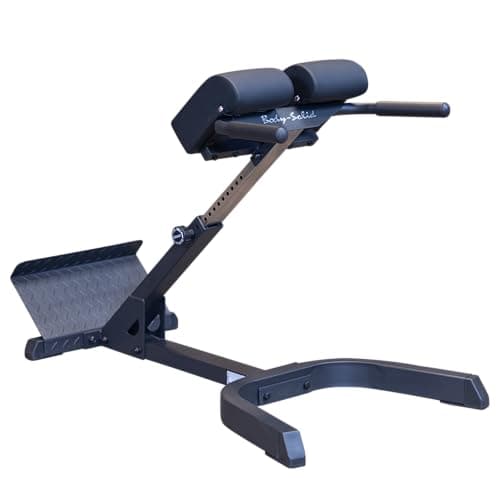
Cheap back extension benches: the budget Roman chairs worth buying
A back extension bench, a hyperextension bench and a Roman chair are usually the same frame under three names. Here is what the price gap from about $80 to a little over $300 actually buys, and which one is worth your money.
Updated September 2026 · By Stephen V.
A back extension bench is a simple angled frame: a pad your hips lie across, two rollers your ankles hook under, and a footplate. You hinge down, you come back up, and your lower back, glutes and hamstrings do the work. That is the whole machine. It has no moving parts, no cables and nothing to calibrate, which is exactly why the budget end of this category is worth taking seriously — there is very little for a cheap version to get wrong.
The first problem is not price, it is naming. The same 45-degree frame is sold as a back extension bench, a hyperextension bench and a Roman chair, often by the same brand in the same listing. A true Roman chair in a commercial gym is a different, more upright piece of equipment, and a glute-ham developer is different again — but on Amazon the three words are effectively interchangeable, which is why searching for one of them hides the other two. Everything on this page is the 45-degree hip-pad-and-ankle-roller design.
The second problem is that the listings are a wall of nearly identical unbranded steel between about $60 and $120. So the criteria we used are the ones that actually separate them: how far the hip pad adjusts (this decides whether the bench fits you, and whether anyone else in the house can use it), what the manufacturer is willing to publish, footprint and whether it folds, and what the warranty is. We have not tested these ourselves — we read each manufacturer's published specs, compare them, and say so, including where a brand publishes nothing at all.
The short answer
In a hurry? These are the picks we'd buy. Prices are live; tap a card below for the full reasoning.
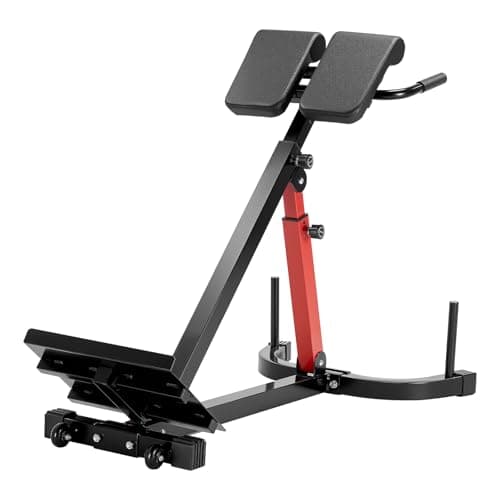
VEVOR Roman Chair Hyperextension Bench, 350 lb (Model 5030)
The budget default: an adjustable 350 lb-rated Roman chair from a brand that at least publishes a model number and a capacity, at a price that makes the mid-range hard to justify.
most home gyms — the highest published capacity here at the lowest price
$83.986% offPrice as of September 23, 2026·#addisclosure
2
Best sub-$100 from a name brand
CAP Strength Roman Chair (FM-CS709)
The cheapest bench here from a brand you can actually look up: adjustable foam leg holders, padded handles and a CAP product page — though CAP publishes almost no numbers on it.
buyers who want a brand with a support line and a product page, for the least money
$112.7113% offPrice as of September 23, 2026·#addisclosure
3
Best adjustability
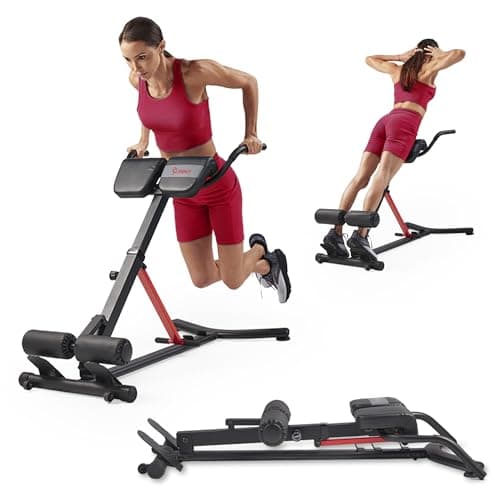
Sunny Health & Fitness Roman Chair with Dip Station (SF-BH620062)
The one to buy if the bench has to fit several people or disappear between sessions: ten hip-pad heights, three incline angles, dip bars, and a manufacturer that publishes every figure.
households where more than one person uses it, and rooms where it has to fold away
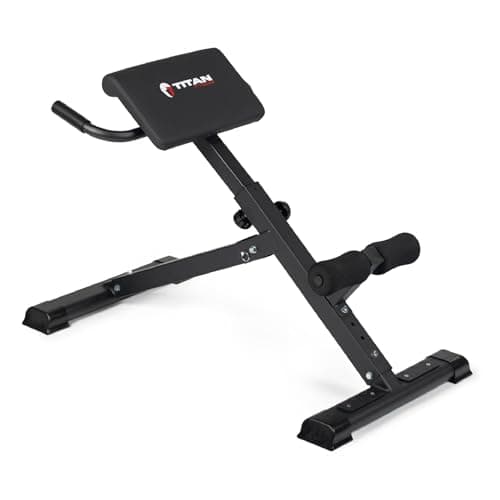
Titan Fitness Hyper Back Extension Bench / Roman Chair V2
The best-documented frame below the premium tier: 11-gauge steel, a quick-pin 40-48 in height range, published pad and roller sizes, and it still folds flat for storage.
a garage gym that wants 11-gauge steel and a full spec sheet without paying commercial prices
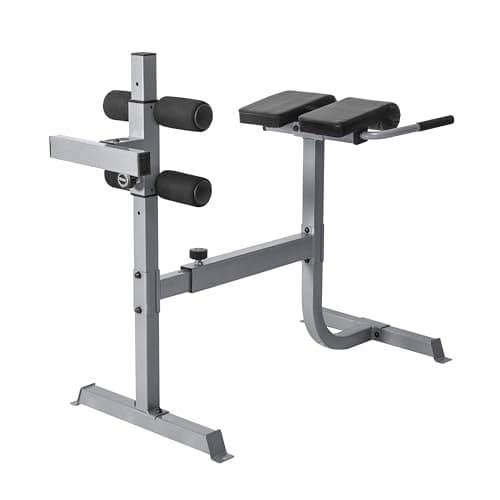
The commercial-grade reference: 3 in DuraFirm pads, a 68 lb frame and an in-home lifetime warranty on the frame and welds. Excellent, and more bench than a budget gym needs.
a gym that will keep this bench for twenty years — and nobody else
$83.986% offPrice as of September 23, 2026·#addisclosure
VEVOR Roman Chair Hyperextension Bench, 350 lb (Model 5030)
The budget default: an adjustable 350 lb-rated Roman chair from a brand that at least publishes a model number and a capacity, at a price that makes the mid-range hard to justify.
Model
5030 (A-type)
Rated capacity
350 lb (mfr)
Frame
Carbon steel
Bench weight
38 lb (mfr, +/-3%)
Footprint
48.4 x 26 x 52 in (listing)
Folds
No
Pros
Highest published user capacity on this page at the lowest price, from a brand with a real model number and a spec table rather than an anonymous listing
Adjustable hip-pad height and foot positions, which is the adjustment that decides whether the bench fits you at all
Detachable back pad and transport wheels — the wheels matter more than they sound if the bench has to live against a wall between sessions
Cons
VEVOR's spec table publishes only the model, capacity, net weight and material — no dimensions, no adjustment range, no pad sizes. The footprint above comes from the Amazon listing, not the manufacturer
No warranty term is published on the product page; VEVOR offers an optional paid third-party protection plan instead, which is not the same thing
Does not fold, so it occupies its full footprint permanently — the Sunny and Titan benches below fold and this one does not
VEVOR sells several near-identical Roman chairs rated 250, 300 and 350 lb at almost the same price. Check the capacity on the variant you are actually adding to the cart
Best for: most home gyms — the highest published capacity here at the lowest price.
$112.7113% offPrice as of September 23, 2026·#addisclosure
CAP Strength Roman Chair (FM-CS709)
The cheapest bench here from a brand you can actually look up: adjustable foam leg holders, padded handles and a CAP product page — though CAP publishes almost no numbers on it.
Model
FM-CS709
Rated capacity
Not published
Bench weight
39 lb (listing)
Footprint
56 x 29 x 43 in (listing)
Adjustment
Two-foam leg holders
Warranty
30 days (listing)
Pros
CAP Barbell is an established budget brand with a real product page for this exact model, a support line and stock in more than one store — rare below $100 in this category
Adjustable two-foam leg holders plus padded handlebars and high-density foam rollers, so the contact points are better specified than most listings at this price
The same brand supplies benches, plates and racks the rest of this site already recommends, so parts and finish are a known quantity
Cons
CAP does not publish a user weight capacity, assembled dimensions or a frame spec for this model. Every number above comes from the retail listing
The listing states a 30-day limited manufacturer warranty — the shortest on this page by a wide margin, against one year from Sunny and Titan
Adjustment is at the leg holders rather than a multi-position hip pad, so it fits a narrower range of heights than the Sunny below
Does not fold, and its published footprint is the longest of the budget picks
Best for: buyers who want a brand with a support line and a product page, for the least money.
Sunny Health & Fitness Roman Chair with Dip Station (SF-BH620062)
The one to buy if the bench has to fit several people or disappear between sessions: ten hip-pad heights, three incline angles, dip bars, and a manufacturer that publishes every figure.
Model
SF-BH620062
Rated capacity
330 lb (mfr)
Height settings
10 (25.2-34.1 in)
Incline positions
3
Assembled
46.9 x 24.4 x 33.9 in (mfr)
Folded
46.1 x 24.4 x 7.9 in (mfr)
Pros
Ten height settings across a published 25.2-34.1 in range plus three incline angles — by a distance the widest fit range here, and the only pick that genuinely suits two people of different heights
Folds to a published 7.9 in thick and has transport wheels, so it can live behind a door instead of owning a corner of the room
Sunny publishes everything: capacity, both sets of dimensions, bench weight, an approximate 6 ft 6 in maximum user height and a one-year structural frame warranty (180 days on other parts)
Built-in dip bars add a second exercise to the same frame, which is unusual at any price in this category
Cons
Roughly twice the price of the VEVOR for the same core exercise — you are paying for fit range, folding and published numbers, not for a better back extension
At 35.4 lb it is the lightest frame here, and light frames feel livelier than heavy ones once you start holding a plate
The dip bars are a bonus rather than a reason to buy: they sit low and are no substitute for a proper dip station
The 330 lb figure is a user-weight rating and does not tell you how much extra load the frame is happy with
Best for: households where more than one person uses it, and rooms where it has to fold away.
Titan Fitness Hyper Back Extension Bench / Roman Chair V2
The best-documented frame below the premium tier: 11-gauge steel, a quick-pin 40-48 in height range, published pad and roller sizes, and it still folds flat for storage.
Model
Hyper / Roman Chair V2 (400919)
Rated capacity
250 lb (mfr)
Height range
40-48 in, quick pin
Frame
11-gauge steel
Pad
17.5 x 11 in, HeftyGrip vinyl
Footprint
46 in deep x 24 in wide (mfr)
Pros
Titan publishes the specs the budget brands leave out: steel gauge, pad dimensions, roller dimensions, footprint, bench weight and a quick-pin height range
11-gauge steel and a Y-frame base with diamond-plated feet — the most substantial construction here short of the Body-Solid
Folds for storage despite the heavier frame, which the CAP and VEVOR benches do not
One-year warranty and a brand that sells spare parts, so a torn pad is not the end of the bench
Cons
Rated 250 lb — the lowest published user capacity on this page, at the second-highest price. If you are a heavier lifter, this is the wrong pick
Costs roughly two and a half times the VEVOR for the same movement pattern, with a lower capacity rating
Titan sells this bench directly as well as on Amazon and the two prices move independently — check Titan's own store before you buy
The 40-48 in height figures describe the bench length adjustment rather than a hip-pad height like the Sunny's, so compare them carefully rather than as like for like
Best for: a garage gym that wants 11-gauge steel and a full spec sheet without paying commercial prices.
The commercial-grade reference: 3 in DuraFirm pads, a 68 lb frame and an in-home lifetime warranty on the frame and welds. Excellent, and more bench than a budget gym needs.
Model
GHYP345B
Rated capacity
Not published
Pads
3 in DuraFirm
Thigh pad range
35-44 in from footplate
Assembled
51 x 29 x 36 in (mfr)
Bench weight
68 lb (mfr)
Pros
Extra-thick 3 in pads and a 68 lb frame — it does not move underneath you, and the hip pad is the most comfortable here by some distance
Body-Solid's in-home warranty covers the frame and welds for life, and extends to upholstery and grips under normal wear
Pop-pin thigh-pad adjustment across a published 35-44 in range, so it fits a wide range of heights without tools
Genuinely commercial-grade: this is the bench the cheaper 45-degree frames are imitating
Cons
Costs about as much as a complete budget power rack, for one exercise. On this site's terms that is very hard to justify
Body-Solid does not publish a user weight capacity for it, which is an odd omission on the most expensive bench here
At 68 lb and with no folding mechanism, it is a permanent fixture — a genuine problem in a shared garage
The Amazon listing quotes 53 x 29 x 36 in and 72 lb while Body-Solid's own page says 51 x 29 x 36 in and 68 lb. Measure your space against the larger figure
Best for: a gym that will keep this bench for twenty years — and nobody else.
Skip this
The budget traps that look cheap and cost you twice. We'd skip these.
The anonymous $60 Roman chair with no brand and no model number
This category is full of them: the same photo, a different four-letter brand, a capacity claim in the title and nothing behind it. No model number means no spec sheet, no parts, no warranty you can enforce and no way to tell whether the listing you are looking at is the same bench as the reviews underneath it. The picks on this page all publish at least a model number, and that single filter removes most of the risk for about $20 more.
Buying the capacity number instead of the bench
The ratings on this page run from 250 lb to 350 lb, and the bench with the lowest rating (Titan) is built from the heaviest steel of the four budget picks. These are manufacturer user-weight claims, not tested load limits, and they are not comparable between brands. Frame weight, steel gauge and footprint tell you more about how a bench feels under load than the number in the title does.
Expecting a Roman chair to be a glute-ham developer
A GHD has a horizontal pad, a foot plate you brace against and enough length to let you go from fully extended to a knee-flexed curl. A 45-degree back extension bench does the hip-hinge half of that and nothing else. Both train the posterior chain, they are not substitutes, and no bench on this page is a GHD. If a GHR is specifically what you want, save for the right machine instead of buying a cheap bench that cannot do it.
Putting it ahead of a bench, a rack or plates
A back extension bench does one movement pattern. A flat or adjustable bench unlocks pressing, rows, hip thrusts and step-ups; a rack makes squats and pressing safe to do alone. If you do not own those yet, buy them first — the roundups on the best budget weight bench and the best budget power rack cover that order, and this bench is a good fourth or fifth purchase, not a first.
How to choose (and what to skip)
Work out which of the three names you actually want
On Amazon, 'back extension bench', 'hyperextension bench' and 'Roman chair' mostly describe the same 45-degree frame, which is the shape every pick here uses and the only shape that is genuinely cheap. A horizontal (90-degree) hyper bench puts you flat and adds range of motion; a true Roman chair is upright and built for sit-ups and obliques; a glute-ham developer is a longer, heavier machine that adds the knee-flexion half of the movement. Search all three terms before deciding, then buy the shape, not the word.
Adjustment range is the spec that decides the fit
The hip pad should sit at your hip crease, not on your stomach or your thighs. Too high and you cannot hinge; too low and the pad digs into your ribs. That is why adjustment range matters more here than on almost any other bench: Sunny publishes ten settings across 25.2-34.1 in, Titan a 40-48 in quick-pin range for the bench length, VEVOR says 'adjustable' without publishing a range, and CAP adjusts at the leg holders instead. If more than one person will use the bench, the number of settings is the spec to buy on.
Treat capacity ratings as claims, not tests
Every capacity figure on this page is the manufacturer's user-weight claim: 350 lb for the VEVOR, 330 lb for the Sunny, 250 lb for the Titan, unpublished for the CAP and the Body-Solid. None of them is an independently tested limit, and none of them tells you how much extra weight you can hold across your chest. A sensible rule is to leave real margin: if you weigh 200 lb and you want to hold a 45 lb plate, do not buy a bench rated 250 lb. The same logic applies to every bench on this site, and the guide on weight bench capacity explains it in more detail.
Pads, rollers and the footplate are what you feel
This is a bench you rest your whole bodyweight on at one narrow contact point, so pad quality is not a luxury. Titan publishes a 17.5 x 11 in pad and 6.25 x 3.25 in rollers in HeftyGrip vinyl; Body-Solid publishes 3 in DuraFirm pads; CAP describes high-density foam rollers and padded handles; VEVOR says 'thick foam padding' and does not quantify it. Thin foam over a thin frame is the most common complaint about cheap hyper benches, and a textured, non-slip footplate is what stops your feet creeping as you fatigue.
Footprint and folding, honestly measured
These benches are longer than they look: the published footprints here run from about 46 in to 56 in deep, and you need clear floor in front of the pad for your head and arms. If the bench has to share the room, folding is worth real money — the Sunny folds to a published 7.9 in and the Titan folds too, while the VEVOR, CAP and Body-Solid stay assembled. Measure the space with the tape on the floor before you order, the same way you would for a rack.
Warranty tells you what the brand expects to go wrong
The spread on this page is stark: the CAP listing states 30 days, Sunny publishes one year on the structural frame and 180 days on other parts, Titan one year, Body-Solid a lifetime in-home warranty on frame and welds, and VEVOR publishes no term at all on its product page. None of that is decisive on its own — a simple steel frame rarely fails — but it is a useful proxy for how much of the price is the brand standing behind the product rather than the steel.
What a back extension bench actually trains
The movement is a hip hinge with your torso unsupported. Your ankles are fixed, your hips are on the pad, and lowering and raising your upper body is resisted by your hamstrings, your glutes and the spinal erectors along your lower back. Change the angle of your torso and the emphasis shifts: rounding slightly and curling up loads the lower back more, staying rigid and hinging at the hips loads the glutes and hamstrings more. Hold a plate against your chest and the whole thing becomes a genuine strength exercise rather than a warm-up.
It is also one of the few pieces of home-gym equipment that earns its keep on rest days. Bodyweight back extensions are low enough in absolute load that most people can do them frequently, which makes the bench useful for accessory volume in a program built around a barbell and plates. If your training already includes heavy deadlifts and squats, this is supporting work; if it does not, it is one of the easiest ways to train the posterior chain without a loaded bar.
45-degree, horizontal, or a GHD?
45-degree. The angled frame on this page. The cheapest, the smallest, the easiest to get into and out of, and the only version with real competition under $100. The range of motion is shorter than a horizontal bench and the hardest point of the movement is at the top.
Horizontal (90-degree). Flat, longer, usually heavier and dearer. Gives a longer range of motion and puts the hardest point where your torso is parallel to the floor. Worth looking for if you specifically want reverse hypers as well, but you will pay more and give up floor space.
Glute-ham developer (GHD). A different machine. It adds knee flexion, so you can perform an actual glute-ham raise rather than a hip extension. Heavier, longer, and priced above everything here. A cheap 45-degree bench is not a substitute and should not be sold to you as one.
Do you actually need one?
Probably not first, and possibly not at all. A back extension bench is an accessory machine: it does one movement pattern extremely well and nothing else. If you already deadlift, squat and do some kind of hip hinge, you are training the same muscles, and the bench is added volume rather than new capability. Where it genuinely earns a place is when you want posterior-chain work that does not load your spine with a bar — on light days, around a training block that is already heavy on deadlifts, or when you simply want to train your lower back without setting up a loaded bar at all.
The honest counter-argument is that a good bench and a pair of dumbbells cover a lot of the same ground. Romanian deadlifts, dumbbell good mornings, hip thrusts off a flat bench and single-leg hinges all hit the glutes and hamstrings, and you may already own the equipment. A hyper bench is not competing with those exercises — it is competing for the floor space they do not need. That is the trade to weigh before spending anything, and how much space a home gym needs is worth reading first if your room is tight.
Budget bench vs premium bench: where the money goes
Adjustment. Budget frames: one or two positions, often unspecified. Sunny publishes ten heights and three inclines; Body-Solid a pop-pin range of 35-44 in. More positions means more people can use the same bench properly.
Steel. Only Titan (11-gauge) and the general 'carbon steel' / 'alloy steel' descriptions on the budget listings are published. Frame weight is the cheap proxy: 35-41 lb for the budget picks against 68 lb for the Body-Solid.
Pads. Budget: 'thick foam', unquantified. Premium: Titan publishes a 17.5 x 11 in HeftyGrip pad, Body-Solid 3 in DuraFirm. This is the difference you feel on every single rep.
Storage. The mid-range benches fold; the cheapest and the dearest do not. In a shared garage that is worth more than a capacity rating.
Warranty. 30 days to lifetime across five benches at the same core function. The extremes tell you where the money is going.
Where this sits in a budget build
After the rack, the bar, the plates and a proper bench. A back extension bench is an accessory purchase in the same tier as a preacher curl bench — a single-job frame you add once the compound lifts are covered. The complete budget build sets out the order we would follow, the best budget weight bench is the bench to buy before this one, and if you are still assembling the basics, a home gym under $500 shows where the money goes first.
One last practical note: this is a bulky, awkward object that does not stack. If it is going in a garage that also holds a car, buy one that folds, and read home gym storage ideas before you order. A bench you have to drag out from behind the mower is a bench you stop using.
Frequently asked questions
What is the difference between a back extension bench, a hyperextension bench and a Roman chair?+
In retail listings, usually nothing — all three names are used for the same 45-degree frame with a hip pad and ankle rollers, and many listings use two or three of them at once. Strictly, a Roman chair is an upright frame for sit-ups and oblique work, a hyperextension bench is the angled or flat frame for hip extension, and a back extension bench is the general term. Search all three phrases when you shop, because the same bench appears under different names at different prices.
Is a cheap back extension bench as good as an expensive one?+
For the exercise itself, close. The movement is a hip hinge against bodyweight with no moving parts, so a solid $80 frame performs the same job as a $310 one. What the extra money buys is fit range, thicker pads, heavier steel, folding storage, published specifications and a warranty measured in years rather than days. Buy the cheapest bench that adjusts to fit you and comes from a brand with a model number, and step up only if you are heavy, you share the bench, or you plan to load it hard.
Is a Roman chair the same as a glute-ham developer?+
No. A GHD has a horizontal pad and a foot plate long enough to let you bend at the knee, so it trains both hip extension and knee flexion — that is the glute-ham raise. A 45-degree back extension bench only does the hip extension half. Both train the posterior chain and they complement each other, but no bench on this page can perform a true glute-ham raise, and any listing claiming otherwise is stretching the name.
What weight capacity does a back extension bench need?+
Enough margin for your bodyweight plus anything you hold. The published ratings here run 250 lb to 350 lb, with two manufacturers publishing nothing at all, and they are manufacturer claims rather than tested limits. A practical approach is to add the heaviest plate you expect to hold to your bodyweight, then buy a bench rated comfortably above that total. The same reasoning applies to every bench, and our guide on weight bench capacity explains how those numbers are generated.
How much space does a back extension bench need?+
More than the footprint suggests. Published footprints on this page run from about 46 in to 56 in long and 24 to 29 in wide, and you need clear floor beyond the head end for your torso and arms at the bottom of the rep, plus room to climb on. Budget for roughly 6 ft by 3 ft of usable space in practice. If that is a stretch, buy a model that folds — the folded thickness is published by Sunny at 7.9 in.
Can you add weight to back extensions?+
Yes, and it is the normal way to progress once bodyweight reps get easy. Most people hold a plate across the chest or hug a dumbbell; some hold a plate behind the head, which is harder on the neck and worth approaching carefully. Remember that anything you hold counts against the bench's user-weight rating, so add it into your margin rather than treating the rating as your bodyweight alone.
Do back extensions help with lower back pain?+
That depends entirely on the cause, and it is a question for a clinician rather than a buying guide. What can be said neutrally is that the exercise strengthens the spinal erectors, glutes and hamstrings through a controlled range of motion, and that manufacturers market these benches for stretching and decompression. If you have existing back pain or an injury, get advice on whether this movement is appropriate for you before buying equipment for it.
Prices and availability shown here come from Amazon's live data and change often; we re-verify them regularly. Bar Bumper is an Amazon Associate and earns a commission on qualifying purchases at no extra cost to you. Read our full disclosure.